


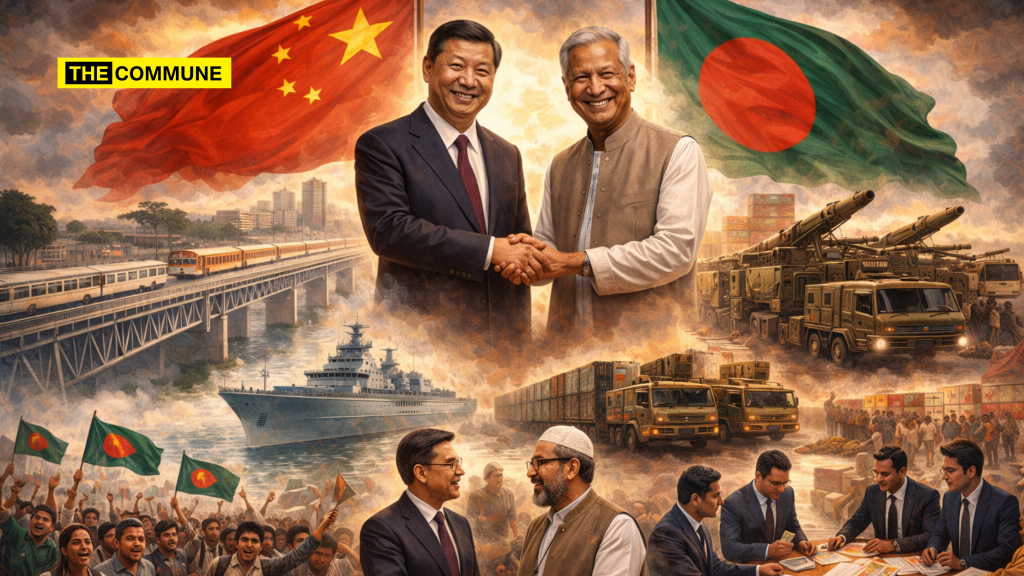
Between October 2024 and January 2026, Bangladesh witnessed a rapid deepening of engagement with China across political, economic, cultural, and military domains.
Following the change of power in Dhaka, a series of high-level meetings, defence procurements, infrastructure projects, cultural initiatives, and political interactions signalled a marked expansion of the China–Bangladesh relationship.
In this report, we take a look at 19 significant incidents that collectively illustrate the breadth and pace of this evolving nexus, based on official statements and media reports.
#1 Chinese Ambassador Meets Jamaat-e-Islami Chief – 12 January 2026
On 12 January 2026, Chinese Ambassador Yao Wen paid a courtesy call on Jamaat-e-Islami Ameer Dr. Shafiqur Rahman at the party’s office in Dhaka’s Bashundhara area. The meeting focused on strengthening party-to-party relations, expanding political exchanges, and enhancing overall China–Bangladesh ties. Accompanied by senior embassy officials, the Ambassador discussed cooperation under the Comprehensive Strategic Cooperative Partnership framework. Both sides reportedly agreed to deepen engagement across multiple sectors, presenting the interaction as cordial and constructive, and signalling Beijing’s growing outreach to influential Islamist political actors in Bangladesh.
#2 Chinese Literature Readers Club Launched in Dhaka – 26 December
On 26 December 2025, the Chinese Literature Readers Club was inaugurated at the Apon Friendship Exchange Center in Baridhara, Dhaka, coinciding with the 50th anniversary of India–Bangladesh diplomatic relations. Officials from the Chinese Embassy and China Media Group jointly launched the initiative to promote Chinese literature in Bangla translation. Writers and publishers highlighted cultural exchange as a tool for long-term influence, with speakers stressing translation, folk narratives, and publishing collaborations as entry points for strengthening people-to-people and cultural ties between China and Bangladesh.
#3 CEAB–BCCCI Dialogue on Trade Disputes – 25 November 2025
A high-level meeting between the Bangladesh China Chamber of Commerce and Industry (BCCCI) and the Chinese Enterprise Association in Bangladesh (CEAB) took place on November 25, 2025. Discussions focused on removing trade barriers, reviving struggling industrial units through joint ventures, and resolving disputes via a proposed Joint Working Group. Bangladeshi representatives emphasised textiles as a priority sector, while both sides underlined legal and institutional mechanisms to smooth Chinese investment operations, reflecting growing economic interdependence.
#4 Bangladesh Approves Purchase of SY-400 Missile System – 2 November 2025
On 2 November 2025, Bangladesh’s Ministry of Defence approved the procurement of China’s SY-400 surface-to-surface missile system under the Forces Goal 2030 programme. The decision marked a significant upgrade in Bangladesh’s strike capability, with the system featuring long-range precision, rapid mobility, and high-speed strike potential. Defence analysts noted that the acquisition underscored Dhaka’s increasing reliance on Chinese military hardware and deepening defence cooperation with Beijing.
#5 China Pledges Support Against U.S. Tariffs – 29 July 2025
Speaking at a discussion organised by the Diplomatic Correspondents Association in Dhaka, Chinese Ambassador Yao Wen stated that China would assist Bangladesh in addressing the impact of U.S. tariffs. He described the tariffs as coercive and contrary to WTO principles. The Ambassador also proposed trilateral cooperation involving China, Bangladesh, and Pakistan to safeguard regional sovereignty and economic development, positioning Beijing as a strategic counterweight to Western trade pressure.
#6 Chinese Investments Create 550,000 Jobs – 4 June 2025
On 4 June 2025, the President of the Chinese Enterprise Association in Bangladesh stated that Chinese firms had invested over $11 billion in Bangladesh since 2016, generating approximately 550,000 jobs. Investments spanned power, transport, water, and digital sectors, with Chinese companies accounting for a majority share of private power generation capacity. The statement reinforced China’s role as Bangladesh’s largest foreign investor and a central driver of its infrastructure-led growth.
#7 Muhammad Yunus Calls China Partnership a ‘Strategic Moment’ – 1 June 2025
At the China–Bangladesh Investment and Trade Conference in Dhaka, Chief Advisor Muhammad Yunus urged Chinese investors to participate in Bangladesh’s transformation at what he termed a strategic moment. He said he had personally requested President Xi Jinping to encourage Chinese investment. Chinese officials reaffirmed support for enhancing export capacity and integrated trade, highlighting the convergence of Bangladesh’s development agenda with Chinese economic outreach.
#8 New MoU Strengthens Textile Cooperation – 1 June 2025
On the same day as the above event, an MoU was signed between Chinese and Bangladeshi textile industry bodies to deepen cooperation in apparel and textile manufacturing. The agreement focused on joint exhibitions, trade promotion, and sustainable innovation. Signed during a high-level Chinese delegation’s visit, the MoU reflected China’s growing role in Bangladesh’s export-oriented textile sector and its efforts to integrate Bangladeshi manufacturing into Chinese-linked supply chains.
#9 Bangladesh Begins Mango Exports to China – 28 May 2025
Bangladesh announced its first-ever mango exports to China, with 50 tons scheduled for shipment in 2025. Officials said discussions with Chinese authorities were finalised to open the market. The initiative was presented as part of a broader push to diversify agricultural exports, with China emerging as a key destination. The move highlighted expanding trade ties beyond infrastructure and industry into agriculture.
#10 Missile and Air Defence Talks With China – 13 May 2025
Senior Bangladeshi army officials met representatives of China Vanguard Co. Ltd to discuss acquiring advanced air defence systems, including HQ-17AE and FK-3 missiles and radar platforms. The talks aimed to modernise Bangladesh’s air defence network, with additional discussions on portable missile systems for naval use. The engagement pointed to deepening military-technical cooperation with China.
#11 Chinese Envoy Promotes Beijing’s Development Model – 11 May 2025
At a readers’ forum on “Xi Jinping: The Governance of China,” Ambassador Yao Wen suggested Bangladesh could draw lessons from China’s modernization model. He argued that modernization need not follow Western pathways and highlighted similarities between Chinese governance ideas and Bangladesh’s development vision. Political leaders from multiple parties attended, reflecting China’s outreach across Bangladesh’s political spectrum.
#12 Reaffirmation of 50-Year Water Management Plan – 20 April 2025
During a meeting at the state guest house Jamuna, Bangladesh and China reaffirmed plans for a long-term water management master plan, including work on the Teesta River. Proposals also included Chinese-backed healthcare projects. The meeting highlighted strategic infrastructure and resource cooperation, positioning China as a long-term development partner.
#13 $2.1 Billion Investment Deal Signed in Beijing – 28 March 2025
Bangladesh secured $2.1 billion in Chinese investment, loans, and grants during an official visit to Beijing. The funds were allocated primarily for infrastructure, energy, and digital projects, with a mix of low-interest loans and direct investment. The agreement provided a significant boost to bilateral economic ties and supported Bangladesh’s foreign exchange position.
#14 China Calls Itself Bangladesh’s ‘Most Trustworthy Partner’ – 10 March 2025
At a dinner hosted by a senior Bangladeshi political leader, Ambassador Yao Wen described China as Bangladesh’s most reliable partner. The event followed a multi-party Bangladeshi delegation’s visit to China. Participants shared experiences of Chinese hospitality, underscoring Beijing’s efforts to build goodwill across political, academic, and media circles.
#15 China Pledges 1,000-Bed Friendship Hospital – 20-24 January 2025
During an official visit to China, Bangladesh’s foreign affairs adviser requested medical cooperation for Bangladeshi patients. China agreed to designate hospitals for Bangladeshi nationals and pledged support for a 1,000-bed Bangladesh–China Friendship Hospital in Dhaka. The commitment marked a significant expansion of bilateral cooperation in healthcare.
#16 China Agrees to Ease BRI Loan Terms – 21 January 2025
China verbally agreed to ease the terms of Belt and Road Initiative loans to Bangladesh by reducing interest rates and extending repayment periods. The assurance came amid discussions on infrastructure financing, healthcare cooperation, and data sharing. Analysts viewed the move as an effort to sustain Chinese projects while addressing debt sustainability concerns.
#17 China-Funded Padma Bridge Rail Link Inaugurated – 24 December 2024
Bangladesh inaugurated the China-funded Padma Bridge Rail Link, the country’s largest railway project. Built under the Belt and Road Initiative, the 170-kilometre line significantly reduced travel time between Dhaka and southwestern regions. The project symbolised China’s central role in Bangladesh’s transport infrastructure development.
#18 Chinese Naval Ships Visit Bangladesh – 12 October 2024
Two Chinese naval vessels arrived at Chattogram port on a goodwill visit, marking the first such visit in four years and the first by a foreign fleet after the interim government assumed power. The visit underscored growing maritime and defence ties between the two countries.
#19 China Backs Bangladesh’s Political Shift – 10 October 2024
China publicly welcomed the student-led protests in Bangladesh that resulted in the collapse of the previous government, signalling its support for the country’s political transition. During a meeting with representatives of the protest movement, Chinese Ambassador to Bangladesh Yao Wen praised the “courage and wisdom” shown by students who spearheaded the unrest. Some of these representatives have since assumed roles in the interim administration headed by Nobel laureate Muhammad Yunus. Beijing’s remarks were viewed as an endorsement of the transitional process in Bangladesh.
Subscribe to our channels on Telegram, WhatsApp, and Instagram and get the best stories of the day delivered to you personally.