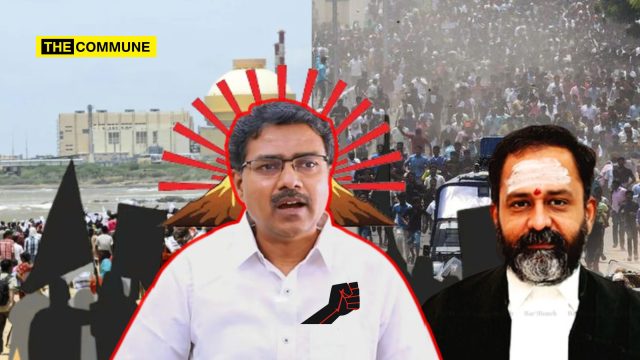
The judiciary is often regarded as the last bastion of hope for the common citizen; a pillar designed to stand above political pressures and ideological influence. India’s Constitution-makers, recognizing this vital role, ensured the judicial system was built to function independently. However, in Tamil Nadu, this very principle is under coordinated attack by factions aligned with the Left, Communists, and Dravidianist movements, who appear determined to subvert judicial independence in favor of their political agenda. When verdicts don’t align with their ideology, their strategy shifts from dissent to outright intimidation of judges through propagating malice and defamation.
A glaring instance of this trend is the recent targeting of Justice GR Swaminathan of the Madras High Court, who came under personal and professional attack from advocate Vanchinathan, a Communist, a figure now being aggressively defended by the Dravidianist, Periyarist, and left-wing ecosystem.
Who Is Advocate Vanchinathan? And Why Is He Being Shielded By DMK Ecosystem?
Contrary to the image being painted by his sympathizers, Advocate Vanchinathan is not a dispassionate human rights defender. He has long been associated with the People’s Right Protection Centre, a pressure group with a history of aligning with disruptive causes. He has served as its state organizer and has played a prominent role in campaigns that often appear more politically motivated than rooted in public interest.
Vanchinathan was a vocal opponent of the Sterlite Copper plant in Thoothukudi, a protest that turned violent and controversial. He has consistently aligned himself against key infrastructure and policy initiatives, from the eight-lane highway project to the Citizenship Amendment Act (CAA) and the National Register of Citizens (NRC). His activism often resembles that of an ideological foot soldier for the DMK and affiliated leftist coalitions, rather than an impartial legal advocate.
The Kudankulam Anti-Nuclear Protests (2012): A Blockade Against Development
In 2012, a group of nearly 20 lawyers led by Advocate S. Vanchinathan practicing at the Madras High Court’s Madurai Bench staged a protest within the court premises. Their demonstration condemned the police action taken against agitators opposing the Kudankulam Nuclear Power Plant in Tirunelveli and urged the central government to halt fuel loading into the reactor.
This protest wasn’t an isolated event. It was part of a broader, well-organized campaign that became one of the most significant attempts to derail a strategic energy project in southern India. The Union Home Ministry eventually revoked the licenses of three NGOs operating in Tamil Nadu, alleging they misused foreign funds to support and intensify the anti-nuclear protests.
This crackdown followed a public statement by then-Prime Minister Manmohan Singh, who suggested that foreign-funded NGOs, particularly from the U.S., were behind the agitation that delayed a major infrastructure project. The first of two 1000-MW Russian-assisted reactors was scheduled for commissioning in late 2011 but was stalled due to the ongoing unrest.
Minister of State V. Narayanasamy later confirmed punitive action against the involved NGOs. Though he did not initially disclose names, he had earlier pointed fingers at organizations linked to Bishop Yvon Ambroise of Tuticorin, who had allegedly received ₹54 crore in foreign funds and was instrumental in mobilizing opposition.
Among those named were the Tuticorin Diocese Association (TDA) and Tuticorin Multipurpose Social Service Society (TMSSS), both Christian organizations under scrutiny for funding and promoting the protests. Other groups like People’s Education for Action and Liberation (PEAL) and Good Vision were also flagged. TMSSS alone had received ₹42 crore over five years, ostensibly for rural development. However, their funds and activities were later found to be intertwined with anti-development protests.
Sterlite Protests: Escalating Dissent Into Violence
In June 2018, Vanchinathan was arrested at Chennai Airport upon arrival from Delhi. He was accused of inciting the violent anti-Sterlite protests in Thoothukudi, where police firing tragically resulted in 13 civilian deaths. Along with fellow lawyer Hari Raghavan, Vanchinathan was booked under various IPC sections including rioting, criminal force against public servants, and for damages under the Tamil Nadu Property Prevention Act.
Following the arrest, a police team conducted searches at his residence in KK Nagar, Madurai, seizing documents and protest material. His role in the protests is viewed by authorities not as advocacy, but as direct involvement in orchestrating unrest.
Ironically, it was Justice GR Swaminathan who granted bail to Vanchinathan during this case.
CAA-NRC Protests And Provocative Speeches (2020): Ideological Rhetoric Disguised As Activism
In early 2020, Vanchinathan again made headlines for his involvement in protests against the Citizenship Amendment Act (CAA) and National Register of Citizens (NRC). He was scheduled to speak at a large rally in Trichy organized by the People’s Right Protection Centre (PRPC), where he serves as a state coordinator. The event was denied permission by local authorities, citing public order concerns. But later was granted permission by the High Court.
Later, in a separate event under the guise of criticizing CAA-NRC his speeches were filled with incendiary political rhetoric. In a seminar at Tiruvannamalai, he accused the Modi government and the RSS of orchestrating violence against JNU students and suppressing intellectual dissent. His statements went beyond critique of legislation; they bordered on personal attacks and conspiratorial narratives, including claims of RSS infiltration in academic institutions and state complicity in campus violence.
His speech, titled “NRC: Are We Becoming Second-Class Citizens in a Hindu Rashtra?” was a tirade against what he described as “Brahminical politics” and “corporate looting” by Adani and Ambani. He claimed that policies like NEET and the New Education Policy were part of a larger agenda to deny education to the underprivileged and to stifle critical thinking.
He also defended controversial statements made by Tamil scholar Nellai Kannan who made contentious remarks against Prime Minister Modi and Home Minister Amit Shah questioning the grounds of his arrest and mocking the intelligence of the Prime Minister in highly derogatory terms.
Targeting Hindu Organizations: Selective Outrage and Legal Intimidation
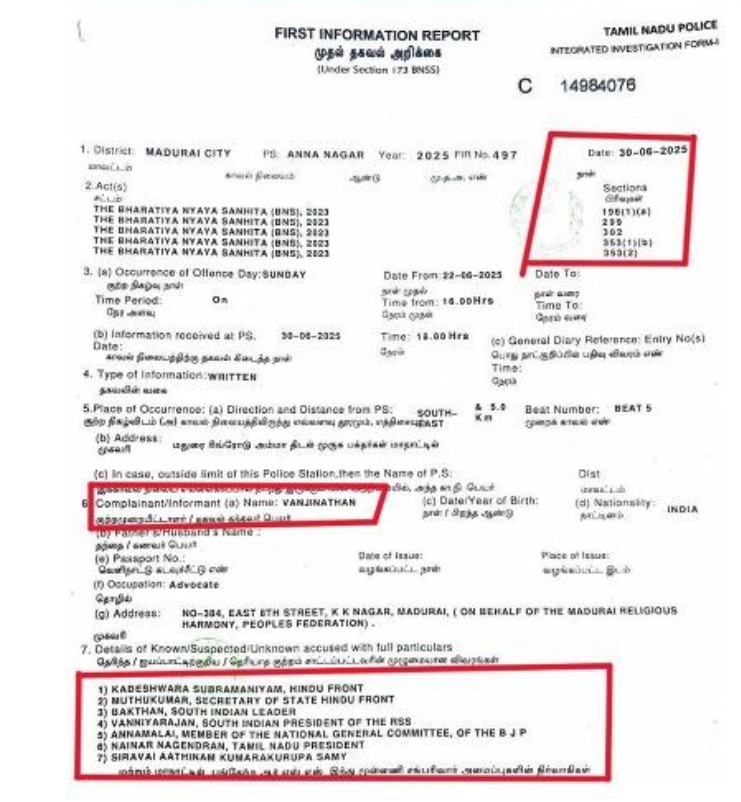
In an equally revealing move, Vanchinathan filed FIRs against several leaders associated with Hindu organizations, including the Hindu Munnani and members of the RSS and BJP, accusing them of inciting religious discord during the Murugan Manadu event. The list included political figures like Annamalai (BJP), Nainar Nagendran, and senior leaders from the Hindu Munnani.
During the peak of the Thiruparankundram controversy, when certain Muslim fundamentalist groups referred to the hills as “Sikkandar Hills” and asserted the right to perform sacrifices at the hilltop dargah Advocate Vanchinathan actively supported the fundamentalist side and propagated claims that sacrificial rituals had historically taken place on the temple hills. However, the Hindu Religious and Charitable Endowments (HRCE) Department denied these claims, and the individuals from the Muslim community who made them were reportedly unable to provide any documentary evidence supporting the occurrence of such sacrifices at Thiruparankundram Hills. Furthermore, in his speeches, Vanchinathan alleged that Lord Murugan had been appropriated and renamed ‘Subramanian’ under a Vedic identity.
The consistent pattern emerging from Vanchinathan’s actions reveals more than isolated incidents of activism. His legal and public interventions almost exclusively target pro-Hindu, nationalist, or development-centric policies and organizations while routinely defending or being backed by the Dravidianist, Periyarist, and leftist political ecosystems.
Not Just A Lawyer, But A Dravidianist Political Actor
Advocate Vanchinathan’s track record does not reflect that of a neutral human rights defender, but rather of a deeply ideological figure whose activism routinely aligns with a specific political narrative. From Kudankulam to Sterlite, from anti-CAA rallies to aggressive targeting of Hindu groups, his actions suggest a broader agenda designed to challenge the state and national leadership, often using legal tools and public discourse to propagate a one-sided ideological viewpoint.
The repeated defense and support he receives from leftist and Dravidianist groups only underscores that Vanchinathan is not acting in isolation. He is a key player in a larger ideological campaign one that poses serious questions about the politicization of activism, the misuse of legal mechanisms, and the erosion of institutional neutrality in the name of dissent.
Subscribe to our channels on Telegram, WhatsApp, and Instagram and get the best stories of the day delivered to you personally.