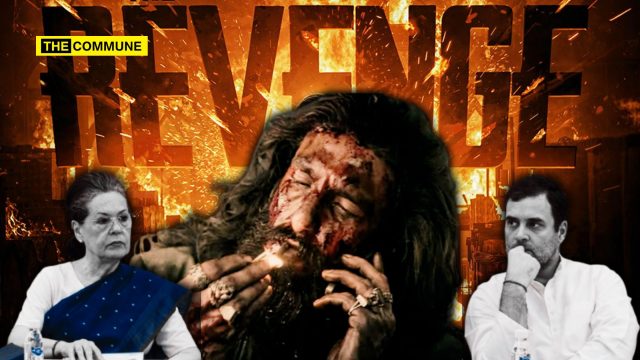
A Bollywood film about intelligence operations, directed by a Kashmiri Pandit and starring Ranveer Singh, has done something no Opposition press conference managed in a decade: it has sent ordinary Indians back to the archives.
As Dhurandhar: The Revenge stormed past over ₹500 crore in four days in India, broke records all across the world and left the “progressive” commentariat scrambling for responses, a parallel excavation broke out on social media. People began pulling out WikiLeaks cables, video transcripts, news reports, newswires, statements by US Secretaries of State – receipts, not rhetoric, from the decade between 2004 and 2014 when the Indian National Congress governed the country and managed, with extraordinary consistency, to blame Hindus for terrorism while bending over backwards for the state that sponsored it.
The film’s themes of national security, buried intelligence, and the price paid by those who fight back hit a nerve precisely because a large number of Indians remember, viscerally, what it looked like when the opposite was true when India’s own government, the UPA led by the Congress, handed its enemies their propaganda scripts and called it statesmanship. Let us take a look at what netizens dug up – the Sins of Congress.
While India Was Bleeding During 26/11, the MEA Was Busy Issuing Joint Statements With Pakistan
As Pakistani terrorists laid siege to Mumbai on 26 November 2008, killing 166 Indians over four days, India’s Ministry of External Affairs was issuing joint statements with Islamabad on counter-terrorism cooperation.
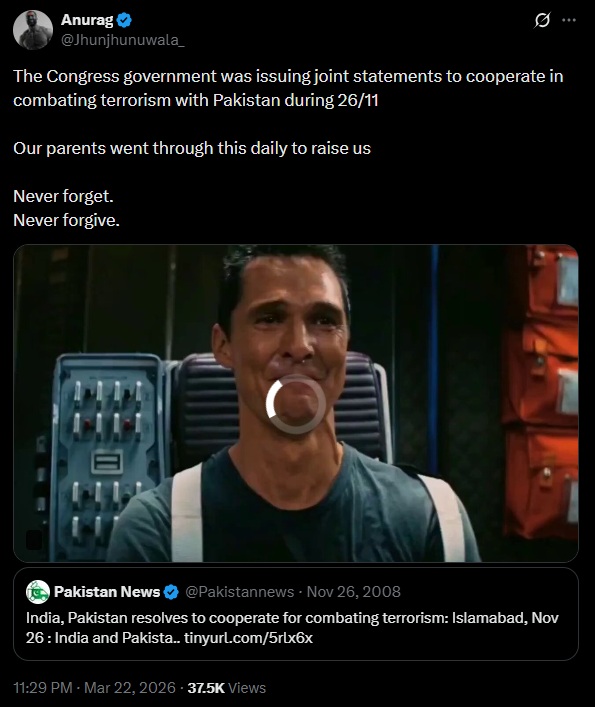
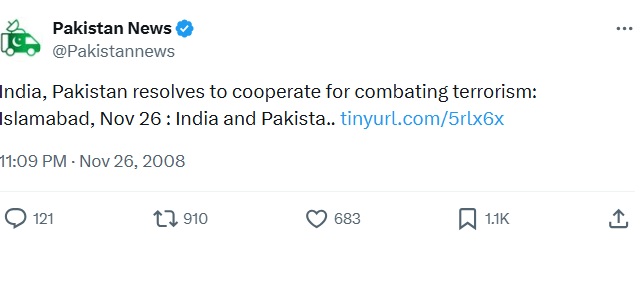
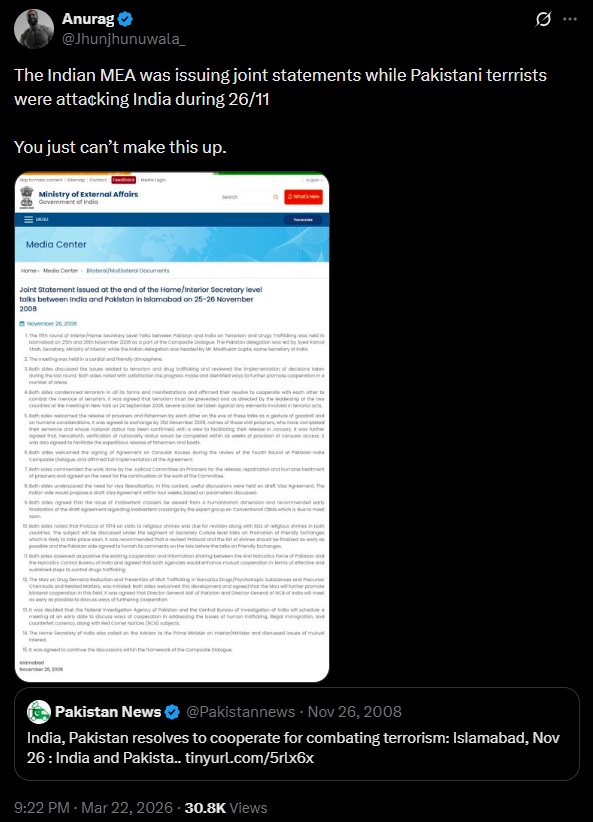
This is not conjecture. The MEA’s own official record shows a Joint Statement issued at the end of Home/Interior Secretary level talks between India and Pakistan in Islamabad on 25–26 November 2008 – the very days the attack was unfolding. Both sides “condemned terrorism in all its forms” and affirmed their “resolve to cooperate with each other to combat the menace of terrorism.”
India’s diplomatic machinery was shaking Islamabad’s hand while Pakistani state-sponsored terrorists were burning down the Taj.
U.S. Had Warned About a Mumbai Terror Attack – But Congress Didn’t Care
American intelligence warned India not once but twice of an imminent sea-borne assault on Mumbai before 26 November 2008. The Guardian confirmed it: “US warned India of attack by Islamist militants, say officials. Intelligence mentioned sea-borne assault.”
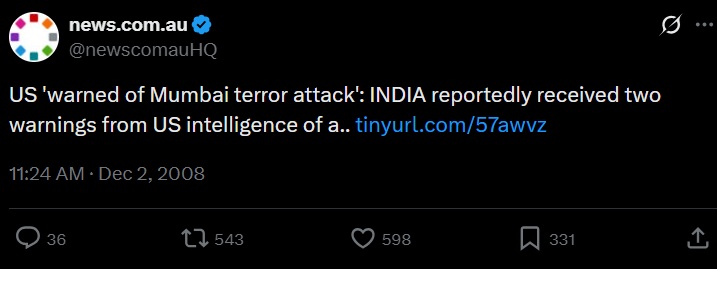
The Congress government, under whose watch India’s intelligence coordination had been allowed to atrophy, took no effective preventive action. The gunmen landed. The killing began. One hundred and sixty-six people died.
No Congress leader has ever been held to account for this failure. No inquiry has produced consequences for anyone in government. The attack has instead been instrumentalised – first as a diplomatic moment to demand Pakistan “do something,” then, grotesquely, as raw material for the saffron terror narrative.
Hafiz Saeed Used India’s Own Home Minister’s Statement to Defend Lashkar-e-Taiba. Let That Sink In.
On 19 January 2013, India’s Union Home Minister, the nation’s top internal security official stood before the All India Congress Committee session in Jaipur and announced: “Reports have come during investigation that BJP and RSS conduct terror training camps to spread terrorism… Bombs were planted in Samjhauta Express, Mecca Masjid and also a blast was carried out in Malegaon.”
After investigations we have seen that be it BJP or RSS, their training camps are promoting Hindu terrorism: HM Sushil Kumar Shinde
— ANI (@ANI) January 20, 2013
Hafiz Saeed was using congress’s HM statement to prove innocence of his terror organisation ‘Lashkar e Tayyaba’ https://t.co/p8GyUCXxll pic.twitter.com/f3WZychPPT
— Anurag (@Jhunjhunuwala_) March 22, 2026
Let that settle. The Home Minister of India, from the stage of his own party’s national conclave, declared that India’s oldest Hindu nationalist organisations were running terror training camps and were responsible for some of the country’s deadliest bomb blasts. He attributed the Samjhauta Express bombing which killed 68 people, most of them Pakistani nationals to the RSS.
The consequences were immediate and internationally damaging. Hafiz Saeed, the mastermind of 26/11, had long maintained that Pakistan and its associated organisations were innocent of all terrorism directed at India. He now had the Indian Home Minister’s own words as his defence brief. He used them. The “saffron terror” terminology, born in Congress party meetings, became a gift to every Pakistani diplomat and every Western journalist who wanted to argue false moral equivalence between RSS and the Lashkar-e-Taiba.
BJP’s Sushma Swaraj put it sharply: Shinde’s statement amounted to “giving a clean chit to real terrorists.”
Shinde’s remark shows LeT innocent: Hafiz Saeed http://t.co/xW1pKvpK
— The Times Of India (@timesofindia) January 21, 2013
Hafiz Saeed, the mastermind of 26/11, a man with a $10 million US bounty on his head, had long insisted Pakistan and its associated organisations were innocent of terrorism directed at India. He now had the Indian Home Minister’s own words as his defence brief. He used them publicly to demand India be declared a “terror state.”
India’s Home Minister handed the architect of the worst terror attack in Indian history the alibi he needed. Let that sink in.
Just 9 Months After 26/11, Rahul Gandhi Was Selling the Idea of “Hindu Terror” to Washington
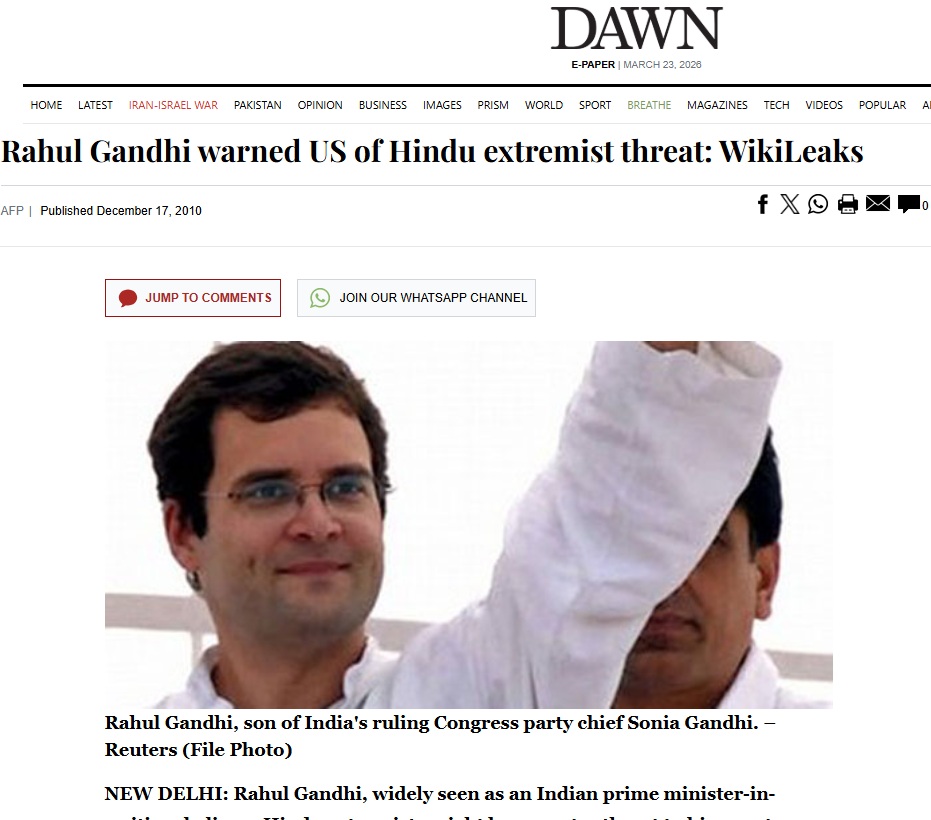
In July 2009, less than nine months after 26/11, Rahul Gandhi sat at a lunch hosted by Prime Minister Manmohan Singh for US Secretary of State Hillary Clinton and told US Ambassador Timothy Roemer “the bigger threat may be the growth of radicalized Hindu groups.”
Here https://t.co/eCuxeiXNEP pic.twitter.com/nzTEEhV4WJ
— Anurag (@Jhunjhunuwala_) March 22, 2026
In less than nine months after 26/11, Rahul Gandhi was reporting to a US envoy that Hindus were a bigger threat than LeT. https://t.co/eCuxeiXNEP pic.twitter.com/qXIKqm8lbu
— Anurag (@Jhunjhunuwala_) March 22, 2026
The same LeT that had just killed 166 Indians in Mumbai.
India’s prime ministerial heir did Islamabad’s diplomatic work for it. Free of charge.
He was not speaking in some private capacity. He was the Secretary General of the ruling party, the acknowledged heir to the Congress throne. He voluntarily told a foreign power’s representative that Hindu radicalism posed a greater danger to India than Lashkar-e-Taiba – the same organisation that had just killed 166 Indians in Mumbai. He acknowledged to Roemer that “some Indian Muslims” supported LeT and then pivoted to present Hindus as the bigger problem.
When WikiLeaks published this cable in December 2010, BJP spokesman Ravi Shankar Prasad put it with clinical precision: “In one stroke, Rahul Gandhi has sought to give a big leverage to the propaganda of all terror groups operating from Pakistan.”
Original wikileaks document, Here: https://t.co/eCuxeiXNEP pic.twitter.com/VMfrRasKDv
— Anurag (@Jhunjhunuwala_) March 22, 2026
He was right. Pakistan’s apologists needed exactly this: an Indian political leader of consequence telling Washington that India’s Hindus, not Pakistan’s military-jihadi complex, were the destabilising force in South Asia.
Dawn, Pakistan’s own newspaper of record, ran the story with visible satisfaction: “Rahul Gandhi warned US of Hindu extremist threat.” India’s Prime Minister’s heir had done Islamabad’s diplomatic work for it, free of charge.
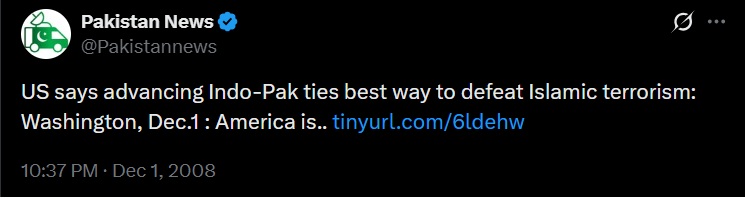
The US Said “Terrorism Will End With Better India-Pak Ties.” Rahul Gandhi Agreed – and Accepted Bilawal Bhutto’s Invitation.
Even as Pakistan News carried the American line, “US says advancing Indo-Pak ties best way to defeat Islamic terrorism”, Rahul Gandhi was walking it.
He accepted an invitation from Bilawal Bhutto Zardari to visit Pakistan.
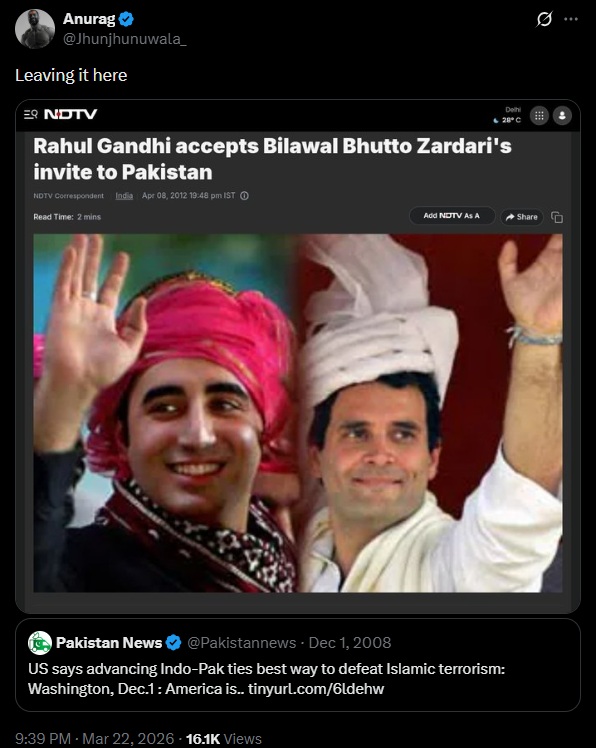
The same Zardari family. The same Pakistan whose president had just told India not to “over-react” to the massacre of 166 of its citizens. The same Pakistan that had refused to hand over a single 26/11 accused.
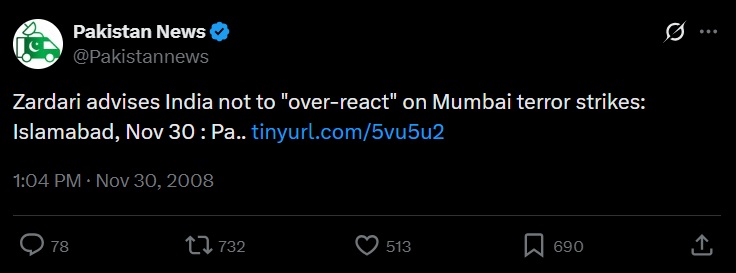
Congress’s response to state-sponsored mass murder: better ties, open arms, accepted invitations.
Rahul Gandhi Shamelessly Said: “Can’t Stop Terror Attacks All the Time”
On 14 July 2011, as India was still counting its dead from serial bombings, Rahul Gandhi told the nation: “Difficult to stop terror attacks all the time.”
Revisiting Rahul Gandhi’s statement on terrorism:
Today, he is asking why the government is not catching terrorists. Rahul Baba, New India eliminates them, not serve biryani like UPA. pic.twitter.com/914VBiF2Yl
— Political Kida (@PoliticalKida) June 12, 2024
The leader of the country’s ruling party, responding to a terror attack, publicly declared that the government could not be expected to stop terrorism consistently. This was not a slip. It was a worldview – one that had already produced 26/11, the Delhi blasts, the Pune blasts, and the Hyderabad blasts on Congress’s watch.
Manmohan Singh After 26/11 – “Determined To Avoid War”
US Secretary of State Condoleezza Rice has, in her own writings and statements, confirmed that after 26/11, Prime Minister Manmohan Singh was “determined to avoid war” and that the MEA conveyed the same reluctance. Her summary of the Indian government’s position: “But you’ve got to get Pakistan to do something.”
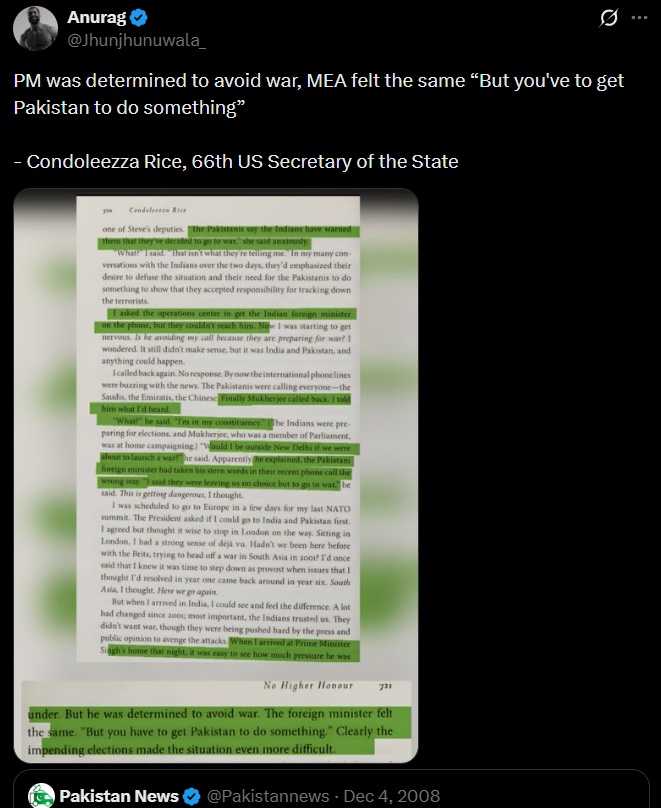
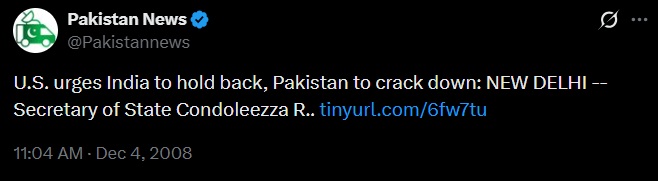
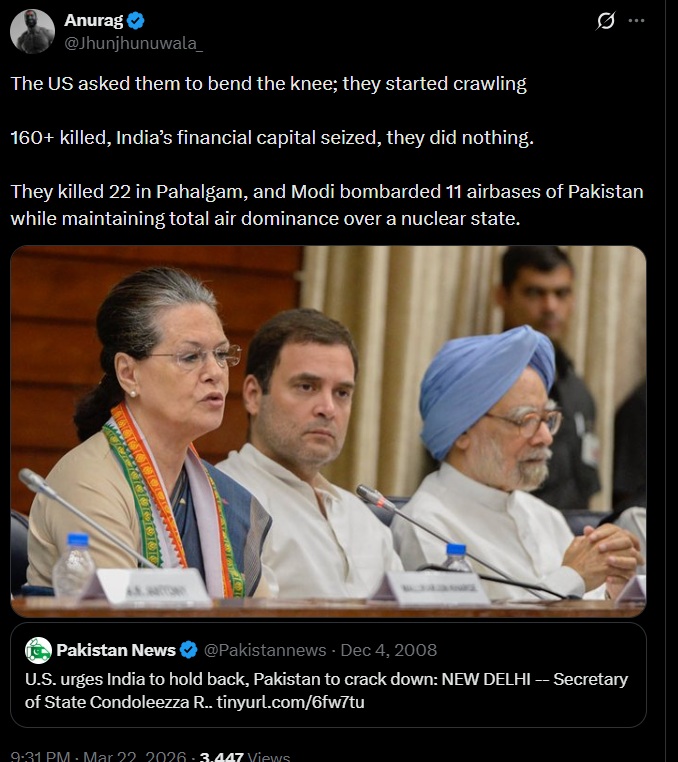
That was India’s response to the massacre of 166 of its citizens by a state-sponsored Pakistani terrorist organisation. Not a military option. Not a strategic cost imposed. A polite request to Washington to pressure Islamabad. Pakistan’s army and ISI watched this response and drew the only rational conclusion available: that Congress-led India would absorb any attack, seek dialogue, and ask the international community to mediate. That conclusion shaped Pakistani strategic calculus for years.
Congress Leaders Coined “Saffron Terror” and Launched Books Like “RSS Ki Saazish” to Smear Hindus
The “saffron terror” narrative was not an accident. It was a coordinated political project executed at the highest levels of government.
P. Chidambaram warned publicly of “saffron terror” as Home Minister.
Chidambaram warns of ‘saffron terror’ http://toi.in/Wj-pJa
— The Times Of India (@timesofindia) August 25, 2010
Sushil Kumar Shinde declared from the AICC stage that RSS training camps promoted Hindu terrorism.
Congress home ministers conspiring against the 1.4 Billion Hindus while protecting LeT and endorsing Hafiz Saeed is just irrelevant tweets apparently
Brace yourselves, i have more in store https://t.co/ROpqQexIwv pic.twitter.com/6Mh4Zih0pb
— Anurag (@Jhunjhunuwala_) March 22, 2026
A Congress Chief Minister, after ten years in power, launched a book titled RSS Ki Saazish – designed to whitewash the crimes of the Pakistani terror state and redirect blame onto Hindus.
Those who call Dhurandhar propaganda will never tell you this: a Congress Chief Minister, after 10 years in power, launched a book whitewashing the crimes of the Pakistani terror state.
Later, it was used by their Home Minister to shift the blame onto Hindus. https://t.co/CPTlNt3HN4 pic.twitter.com/WNYbtXESEO
— Anurag (@Jhunjhunuwala_) March 22, 2026
From the top of the party to the grassroot worker, the ecosystem pushed one narrative: the Hindu is the threat. LeT was the beneficiary. Hafiz Saeed was the beneficiary. Pakistan was the beneficiary.
And had Tukaram Omble not caught Ajmal Kasab alive that night in Mumbai, at the cost of his own life, the entire 26/11 story might have been turned on its head using exactly this pre-laid groundwork.
Bending and Bowing To Pakistan
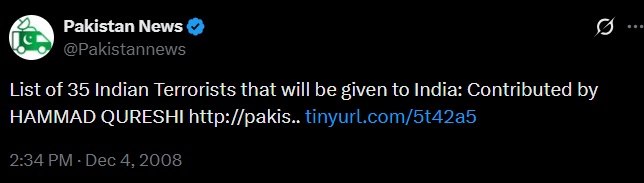
Guess what, amid all the terror attacks, even Pakistan treated India like a wastecloth, thanks to the zero response/action taken post 26/11 terror attack.
They even promised to give a list of 35 ‘Indian’ terrorists to the country. But that list never came is another story.
Abolishing POTA – Dismantling India’s Anti-Terror Architecture
Within a year of coming to power in 2004, the Congress-led UPA government repealed the Prevention of Terrorism Act (POTA). The law had given India’s security forces the legal tools to arrest, investigate and prosecute terror suspects with appropriate rigour. The UPA abolished it not because it was being misused systematically, but because abolishing it played well with the constituency that Congress needed to retain. India then fought the most terror-intensive decade in its post-Kargil history: 26/11, serial train bombings, Hyderabad blasts, Delhi blasts, Pune blasts without the legal infrastructure it had dismantled for electoral gain.
Rahul Gandhi reporting to CIA masters that Hindu groups are a bigger threat than Lashkar-e-Taiba, which attacked the Indian Parliament, orchestrated 26/11, and carried out multiple train bombings.
Why ? https://t.co/eCuxeiXNEP pic.twitter.com/fiwrCwnkDq
— Anurag (@Jhunjhunuwala_) March 22, 2026
BJP’s Sushma Swaraj described this as “abolishing the tool to fight terrorism.” She was not being rhetorical. She was being accurate.
Sending Aid To Pakistan Within Months Of 26/11
Twenty-two months after Pakistani terrorists massacred 166 people in Mumbai, the Congress government wrote a $25 million cheque to Pakistan. External Affairs Minister S.M. Krishna announced the aid in Parliament on 31 August 2010, framing it as flood relief.
The timeline is worth sitting with. Ajmal Kasab was still alive in Indian custody. Hafiz Saeed was walking free in Lahore. Pakistan had not handed over a single 26/11 accused. Its ISI’s fingerprints on the attack were documented and undeniable.
Pakistan initially refused even the first tranche of $5 million. Washington had to pressure Islamabad to accept Indian charity. Manmohan Singh then personally called Pakistan’s Prime Minister to express “solidarity” and quietly increased the amount five-fold.
This was not humanitarianism. This was a government so ideologically committed to appeasing its enemy that it rewarded state-sponsored mass murder with a $25 million gift paid for by Indian taxpayers.
🔥 @INCIndia “patriotism” for you!
Just 22 months after 26/11 — with 166 Indian martyrs’ blood still fresh — S.M. Krishna smirks in Rajya Sabha on 31 Aug 2010: “$25 MILLION aid to Pakistan!”
funding the same terror factory under fake “flood relief”!Pakistan First. India Never!… pic.twitter.com/JiRohPUYqR
— Major Madhan Kumar (Retd)🇮🇳 (@major_madhan) March 23, 2026
Every reset gave Pakistan’s establishment a diplomatic clean slate. Every resumption of talks was presented in Islamabad as proof that terrorism carried no strategic cost. The pattern was not naivety. It was deliberate policy, calibrated to the needs of a domestic coalition that included parties and leaders for whom conflict with Pakistan was always more dangerous than conflict with India’s security establishment.
The Sum of It
In a single decade, Congress: told a foreign power that Hindus were India’s biggest security threat; had its Home Minister declare that RSS ran terror training camps; gave Pakistan’s most wanted terrorist his alibi; ignored two specific pre-attack intelligence warnings; refused for years to hang a man convicted of attacking India’s Parliament; and dismantled the country’s anti-terror legal framework.
Each decision served the same master: the arithmetic of a political coalition that required the permanent subordination of national security to community appeasement. The nation bled. The party calculated. And then, when filmmakers came along to fictionalise the story of those who actually fought back, Congress’s inheritors called it “propaganda.”
The real propaganda ran in North Block for ten years. We have the receipt
Subscribe to our channels on WhatsApp, Telegram, Instagram and YouTube to get the best stories of the day delivered to you personally.