


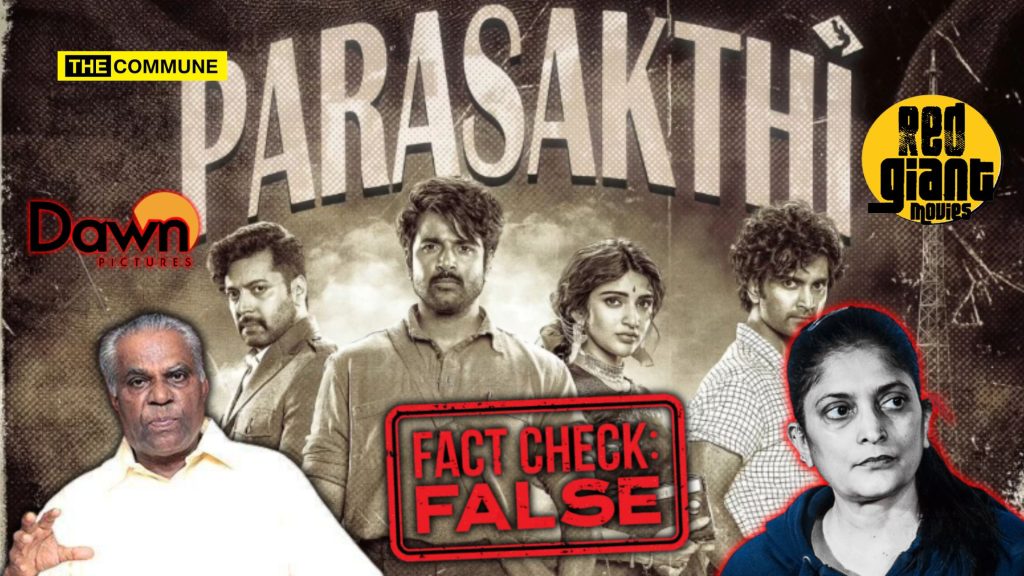
Sudha Kongara’s cinematic falsehoods have now been publicly dismantled by a man who was actually on the ground during the 1965 anti-Hindi agitation. The director’s claim in Parasakthi that nearly 200 civilians were gunned down by the Army in Pollachi has been exposed as a fabrication, with first-hand testimony contradicting the film’s sensationalist narrative.
In an interview to The Hindu, M.G. Devasahayam—who was serving in the Madras Regiment during the period—rejected the film’s portrayal as outright untrue. He underscored a crucial detail conveniently erased by Dravidian propaganda: the Madras Regiment was composed overwhelmingly of South Indians, largely Tamils, not a mythical “Hindi Army” unleashed to brutalise Tamil civilians.
The reality of February 1965, as recalled by Devasahayam, was far removed from the blood-soaked fantasy presented on screen. While parts of Coimbatore city did witness serious unrest—including arson and mob violence that forced the Army to be placed on high alert—the worst brutality occurred in Tiruchengode, where a sub-inspector and three policemen were burned alive by rioters. The Army’s role there was to restore order, not to carry out mass executions.
Pollachi, which Parasakthi projects as the site of an Army massacre, tells a very different story when stripped of propaganda. When troops were called in to assist the civil administration, the mob did not disperse—as is usually the case—but instead launched an attack on both the police and the Army column. With no opportunity to issue warnings, troops opened fire briefly. The death toll, according to Devasahayam, stood at around 8 to 10, with a similar number injured—not the hundreds invented for cinematic and political effect.
Equally false is the film’s insinuation that the Army used Light Machine Guns. Devasahayam clarified that the regiment carried bolt-action .303 rifles, firing one round at a time. Had automatic weapons been deployed, casualties would have been exponentially higher. In total, only about 35 rounds were fired, and even among the roughly 90 soldiers present, firing was carried out strictly on command by named personnel.
Devasahayam also noted that an official inquiry by Army Headquarters was conducted at the time, further puncturing the film’s claims.
My story today. I speak to former Army officer, who was a part of the Madras Regiment and posted in Coimbatore region during the anti-Hindi agitation in Feb 1965. He tells me that claim of 200 people being killed in firing is false. pic.twitter.com/Ltx57ltlOM
— Udhav Naig (@udhavn) January 17, 2026
Other Factual Distortions By Sudha Kongara
Sudha Kongara, notorious for bending and distorting historical facts in her films, has traded historical truth for ideological convenience, mutilating the history of the 1965 anti-Hindi imposition agitation to peddle a present-day Dravidian political narrative.
As The Commune has consistently pointed out, this is not an isolated lapse but part of a broader pattern in which Parasakthi repackages the 1965 agitation through selective amnesia and political distortion—whitewashing mob violence, demonising institutions, and manufacturing atrocities where none occurred.
There’s a scene in which protesting students are described as “kaali payaluga” (good-for-nothing chaps). The framing strongly implies that this contemptuous description came from Bhaktavatsalam and the Congress establishment.
Archives of DK’s own mouthpiece Viduthalai from the period show that it was EV Ramasamy (hailed as ‘Periyar’ by his followers) who openly criticised the protesting students, referring to them as hooligans and questioning the political motives behind the agitation.
The film also shows Tamil Brāhmī being used as a secret code scribbled into a Hindi document.
Tamil Brāhmī was barely known in 1964. While KV Subramanya Iyer conducted pioneering work in the 1930s, it was not pursued systematically. Serious academic focus began only in 1961, when K A Nilakanta Sastri encouraged Iravatham Mahadevan to take up the subject.
Mahadevan published his first major findings only in 1965–66, based on the Pugalur and Mangulam inscriptions. Even then, Tamil Brāhmī did not enter wider academic or public consciousness until the 1990s, when Mahadevan resumed extensive research.
When propaganda takes centre stage, facts tend to go missing. Tamil Brāhmī was barely known in 1964. Although K. V. Subramanya Iyer had carried out some pioneering work in the 1930s, it was not pursued systematically thereafter. It was only in 1961 that K. A. Nilakanta Sastri… https://t.co/uADqanxGna
— 𑀓𑀺𑀭𑀼𑀱𑁆𑀡𑀷𑁆 🇮🇳 (@tskrishnan) January 5, 2026
The idea that Tamil Brāhmī was being widely understood,or covertly used as a “code” within government circles in 1964, has no historical basis.
In her previous film Soorarai Pottru, Sudha cunningly inserted the Dravidianist ideology into the film – he was depicted as a Periyarist fighting for social justice and the villains in the film were all, no prizes for guessing, Brahmins!
Hindi version of Soorarai Potru’s song just dropped.
Black shirt during wedding, EVR images in the background aren’t there in the Hindi version.
Maximum Puratchi is in signing the registration documents on site.Maybe there are no takers for such Vadais outside Gummidipoondi. pic.twitter.com/Ec6M4afT3j
— Tamil Labs 2.0 (@labstamil) July 4, 2024
Interestingly, the Hindi version of the film’s song in Soorarai Potru was released on 4 July 2024. Comparing it with the Dravidianist Tamil version featuring EVR’s picture and a black shirt-borne Suriya, the Hindi version had nothing revolutionary.
That such demonstrable falsehoods are being passed off as historical truth in a mass-market film is not merely irresponsible—it is dangerous. When cinema is weaponised to launder political mythology, facts become the first casualty, and history is reduced to a propaganda tool.
Subscribe to our channels on WhatsApp, Telegram, Instagram and YouTube to get the best stories of the day delivered to you personally.