



In the aftermath of a tragedy that claimed 41 innocent lives, one would expect India’s leading newspapers to champion accountability and justice. Instead, The Hindu, under the editorial leadership of N. Ram, has published a deeply troubling editorial titled “Flawed Order” that does more to shield the ruling DMK government in Tamil Nadu than to seek truth for the victims of the Karur stampede.
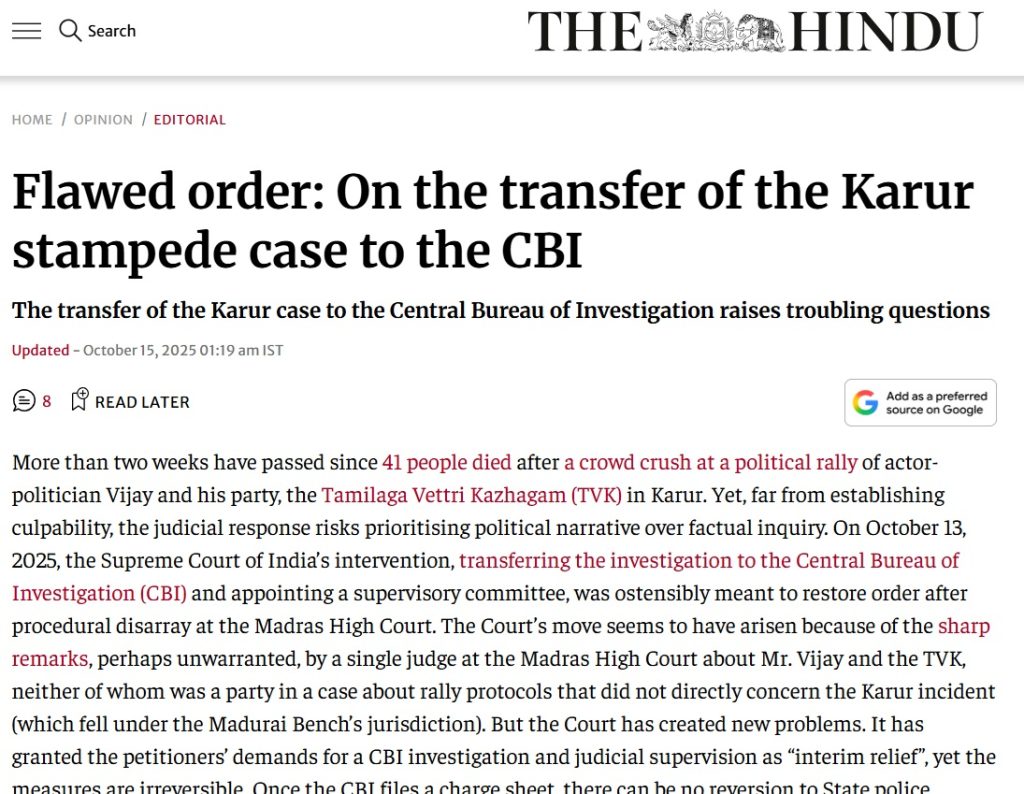

The editorial’s central premise that the Supreme Court erred in ordering a CBI investigation reveals a startling disconnect from both legal principles and ground realities. What The Hindu dismisses as a “flawed order” is, in fact, a necessary judicial intervention to restore public confidence in an investigation marred by political undertones, procedural irregularities, and credibility concerns.
Misreading the Court’s Necessary Intervention
The editorial’s central premise that the Supreme Court erred in ordering a CBI investigation reveals a startling disconnect from the facts. What The Hindu dismisses as a “flawed order” was actually a necessary judicial correction after senior Tamil Nadu police officials, including Additional Director General of Police Davidson Devasirvatham, held press conferences defending their conduct before any investigation could begin. When investigators become public advocates for their own innocence, the integrity of the entire process collapses.
The Supreme Court rightly observed that “the comments made before the media by top officers of the Police Department may create doubt in the minds of the citizenry on impartiality and fair investigation.” This isn’t a “gag order” as The Hindu claims, but common sense: you cannot credibly investigate yourself after publicly declaring your innocence. The editorial’s position suggests that state officials should be free to try their case in the media while simultaneously conducting an “impartial” investigation – a contradiction that undermines basic principles of natural justice.
Selective Legal Analysis and Cherry-Picked Precedents
The editorial’s invocation of the 2010 State of West Bengal case is particularly misleading. While correctly noting that the precedent warns against routine CBI transfers, The Hindu conveniently ignores that the same judgment affirms constitutional courts’ power to order CBI investigations when state police lack credibility. The Constitution Bench explicitly ruled that High Courts and the Supreme Court possess this power without state consent when circumstances demand.
The Karur case, with 41 deaths, allegations of conspiracy from both sides, rushed nighttime autopsies, and investigating officers publicly defending themselves, presents exactly the “exceptional circumstances” warranting such intervention. The Hindu’s selective quotation from this precedent, amounts to legal cherry-picking designed to support a predetermined conclusion rather than honest legal analysis.
Conveniently Ignoring Troubling Facts
Most revealing is what the editorial completely omits. It makes no mention of the medically questionable autopsies – 31 completed in just over six hours at a hospital with only 2-3 tables that fueled public suspicion. Medical experts consistently state that proper autopsies require approximately 2-4 hours per body. This procedural irregularity, combined with bodies being handed over for cremation by dawn, created legitimate questions about investigative thoroughness that The Hindu conveniently ignores.
The editorial also fails to address the fundamental mathematics of the autopsy controversy. Even with three tables and 22 additional doctors rushed in from neighboring districts, completing 31 detailed postmortems documenting cause of death, injuries, and chain of custody in just over four hours defies credibility. This silence on substantive factual concerns undermines the editorial’s claim to be defending “factual inquiry.”
The “Caged Parrot” Red Herring and Robust Safeguards
The Hindu dismisses the CBI as “a caged parrot of the centre,” recycling a phrase from a 2013 case. This rhetorical flourish ignores that the Supreme Court specifically addressed this concern by appointing a three-member supervisory committee headed by retired Supreme Court Justice Ajay Rastogi. This oversight mechanism, stronger than in most CBI transfers and including two IPS officers from outside Tamil Nadu, directly counters concerns about central government influence.
The supervisory committee possesses authority to “issue proper direction for the areas in which the investigation is required to be carried out” and review evidence “from time to time.” By dismissing the CBI transfer with a glib “caged parrot” reference while ignoring these robust safeguards, The Hindu reveals that its real objection isn’t about investigative independence, it’s about protecting the DMK government from scrutiny.
The editorial notes allegations that “one petitioner was unaware of the petition filed in his name” and “another litigant who abandoned his family years ago is not a real representative of a child victim”. While these allegations merit examination, they don’t undermine the Supreme Court’s fundamental rationale for transferring the case to the CBI. The core issue remains whether Tamil Nadu police, who publicly defended their actions through press conferences, could impartially investigate themselves. Notably, The Hindu applies rigorous procedural scrutiny here while remaining silent about the Madras High Court’s own overreach, where a single judge made sweeping allegations against Vijay’s TVK without making them a party to the proceedings. This selective concern reveals inconsistent standards.
Double Standards on Judicial Overreach
The editorial faults the Supreme Court for making “no mention of the TVK’s or leaders’ responsibilities” while simultaneously accusing the Court of pre-judgment. This contradictory logic ignores that the Madras High Court single judge, whom The Hindu doesn’t criticize had already pre-judged the case by declaring that Vijay and TVK leaders “absconded from the venue” and showed “no remorse” without making them parties to the proceedings.
The Supreme Court’s approach, focusing on structural impartiality rather than assigning preliminary blame, represents judicial restraint, not overreach. The Hindu essentially faults the Supreme Court for not doing what it criticizes the Court for allegedly doing: pre-judging responsibility before evidence is properly examined.
Subscribe to our channels on Telegram, WhatsApp, and Instagram and get the best stories of the day delivered to you personally.