



The Uttar Pradesh government’s recent decision to allow women to work night shifts, with written consent and strict safety measures, has triggered a wave of mockery from some feminist activists and habitual detractors of the state. Critics online portrayed the move as an outlier in a supposedly backward state.
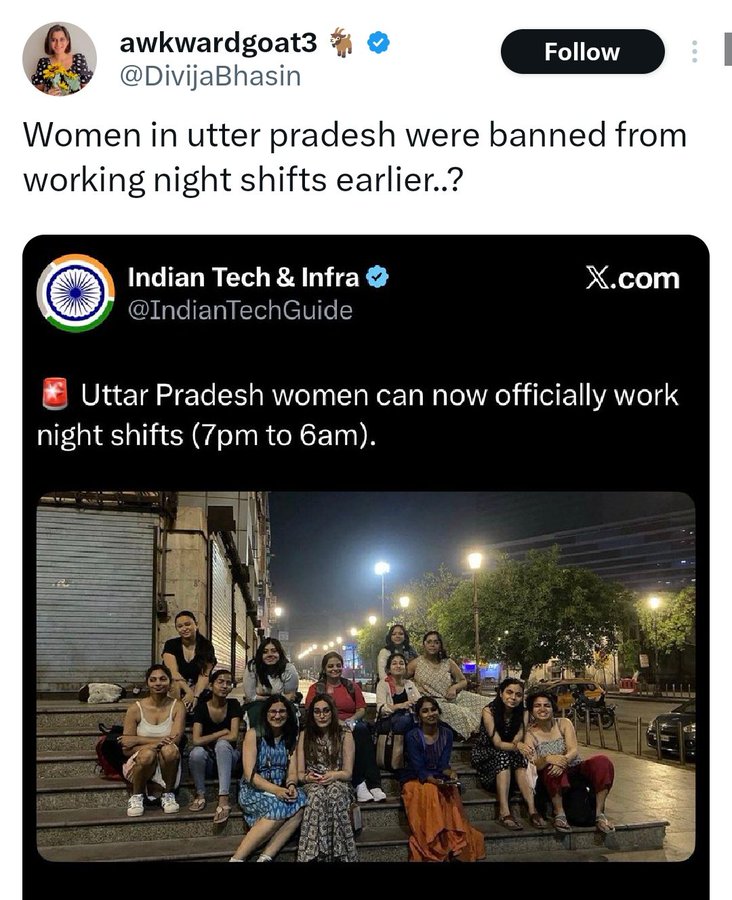

However, labour-law data and state-wise policies show a very different picture: UP is not an exception but part of a nationwide, decade-long trend of cautiously lifting night-shift restrictions on women.
What many critics have overlooked is that several Indian states still retain significant restrictions, while many others removed them only recently, often with conditions very similar to those introduced in Uttar Pradesh.
What UP Has Done
Under the amended law, women in Uttar Pradesh can now work between 7 pm and 6 am after providing written consent. Employers must provide transportation, CCTV surveillance, security personnel, health facilities, and digital monitoring systems. Overtime pay has been doubled, and women can work in all hazardous sectors, up from just 12 earlier.
Supporters of the reform argue that these protections simply align UP with best practices followed across other industrial states.
What Critics Are Ignoring: Many States Still Restrict Night-Shift for Women
Let us begin with how it started.
The Factories Act, 1948 (especially Section 66) laid down restrictions on women working night shifts (generally defined as from 7 PM to 6 AM) mainly to protect women from potential hazards. This was brought about by India’s first Prime Minister, Nehru’s government.
This rule applied across India in various forms, but states had their own variations and enforcement mechanisms. Over decades, the restrictions were challenged as discriminatory, particularly after various High Court rulings in the 2000s deemed them unconstitutional for depriving women of economic opportunities.
Despite heavy commentary targeting UP, restrictions on women’s night work are still active in large parts of India:
As of 2024, West Bengal continues to prohibit women from working in shops or commercial establishments after 8 PM. A year later only partial exemptions were present in draft rules that were yet to be fully implemented.
Around 25 states still maintain statutory or operational limitations, particularly affecting migrant workers, contract workers, and factory employees. Several states did amend laws or issued exemptions allowing women to work night shifts, often requiring their written consent and safety measures:
Andhra Pradesh, Assam, Haryana, Himachal Pradesh, Maharashtra, Uttar Pradesh: Between 2014 and 2017, these states amended laws to allow women night shifts, usually with conditions on safety and consent.
Gujarat: Courts and later government orders allowed women to work night shifts with consent; no compulsion is allowed.
Punjab: Punjab lifted its night-shift restrictions for women only recently, and even today the relaxation is far from absolute. Until 2022, Punjab, like most states operating under the Factories Act, 1948 and the Punjab Shops & Commercial Establishments Act, largely prohibited women from working between 8/9 PM and 6 AM, except through special permissions. The state issued a notification in March 2022 allowing women to work night shifts in factories, shops, and commercial establishments, but only through a conditional exemption system. Employers must apply for approval and meet an extensive list of requirements, including strict POSH compliance, dedicated transport, on-site security, CCTV coverage, batch employment of a minimum number of women per shift, and continuous safety audits.
Delhi: Lifted restrictions in 2025, allowing women to work night shifts under safety protocols.
Odisha, Jharkhand, Karnataka, Tamil Nadu, Madhya Pradesh, Telangana: These states have also lifted or relaxed restrictions in recent years, with emphasis on women’s consent and employer responsibility for safety.
Rajasthan: Issued a temporary exemption in 2024 allowing women night work in shops and establishments, subject to consent and safety norms.
Even where states allow night work, the fine print often includes rigid consent requirements, mandatory transport, minimum number of women per shift, and prohibitions on working alone – conditions very similar to UP’s.
A National Issue, Not a UP-Specific One
Labour researchers say India’s night-shift restrictions have historically been shaped by outdated “protective” laws dating back to the Factories Act, 1948. All states inherited these restrictions, and most have been lifting them only gradually in response to industrial demand, court rulings, economic growth needs, as well as pressure from women seeking equal opportunities.
Viewed in this context, UP’s reform is not an exception, it is part of a broader national shift toward equal workplace access.
Why the Mockery Is Selective
Analysts point out that criticism targeting UP often ignores. Many states still maintain harsher restrictions, including those governed by parties favoured by the same critics.
UP’s conditions viz, written consent, transport, safety protocols, mirror those in other states, including Delhi, Tamil Nadu, and Maharashtra.
The reform expands women’s economic opportunities in a state where 36% of the workforce is female.
Officials say the policy aims to increase women’s participation in industries operating round-the-clock while reducing gender discrimination in hiring.
A Policy Change That Reflects National Reality
While the debate continues online, labour experts argue that UP’s move is consistent with global norms and India’s gradual legal reform trajectory. The selective backlash, they say, overlooks both the national landscape and the realities of labour regulation in India.
In short: the UP reform is neither unusual nor regressive. If anything, it mirrors or exceeds protections offered in several states that are rarely scrutinised with the same intensity.
Subscribe to our channels on WhatsApp, Telegram, Instagram and YouTube to get the best stories of the day delivered to you personally.