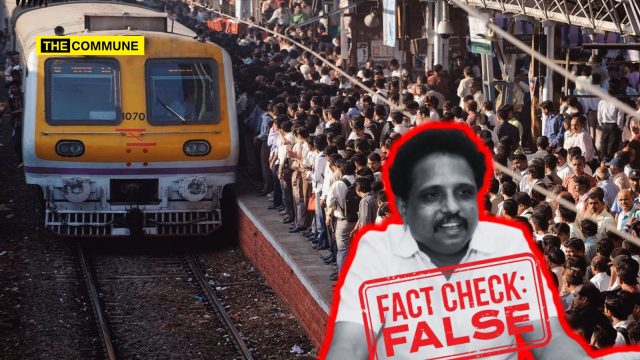
CPI(M) Madurai MP Su Venkatesan on 26 December 2025 criticised the Union government’s latest railway fare hike, stating that rising fares and withdrawal of concessions had driven passengers away from train travel. He claimed that railway passenger numbers declined from 822 crore in 2014–15 to 690 crores in 2023–24 and argued that fare policies had forced commuters onto road transport.
A review of official railway and metro data shows a more complex picture, shaped by structural changes in urban transport over the past decade.
Passenger Numbers: What Su Venkatesan Skips
The quoted 822 crore figure for 2014–15 includes suburban rail passengers in major metros such as Chennai, Mumbai and Kolkata. Official Indian Railways data for 2013–14 records about 8,397 million originating passengers (≈ 840 crore), confirming that suburban commuters formed a large share of the total.

What has changed since then is not “people abandoning railways”, but people shifting from suburban rail to metro rail.
Metro Expansion Explains The Shift
In 2014, India had only 248 km of operational metro rail. By 2024–25, this has expanded to around 1,000–1,013 km across more than 20 cities, according to government sources.
Daily metro ridership rose from about 28 lakh passengers in 2013–14 to around 1.12 crore passengers per day in 2024–25. On an annual basis, this amounts to roughly 340 crore passenger journeys; journeys that no longer appear in Indian Railways’ passenger totals.
When metro ridership is added to non-suburban railway travel, overall rail-based public transport usage is higher than in 2014, not lower.
The claim that “132 crore passengers were driven away from trains” collapses once metro usage is included.
Covid Impact Conveniently Ignored
Passenger numbers in 2020–21 and 2021–22 collapsed globally due to Covid-19 restrictions. Even in 2022–23, Indian Railways passenger figures were still in the recovery phase.
Presenting post-pandemic passenger data as proof of policy failure, without acknowledging this disruption, distorts the record.
Fare Hike Narrative vs Fare Reality
Indian Railways’ own policy documents confirm that passenger fares are kept below cost and are cross-subsidised by freight revenue.
Freight earnings increased from about ₹94,000 crore in 2013–14 to around ₹1.69 lakh crore in 2023–24, enabling continued passenger subsidies.
While charges for Tatkal, premium Tatkal, special trains and cancellations have increased, there has been no across-the-board fare shock of the kind implied. Claims such as “fares are near airline levels” do not reflect average passenger tariffs.
Senior citizen concessions were withdrawn, but this policy change alone does not explain the scale of passenger shifts claimed, especially when metro migration accounts for hundreds of crores of journeys annually.
Second-Class Coaches: Partial Picture
The reduction in unreserved second-class coaches cited by Venkatesan is selective data use. Indian Railways has reconfigured coach composition alongside:
- higher train frequencies
- longer rakes
- suburban-to-metro migration
Affordable mass transit did not disappear; it changed mode.
Tamil Nadu Allocation Claim Also Selective
Railway Budget data shows that Tamil Nadu’s annual railway outlay before 2014 was in the few-hundred-crore range, while in recent years it has consistently run into several thousand crore rupees annually.
Exact figures vary by year and accounting method, but the claim that Tamil Nadu was “denied funds” does not align with budgetary records.
Last Word
Su Venkatesan’s statement that rising fares alone “pushed people off trains” is factually incomplete. What the data actually shows is a massive shift from suburban rail to metro rail, pandemic-related distortions in passenger counts, continued passenger fare subsidy via freight revenue, and increased rail investment, including in Tamil Nadu.
Omitting metro expansion while citing suburban rail decline creates a false impression of collapse where the evidence points to restructuring and modal transition.
This is not a story of people abandoning railways – it is a story of India’s urban transport system evolving, a fact conveniently absent from the political claim being made.
View this post on Instagram
Subscribe to our channels on WhatsApp, Telegram, Instagram and YouTube to get the best stories of the day delivered to you personally.