


The Bengal Files film has brought to focus some of the dark chapters of Indian history, especially the circumstances around the Direct Action Day. This brings us to the topic of how the attitude of the so-called “father of the nation” was towards Hindu women amid a genocide. Let us also take a look at the instances of MK Gandhi making statements against Hindus and asking them to be submissive to Muslims.
#1 1946 Noakhali Massacre
Social media users shared videos/clippings from the film The Bengal Files – scene of the interaction between Gopal Patha and Mahatma Gandhi regarding the 1946 Noakhali genocide of Hindus, women especially, in the film have gone viral.
In the scene, Gandhi is shown telling women to embrace death rather than resist sexual assault, advice that is now being widely circulated in the form of archival newspaper clippings and references from Gandhi’s own collected works.
Gandhi was a bigger enemy of Hindus than Muslims. Gandhi weakened the Hindu psyche.
The coward was not a Mahatma.#TheBengalFiles pic.twitter.com/473XL2TThx
— Kashmiri Hindu (@BattaKashmiri) September 6, 2025
The non-violent formula of the great soul to avoid brutal r@pes, ‘take poison before submitting’.
Yes, that’s right. He doesn’t tell Hindu women to fight, resist, speak up. Just take poison ‘before submitting’!
What a father for a nation to have! pic.twitter.com/3Eclew2zMn
— Shefali Vaidya. 🇮🇳 (@ShefVaidya) September 8, 2025
The controversy stems from Gandhi’s statements made during the October 1946 communal violence in Noakhali and Tipperah districts of Bengal, where large-scale killings, forced conversions, rapes, and abductions of Hindus were carried out by Muslim League mobs demanding the creation of Pakistan. According to contemporary records, over one lakh Hindus were affected, with confirmed casualties crossing 285, though some estimates put the number in the thousands.
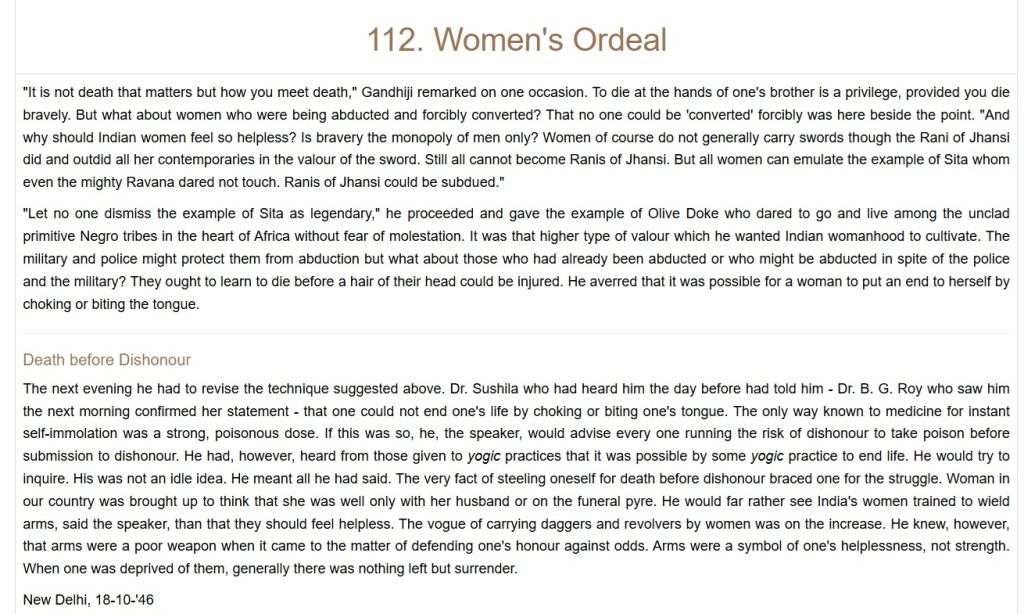
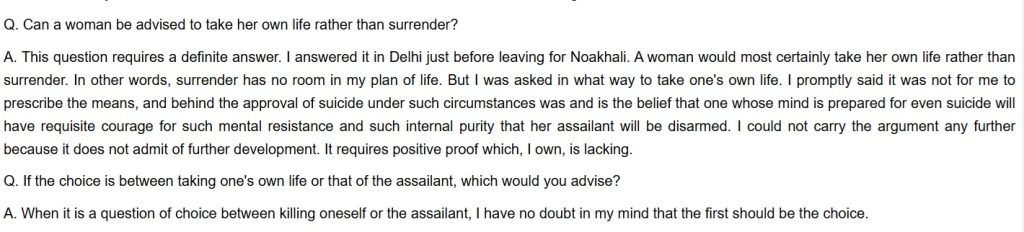
Faced with reports of women being abducted, raped, and forcibly converted, Gandhi did not call upon Hindu women to resist with arms or to organize for self-defense. Instead, he advised them to consider suicide as a way of preserving their “honour.”
In his collected writings, later published under the title My Non-Violence, Gandhi is quoted as saying: “They ought to learn to die before a hair of their head could be injured… It was possible for a woman to put an end to herself by choking or biting the tongue. The only way known to medicine for instant self-immolation was a strong poisonous dose. If this was so, I would advise every one running the risk of dishonour to take poison before submission to dishonour.”
He added that he “meant all he had said” and that “the very fact of steeling oneself for death before dishonour braced one for the struggle.” Gandhi also declared that when it came to choosing between killing oneself or the assailant, he had “no doubt in [his] mind that the first should be the choice.”


International press at the time captured this extraordinary advice. A New York Times report from late October 1946 ran with the headline: “Gandhi Urges Women To Take Poison”, noting that he was counseling Hindu women “running the risk of dishonor” during the Noakhali carnage to kill themselves rather than be violated.
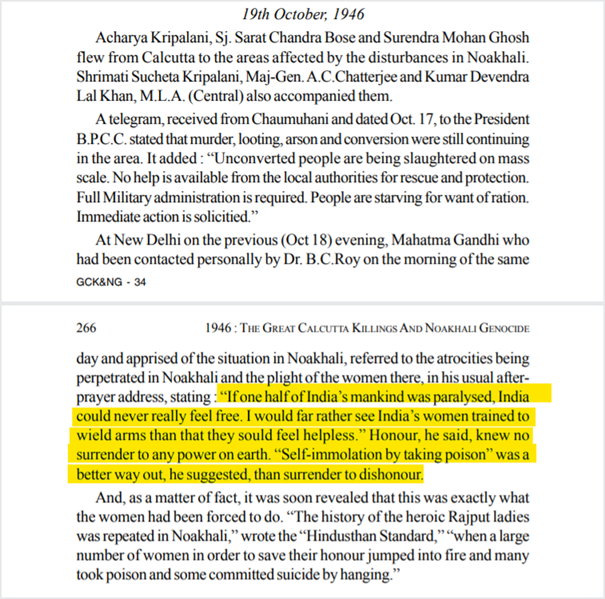
Bengali historian Dinesh Chandra Singha, in his book 1946: The Great Calcutta Killings and Noakhali Genocide, corroborates this, recording Gandhi’s remarks delivered in his evening prayer meetings in Delhi before he set out for Noakhali. Gandhi reportedly told the gathering: “Self-immolation by taking poison was a better way out than surrender to dishonour.”
The book further notes that in some affected villages, Hindu women did in fact commit suicide by poison, fire, or hanging to avoid abduction and forced conversion. The Hindustan Standard at the time compared the tragedy to the Rajput tradition of jauhar — mass self-immolation by women in the face of invading armies.

Critics argue that Gandhi’s stance, while framed in the language of “bravery” and “non-violence,” effectively denied Hindu women the right to resist, fight back, or demand protection. Instead, it reduced them to passive victims whose only “non-violent” option was death.
#2 Moplah Massacre (1921) – Khilafat Movement Support
During the Malabar riots in 1921, Moplah Muslims massacred over 10,000 Hindus, raped thousands of Hindu women, and desecrated temples. Despite this genocide, Gandhi continued supporting the Khilafat movement.
Gandhi’s support for the Khilafat movement epitomized his approach of asking Hindus to sacrifice for Muslim causes. He made Hindu participation in the movement conditional on Muslim support for independence. He continued supporting the movement even after it led to anti-Hindu violence across India. He prioritized Islamic caliphate concerns over Hindu safety and interests
Gandhi’s response to Hindu victims was as below.
Gandhi blamed Hindus for causing Muslim violence against them
“Hindus,” said the Mahatma, “must find out the causes of Moplah fanaticism. They will find that they are not without blame. They have hitherto not cared for the Moplah. They have either treated him as a serf or dreaded him. They have not treated him as a friend and neighbour, to be reformed and respected. It is no use now becoming angry with the Moplahs or the Muslims in general.”
Asked Hindus to excuse Muslim atrocities
“Even if one side is firm in doing its dharma,” said Gandhi, “there will be no enmity between the two. He alone may be said to be firm in his dharma who trusts his safety to God and, untroubled by anxiety, follows the path of virtue. If Hindus apply this rule to the Moplah affair, they will not, even when they see the error of the Moplahs, accuse the Muslims.”
Praised Hindus who died rather than convert
“I see nothing impossible in asking the Hindus to develop courage and strength to die before accepting forced conversion. I was delighted to be told that there were Hindus who did prefer the Moplah hatchet to forced conversion,” he said.
Asked Hindus to love their Muslim attackers more
“Even so is it more necessary for a Hindu to love the Moplah and the Muslim more, when the latter is likely to injure him or has already injured him.”
Questioned why Hindus fled from being massacred
“Why should a single Hindu have run away on account of the Moplahs’ atrocities?”
Here’s how Gandhi justified Muslim violence and praised the perpetrators saying, “Moplah bravery must command admiration. These Malabaris are not fighting for the love of it. They are fighting for what they consider is their religion and in the manner they consider is religious”
#3 Kohat Riots (1924)
In September 1924, Muslim mobs attacked Hindus in Kohat, killing 12 and wounding 86. The entire Hindu population (3,000 people) was forced to evacuate.
The following was Gandhi’s advice to Hindu victims.
Asked Hindus not to return to their homes
“Even if Musalmans refuse to make approaches and even if the Hindus of Kohat may have to lose their all, I should still say that they must not think of returning to Kohat till there is complete reconciliation between them and the Musalmans until they feel that they are able to live at peace with the latter without the protection of the British bayonet”
Insisted this was the only acceptable approach
“This is a counsel of perfection. I can tender no other advice. For me, it is the only practical advice I can give”
#4 Partition Violence (1946-1947)
Direct Action Day (August 16, 1946)
When Muslims launched “Direct Action Day” leading to the Great Calcutta Killings, Gandhi criticized Hindu self-defense efforts led by Gopal Patha. He opposed Hindu defensive measures while not placing equivalent pressure on Muslim aggressors.
Here is what he gave in the name of advice on the Partition to Hindus.
Asked Hindus to accept death rather than resist
“Hindus should not harbour anger in their hearts against Muslims even if the latter wanted to destroy them. Even if the Muslims want to kill us all we should face death bravely. If they established their rule after killing Hindus we would be ushering in a new world by sacrificing our lives”
“None should fear death. Birth and death are inevitable for every human being. Why should we then rejoice or grieve? If we die with a smile we shall enter into a new life, we shall be ushering in a new India”
#5 Specific Documented Quotes
Let’s take a look at some other documented quotes of MK Gandhi on how Hindus must behave with Muslims.
On Hindu-Muslim Unity
Prioritized appeasing Muslims over Hindu safety
“I consider the eternal friendship between Hindus and Mussalmans as infinitely more important than the British connection”
Asked Hindus to ignore forced conversions
“Even if it were true that the Muslims were converting Hindus by force, the Hindus must not let this put a strain on the Hindu-Moslem unity and break it”
On Muslim Violence
Asked Hindus to see Muslim killers as brothers
“After all, who are the killers? They are our Muslim Brethren, none other. Does a converting into another religion break the bond of brotherhood?”
“Even if Muslims decide to wipe out the Hindu race, there is no point in Hindus getting angry on Muslims. Even if they slit our throats, we should be patient and accept death”
#5 Pattern of Victim-Blaming
Gandhi consistently placed the blame for communal violence on Hindu victims while refraining from holding Muslim leaders to the same standard of accountability. He often portrayed Muslim aggression as a justified response to alleged Hindu provocation, framing it as reactive rather than deliberate. In his appeals for peace, Gandhi directed his calls for restraint and non-violence almost exclusively toward Hindus, while excusing instances of Muslim violence as expressions of religious sentiment. This selective approach created the impression that Hindus bore the burden of responsibility, even in situations where they were the victims of aggression.
Dr. Ambedkar’s Criticism
Dr. B.R. Ambedkar strongly criticized Gandhi’s approach. He said, “Mr Gandhi has never called the Muslims to account even when they have been guilty of gross crimes against Hindus… Mr Gandhi was anxious to preserve Hindu-Moslem unity and did not mind the murders of a few Hindus, if it could be achieved by sacrificing their lives”.
Impact and Legacy
Documented statements and positions from Gandhi reveal a consistent pattern in his approach to communal violence. He frequently blamed Hindu victims for Muslim attacks and urged Hindus to accept such violence without resistance or anger. At the same time, he praised Muslim perpetrators as brave and religious, prioritising appeasement of Muslims over the safety of Hindus.
While he never placed equivalent demands on Muslim leaders to restrain their followers, he consistently portrayed Hindu self-defense as morally wrong, even as he excused Muslim aggression. This approach, reflected in Gandhi’s writings in Young India, official records, contemporary newspapers, and scholarly accounts, played a significant role in rationalising Hindu victimisation during Partition under the banner of “communal harmony.”
Subscribe to our channels on Telegram, WhatsApp, and Instagram and get the best stories of the day delivered to you personally.