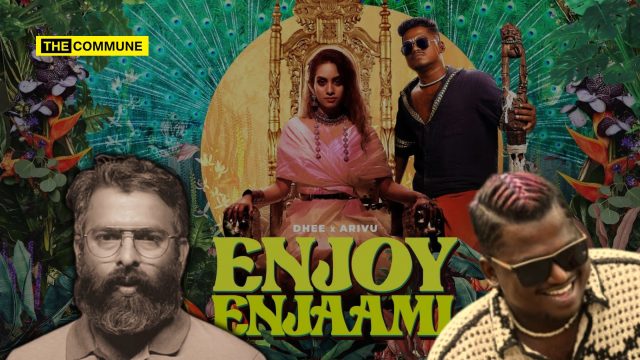
On 5 March 2021, Maajja released “Dhee ft. Arivu – Enjoy Enjaami (Prod. Santhosh Narayanan)” – a Tamil indie track built on oppari folk music, gaana, and hip-hop, telling the story of Arivu’s grandmother Valliammal, a former indentured plantation labourer. The song crossed 500 million YouTube views, hit Times Square via a DJ Snake remix, and became the most successful Tamil indie release in history.
The song’s full title told you everything about the collaboration’s structure: Dhee was the primary vocalist and credited lead artist. Arivu was the rapper and lyricist, billed as a featured artist. Santhosh Narayanan composed and produced. This was documented, credited, and publicly available from release day.
What followed over the next three years was how the Leftist-Dravidianist ecosystem transformed their politically aligned artist into a permanent, monetisable victim and how that victim can ride the sympathy wave indefinitely while producing nothing much of comparable independent merit.
Act I: Rolling Stone India – The Outrage Is Manufactured (August 2021)
Rolling Stone India published its August 2021 cover featuring Dhee (the lead artist of Enjoy Enjaami) and Shan Vincent de Paul (the lead artist of “Neeye Oli,” another Maajja track to which Arivu had contributed lyrics). Arivu was not on the cover. He appeared inside the feature.
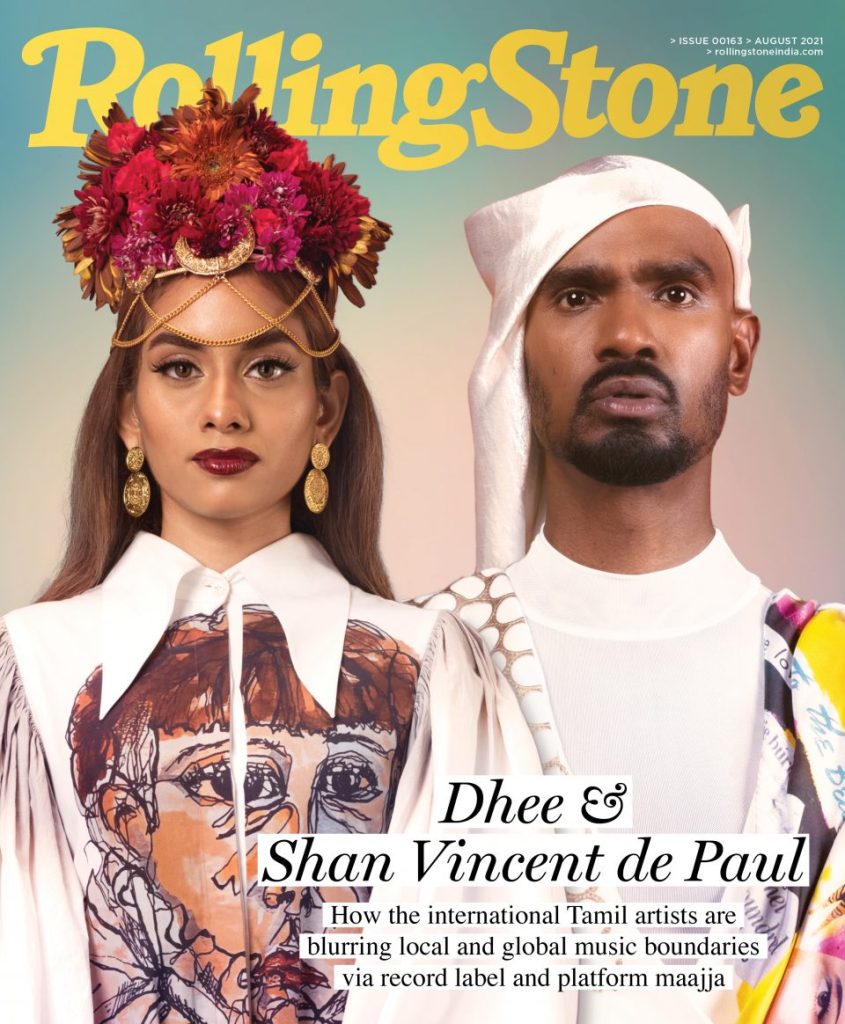
Before anyone could read the article, Dravidianist hate-mongering filmmaker Pa Ranjith, and the most powerful patron Arivu had, fired the first shot on 22 August 2021: “@TherukuralArivu, the lyricist of #Neeyaoli and singer as well as lyricist of #enjoyenjami has once again been invisiblised. @RollingStoneIN and @joinmaajja is it so difficult to understand that the lyrics of both songs challenges this erasure of public acknowledgement?”
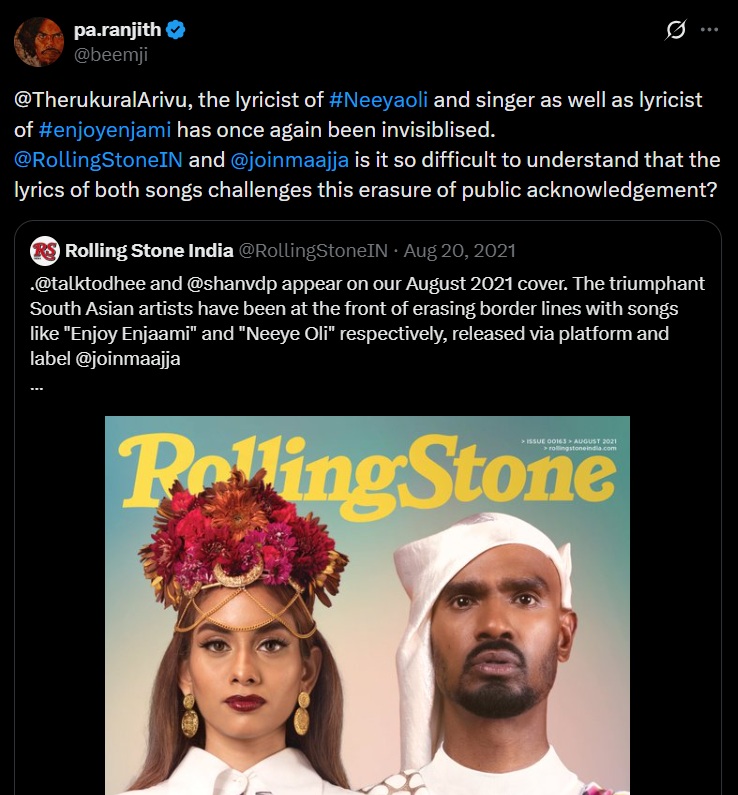
Note the framing. Not “why wasn’t Arivu on the cover?” but “he has once again been invisiblised” – as if to ‘imply’ a pattern of deliberate erasure. The “once again” was doing enormous work. There was no prior Rolling Stone erasure to point to. Ranjith was establishing a pattern that did not exist.
Within hours, filmmaker CS Amudhan escalated: “If the @TherukuralArivu erasure wasn’t a deliberate & blatant move, Dhee, @Music_Santhosh & @arrahman should speak up, otherwise it will go down as a historical injustice. These are people we believe are on the right side of the good fight, I really hope they do the right thing.”
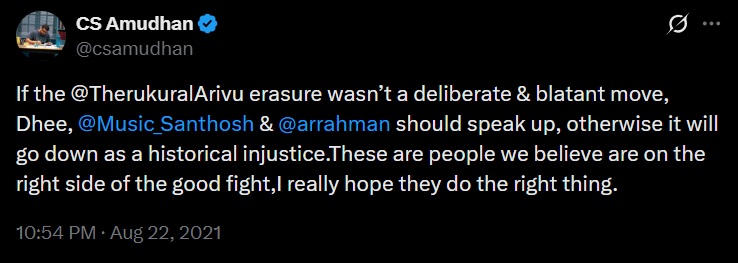
This post did something calculated: it issued a public ultimatum to Arivu’s collaborators – either publicly side with Arivu or be complicit in a historical injustice. It weaponised their silence before they had even had a chance to respond. It also framed a magazine’s editorial call about a cover photograph as something that would “go down in history” if not corrected.
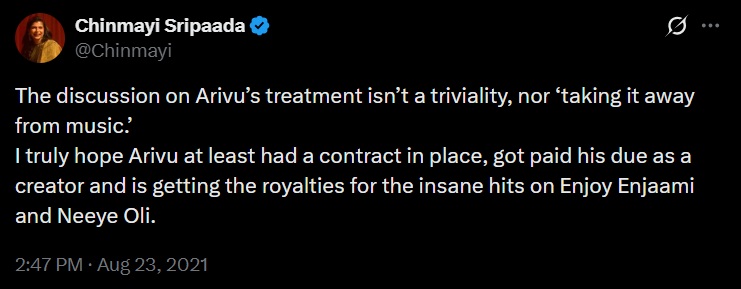
Radical woke singer Chinmayi Sripada also gave her two cents.
Filmmaker Leena Manimekalai chimed in.
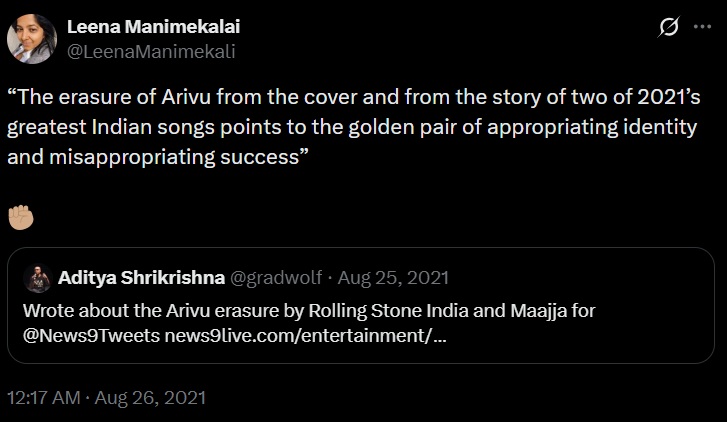 The ecosystem was fully operational.
There was one dissenting voice. Shan Vincent de Paul, whose cover appearance was being used as a prop in this outrage, came out and publicly criticised Pa Ranjith himself for “creating a rift between Tamil rappers” and fanning division rather than solidarity. He even released a response track addressing the manufactured conflict.
Regarding the cover : https://t.co/2QrRJGhPS3 pic.twitter.com/Zn0LZUQOIr
— SVDP (@shanvdp) August 26, 2021
His nuance was noted briefly and promptly buried. The narrative had momentum and nuance was not useful.
Under the pressure, Rolling Stone India issued a digital-only cover featuring Arivu.
View this post on Instagram
The left media apparatus then filed its long-form analyses, all pre-framing any future controversy:
The Wire/LiveWire: “What Arivu’s ‘Enjoy Enjaami’ Tells Us About the Cultural Resistance to Caste” – published even before any controversy, pre-loading the interpretive lens
Feminism in India: A full deconstruction framing the Tamil mainstream music industry as “Brahmanical and patriarchal”
Act II: Arivu Breaks Silence – And Claims Solo Authorship (July–August 2022)
For over a year, Arivu said nothing publicly. Then in July 2022, he posted on Instagram with a claim that went far beyond anything his collaborators had said: “I composed, wrote, sang and performed Enjoy Enjaami.”
Not co-wrote. Not collaborated on. Composed, wrote, sang and performed – framed as sole authorship of a song that had a credited music director and a credited lead vocalist from day one.
Santhosh Narayanan responded directly on 1 August 2022, confirming that the rights and revenues of Enjoy Enjaami were equally shared among all three artists, always had been, and that Arivu had received his share.
— Santhosh Narayanan (@Music_Santhosh) August 1, 2022
Dhee issued her own statement: “I have always credited Arivu”.
Two of the three collaborators, on the record, contradicted the sole-authorship framing. The factual matter was settled. The ideological narrative was not, because the ecosystem had already filed its pieces, and the corrections were not amplified with anything close to the energy of the original outrage.
The Swaddle piece published after Santhosh’s clarification, still framed the controversy as Arivu “claiming his credit” and resisting “mainstream erasure,” making no meaningful acknowledgement that his collaborators had publicly contradicted his characterisation.
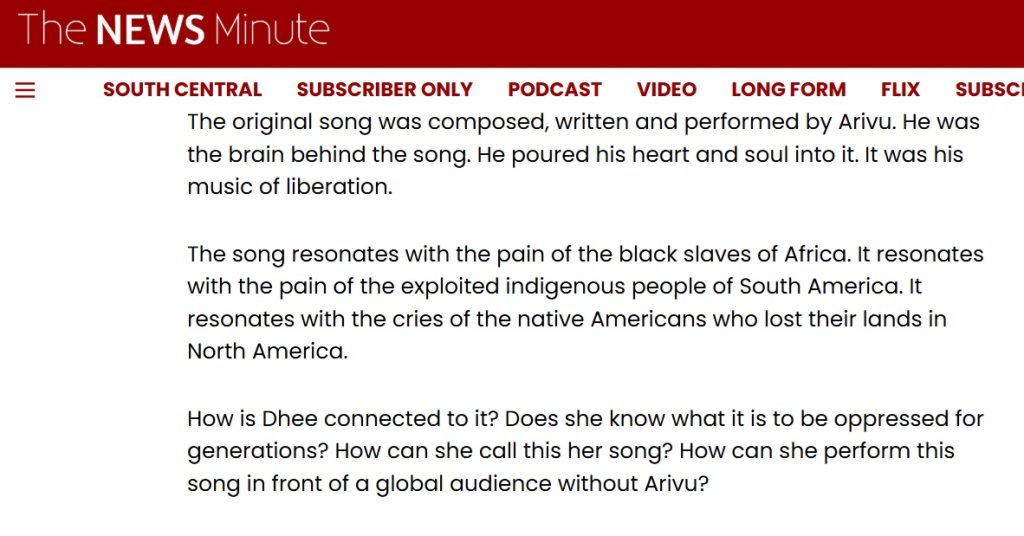
The News Minute also framed it as a caste issue. They made elaborate explainer videos like this one, got a Dalit activist to spew venom on ‘savarnas’ – the go-to punching bag for the Leftist-Dravidianist cabal.
The Targeting of Dhee and Santhosh For Their Brahmin Identity
The most revealing and ugliest dimension of the ecosystem’s campaign was what it did to Arivu’s collaborators. Dhee, whose voice is on every second of the song, was subjected to a sustained ideological assault on the basis of her caste identity. A widely circulated Newslaundry-amplified quote from multimedia artist Rajesh Rajamani framed her participation in the song as an act of cultural extraction: “While Dhee might be a talented singer, as a Brahmin artist she is forced to borrow from Bahujan cultural history (the oppari tradition in particular) through Arivu in order to create something that is both rooted and contemporary”.
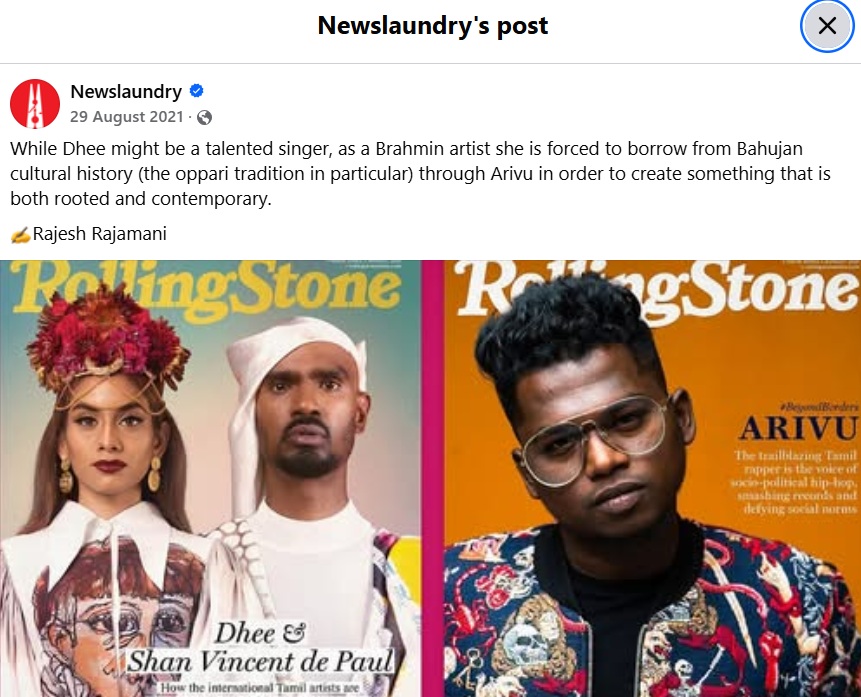
The implication was precise: a Brahmin woman had no legitimate claim to the song she co-created, co-performed, and was billed as lead artist on, because of her birth. The Indian Express published an opinion piece calling the song’s own music video an example of “Dalit music, art, and verse being encroached upon by the savarna gaze” – characterising Dhee’s jewellery choices in the video as evidence of “dominant-caste bridal aesthetics” imposing themselves on subaltern art.
The News Minute went further, publishing a piece by the same Dalit activist they platformed on their YouTube channel, that directly questioned whether Dhee had any right to the song at all: “How is Dhee connected to it? Does she know what it is to be oppressed for generations? How can she call this her song? How can she perform this song in front of a global audience without Arivu?”.
Santhosh Narayanan was not spared either: Feminism in India framed the entire Tamil mainstream music industry he represents as “Brahmanical and patriarchal”, pre-positioning him as a structural oppressor before any dispute had even occurred. When both Santhosh and Dhee issued measured, factual clarifications in August 2022, confirming equal credit and equal revenue shares, the ecosystem did not amplify it. Their statements served no useful purpose to the narrative. They were noted and discarded.
This is the Left’s classic divisive ‘Oppressor-Oppressed’ narrative mechanism at its most naked: the Brahmin collaborators who had put equal creative labour into the song were retroactively recast as cultural appropriators and oppressors. Their caste identity was weaponised to delegitimise their own authorship of their own work. Arivu’s caste identity was simultaneously used to monopolise authorship of a collaboration. The logic ran in only one direction, and it had nothing to do with the music.
Act III: The Royalties Dispute – Real Grievance, Selectively Weaponised (March 2024)
On 5 March 2024, the song’s third anniversary, Santhosh Narayanan revealed that all three artists had received “a whopping zero cents” from Maajja despite over a billion cumulative streams and alleged the label had hijacked his YouTube channel: “To date, all three artists, we received a whopping zero cents from this song. Unfortunately, we tried our best to reach out to the label.”
This was a legitimate, documented commercial grievance – equally shared by Santhosh, Dhee, and Arivu. The villain was the label. The victims were all three, together.
Maajja CEO Noel Kirithiraj responded with a now-infamous Instagram story calling the artists out for confusing “a legal agreement with a sugar daddy”. Santhosh called it sexual shaming. AR Rahman distanced from the label entirely. Maajja subsequently issued a formal counter-claim alleging there was “no consensus around contribution to the song among the artists involved” and that the artists had received advances.
The facts: a messy commercial dispute between three equal-share artists and a label with a toxic CEO.
The narrative that emerged in left commentary: a Dalit artist whose grandmother’s suffering powered a billion-stream song was being denied his dues by a corporate structure. Santhosh and Dhee’s identical grievance were background noise. Arivu’s became the story.
The Numbers That Nobody Talks About
Here is the question the left ecosystem has never asked: If Arivu is as singular a creative force as his supporters claim — capable of composing, writing, singing and performing a billion-stream song — why has nothing he has done independently come close?
The Spotify data answers it cleanly:
- Arivu’s total Spotify streams: ~685 million
Of those:
- As lead artist (his own projects): ~32 million
- Solo (truly independent): ~782,000
- As featured artist (on someone else’s song): ~600 million
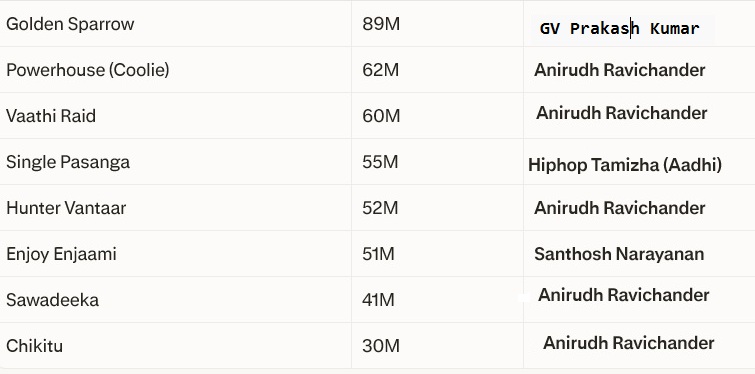
His independent/solo tracks — the ones where Arivu is purely in charge of his own creative output:
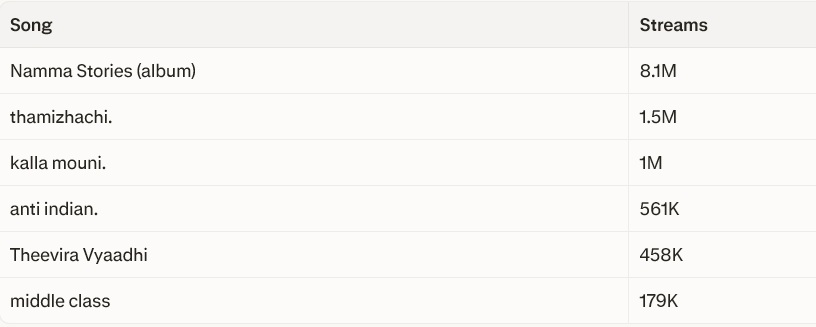
The pattern is there for all to see. Every song in Arivu’s catalogue with meaningful streams is a film song where a major composer – Anirudh Ravichander, Santhosh Narayanan, GV Prakash, brought him in as a featured vocalist/supporting vocal. His own independent albums and singles sit in the lower part of the table. His best-performing fully independent track has 8.1 million streams. Enjoy Enjaami, which he claims sole authorship of, has 51 million on Spotify alone.
Vaathi Raid (Master), Powerhouse (Coolie), Single Pasanga, Hunter Vantaar (Vettaiyan) – these are all Anirudh Ravichander compositions for Vijay blockbusters. They are hits because Anirudh wrote them, because Vijay starred in the films, because multi-crore marketing budgets pushed them globally. Arivu’s verses are a component. The machinery is someone else’s.
Enjoy Enjaami is a masterpiece. It is also the product of Santhosh Narayanan’s production, Dhee’s vocal presence, and a music label’s international distribution network. Strip those elements out and Arivu’s independent output, by the numbers, is a collection of low-stream releases that have never broken through on their own.
The Grievance as Career Infrastructure
The most revealing quote Arivu has given came in a Reuters/Yahoo Finance profile in 2023: “I became angry and wrote a song, but did that bring me justice? No.”
He is describing Enjoy Enjaami – the song that brought him international recognition, a Times Square billboard, collaborations with Anirudh Ravichander, AR Rahman, and Rajinikanth’s Coolie, and a platform to speak to global media about caste and justice. And he is framing it as having brought him no justice.
In the same profile, he describes a college incident where he says former friends told him: “We gave you too much significance; we should have kept you in your place”. Whether this happened or not, it has become part of the standard Arivu biographical apparatus – the caste humiliation story that precedes every interview, every profile, every cultural analysis.
The Swaddle quoted him in its piece maintaining that “every song of his has ‘the scarmark of this generational oppression'”.
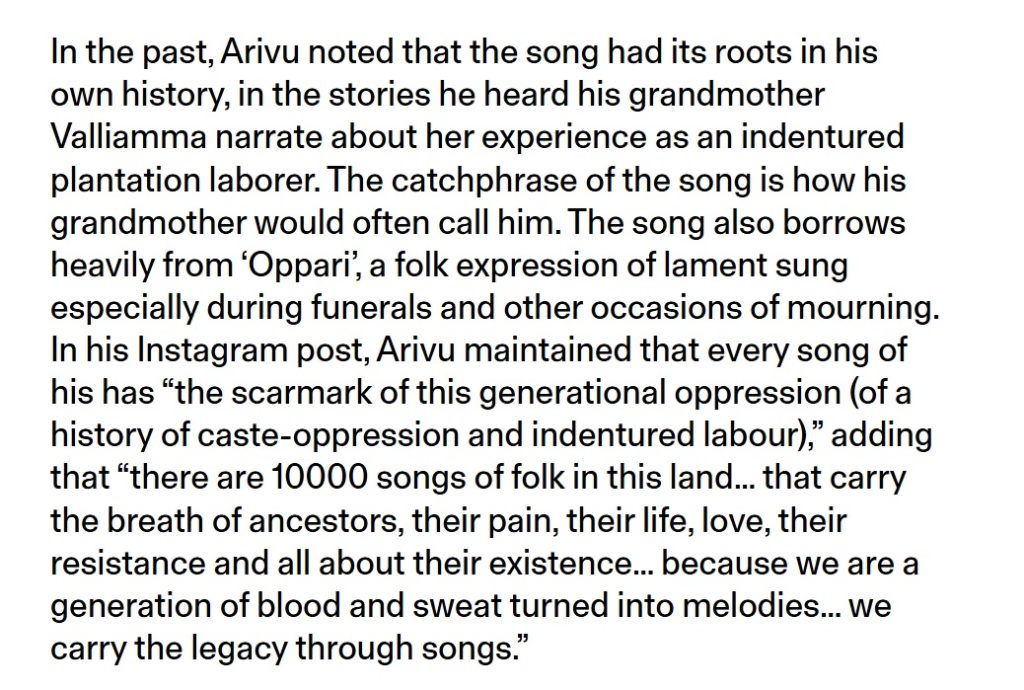
Not some songs. Not the political ones. Every song. Every chord, every lyric, every release – permanently marked by caste suffering. When every creative act is framed as an act of resistance against generational oppression, the creative act itself stops being evaluated on its own terms. To say the independent albums are underperforming is to minimise the oppression. To ask why Arivu’s solo career hasn’t produced another Enjoy Enjaami is to be complicit in erasure.
This is not accidental. It is a framework that immunises an artist from critical evaluation while keeping him perpetually in the news cycle. The Rolling Stone cover controversy (2021), the sole-authorship claim (2022), the royalties dispute (2024) – each episode, timed roughly 12–18 months apart, has reset the victim narrative and generated another round of left-media profiles, cultural analyses, and solidarity campaigns.
The Bottom Line
Enjoy Enjaami is real. The pain behind it is real. None of that is the argument.
The argument is this: a featured rapper on a collaborative single, produced by Santhosh Narayanan, fronted by Dhee, claimed sole authorship when it suited him, spent three years recycling the same grievances on the same anniversaries, and has not produced a single independent hit to justify the singular-genius narrative built around him. His collaborators contradicted him on record. The ecosystem ignored it.
Arivu had his agenda. The ecosystem also had an agenda and needed a mascot. They found one in each other.
Subscribe to our channels on WhatsApp, Telegram, Instagram and YouTube to get the best stories of the day delivered to you personally.