


Union Home Minister Amit Shah has set a target of March 2026 to achieve a Naxal-Free Bharat. In accordance with that, we see several surrenders, reformed ex-Maoists/Naxals, and more recently the neutralising of most wanted Naxal terrorist Hidma Madvi. But looking back at the UPA years, the situation is completely the opposite.
On 5 May 2010, India’s 28th Home Minister said at JNU – “We are ready for talks; we’re not asking you to lay down your arms. We understand you won’t do that because you believe in armed struggle.”
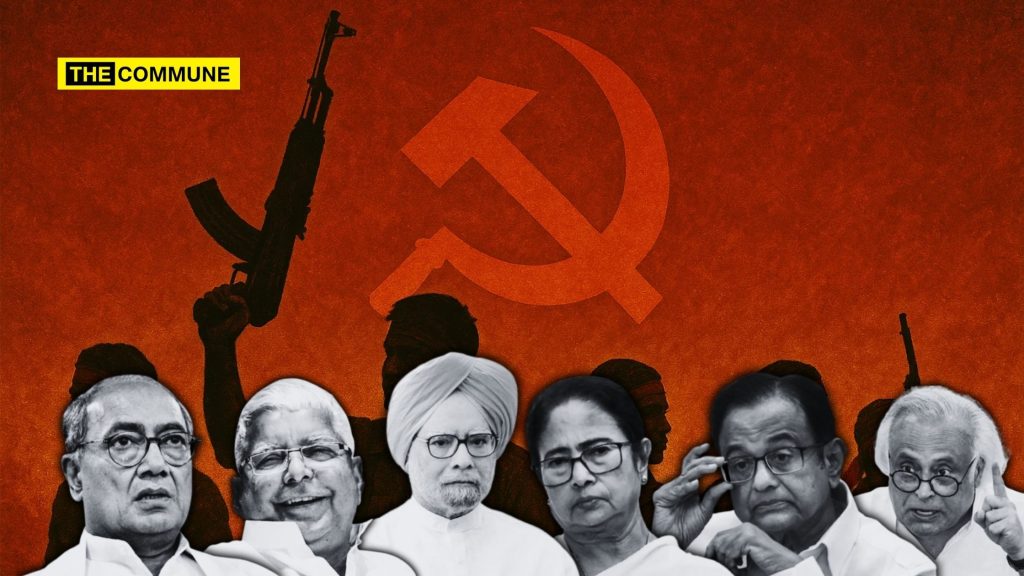
In this report, we take a look at 8 documented instances (2009-13) where UPA leaders appeared to defend or empathize with certain Maoist concerns, based strictly on credible news and public statements.
#1 AK Antony Rejects Army Deployment in Maoist Zones – Date: 28 October 2009
Defence Minister A.K. Antony dismissed Mamata Banerjee’s demand to deploy the Indian Army in Maoist-hit regions, asserting that armed forces must remain a “last resort” in internal security matters. Antony ruled out dialogue with Maoists unless they first renounced violence and reiterated that maintaining law and order was primarily a state responsibility. While calling Naxalism one of India’s biggest internal threats, he emphasised that developmental grievances could not justify armed rebellion.
#2 Manmohan Singh Says “Naxalites Are Our Own People” – 26 August 2010
Prime Minister Manmohan Singh reiterated the UPA government’s willingness to hold talks with Maoist groups, saying discussions could begin if they first abandoned violence. Referring to them as “our own people,” Singh stressed that the government remained committed to special development initiatives in Maoist-affected districts. His comments drew criticism for appearing overly conciliatory at a time when Maoist attacks were surging across central India, including high-profile ambushes targeting security forces.
#3 Home Minister P. Chidambaram Invites Maoists for Talks Without Laying Down Arms – 5 May 2010
At JNU, Home Minister P. Chidambaram declared the government was ready for dialogue with Maoists and acknowledged that they were unlikely to lay down arms immediately because of their belief in armed struggle. He challenged the ideological basis of violent revolution, asking for any global example where poverty or injustice was eliminated through violence.
#4 Mamata Banerjee Says Killing of Maoist Leader Azad “Not Right” – 9 August 2010
At a rally in Lalgarh, then a Maoist stronghold, Trinamool Congress chief Mamata Banerjee criticised the killing of Maoist spokesperson Cherukuri Rajkumar (Azad), calling it “not right” and demanding a probe. Her statement was widely interpreted as sympathetic to Maoist leadership and caused friction within the UPA. Critics accused her of legitimising extremist elements, even as West Bengal faced intense Maoist violence.
#5 Pranab Mukherjee Defends Mamata’s Statement on Azad – 29 August 2010
Finance Minister Pranab Mukherjee defended Mamata Banerjee after her remarks questioning the killing of Maoist leader Azad drew political backlash. Asked if her statement was inappropriate for a senior UPA figure, Mukherjee said, “I don’t think so,” adding that she had “every right to make independent statements.”
#6 Lalu Prasad Says Maoists “Don’t Target Common People” – 21 May 2010
RJD chief Lalu Prasad claimed Maoists do not attack ordinary civilians and only target those “spying” for police. He dismissed allegations that he supported Maoist violence and instead blamed Bihar Chief Minister Nitish Kumar for failing to control the insurgency. Lalu also questioned Chhattisgarh’s BJP government for its inability to curb Maoist activities.
#7 Digvijay Singh Calls Maoists “Misguided, Not Enemies” – 12 May 2010
Congress leader Digvijay Singh argued that Maoists should not be labelled as enemies or terrorists, describing them instead as “misguided ideologues.” While condemning their violent acts, he insisted that their motivations must be understood and addressed. He opposed any use of the Army or Air Force in anti-Maoist operations and maintained that Maoists could not be defeated militarily.
#8 Jairam Ramesh Links Tribal Displacement to Spread of Naxalism – 29 September 2013
Union Rural Development Minister Jairam Ramesh attributed the rise of Naxalism to mass tribal displacement caused by the colonial-era Land Acquisition Act of 1894, which lacked rehabilitation provisions. He argued that forced land acquisition for mining, irrigation and forest projects created fertile ground for Maoist recruitment. Ramesh noted that over 88 districts were heavily affected and emphasised the need for people-centric development policies.
Subscribe to our channels on WhatsApp, Telegram, Instagram and YouTube to get the best stories of the day delivered to you personally.