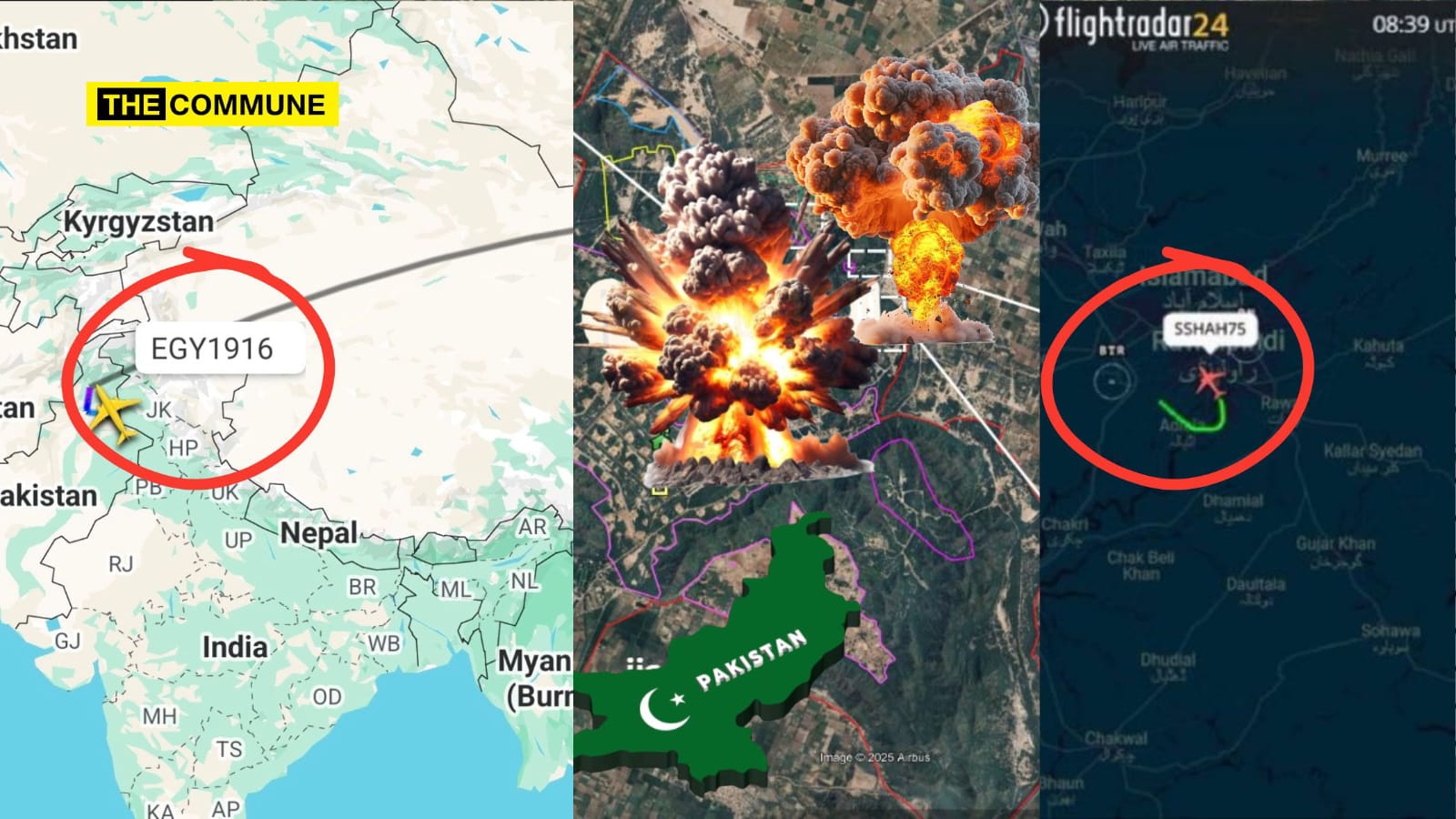
After days of missile strikes and drone assaults across the India-Pakistan border, India launched a powerful and unprecedented aerial retaliation—one that may have taken the escalating conflict to the doorstep of Pakistan’s nuclear command.
Military Briefing
According to top Indian military officials, it was Pakistan’s sustained missile barrage and attempted drone strikes on Indian cities that triggered the Indian response. In a press briefing on 11 May 2025, Air Marshal AK Bharti revealed that India had conducted “precise, measured and calibrated” air strikes targeting key Pakistani military infrastructure, including air bases, command centers, and air defense systems across the western front.
Among the targets reportedly hit were 11 Pakistani military bases—Nur Khan, Rafiqui, Sargodha, Bholari, Murid, Chunian, Pasrur, Sukkur, Sialkot, Skardu, and Jacobabad—within a three-hour window on the night of May 9 and the morning of May 10. Notably, Chaklala Air Base, located within Islamabad and adjacent to the Nur Khan Airbase, was also struck—an operation Indian officials have described as the “turning point.”
Government sources called the strikes “hell fire,” citing significant damage to Pakistan’s air power. According to estimates shared by Air Marshal Bharti, nearly 20% of Pakistan’s Air Force infrastructure was degraded.
The turning point was air strikes by India on 9th May and the morning of 10th May, it was a 'hell fire' by India. US Secretary of State Marco Rubio, after talking to Pakistan Chief of Army Staff, Asim Munir, called EAM Dr S Jaishankar and informed that Pakistan is ready to talk.… pic.twitter.com/qcJeA7LRCx
— ANI (@ANI) May 11, 2025
Ammunition depots were also targeted, and key Pakistani assets such as F-16s and JF-17 fighter jets were destroyed. Among the casualties was Squadron Leader Usman Yousuf of the Pakistan Air Force.
Nur Khan Airbase
But it’s the hit on Nur Khan Airbase in Rawalpindi that had stirred international concern. Located just kilometers from the Strategic Plans Division—the nerve center managing Pakistan’s nuclear arsenal—Nur Khan functions as a refueling and logistics hub. The proximity of Indian strikes to Pakistan’s nuclear command structure has triggered urgent diplomatic action, including U.S. intervention.
According to international news reports, the Trump administration received “alarming intelligence” suggesting possible escalation toward a nuclear confrontation. While initially dismissing the conflict as “none of our business,” U.S. Vice President JD Vance, Secretary of State Marco Rubio, and other top officials quickly reversed course. Diplomatic cables state that Rubio spoke with Pakistan Army Chief Asim Munir before urging India’s Foreign Minister S. Jaishankar to consider ceasefire terms.
Some things will always remain a mystery but what a fantastic show by our boys… pic.twitter.com/6IXLaoG7cz
— Mr Sinha (@MrSinha_) May 11, 2025
India insisted on direct DGMO-level talks only. The conversation reportedly took place on May 10 after Pakistan’s DGMO requested time following the strikes.
Presence Of Egyptian Cargo Plane?
Earlier in the day, a specialized U.S. Nuclear Emergency Support aircraft touched down in Pakistan, reportedly to conduct a reconnaissance mission over the Sargodha region—an area heavily bombarded by Indian airstrikes in recent days.
Has shit hit the fan in Bhikharistan? 🔥🔥🔥
Earlier today a US Nuclear Emergency Support Aircraft landed in Pak to do a recce of the Sargodha area which was smashed by India
Now a cargo plane from Egypt suspected to contain “Boron” is further fuelling questions about a… pic.twitter.com/oOZqaBegY1
— Sameer (@BesuraTaansane) May 11, 2025
Adding to the intrigue, an Egyptian Air Force IL-76 military cargo plane is said to have landed in Pakistan in the early hours following the strikes.
An Egypt Air Force cargo plane just arrived in Pakistan from China. pic.twitter.com/00oMolta6X
— Vijay Patel (@vijaygajera) May 11, 2025
Official sources have offered no clarification, but defense watchers noted the possible significance: Egypt’s Nile Delta is rich in Boron-10—a substance with known radiation absorption properties used in nuclear containment.
Egypt air plane also came today. Mostly carrying emergency shipment of boron. I googled to see if Egypt has boron. It does in abundance in the Nile delta. So here we go. Shit has happened.
PS: Boron is the element of choice for damping radioactive spills https://t.co/tpuarV5Jfe pic.twitter.com/wUIg49mKJy
— Ashtavakra Anshumat (@AnshumatVakra) May 11, 2025
Interestingly, External Affairs Minister S Jaishankar also received a call from his Egyptian counterpart around the same time.
Coincidence he talked to FM Egypt? I think NOT!!! https://t.co/br1lYZslwR pic.twitter.com/rtJnsoE2rm
— Ashtavakra Anshumat (@AnshumatVakra) May 11, 2025
The confluence of these events has fueled speculation: Did India’s strikes come dangerously close to Pakistan’s nuclear infrastructure—and if so, was that intentional?
While no official from either side has confirmed damage to nuclear assets, the fact that both the U.S. and Egypt have taken rapid, high-level actions suggests the world is treating the situation with grave seriousness.
(With inputs from NDTV)
Subscribe to our channels on Telegram, WhatsApp, and Instagram and get the best stories of the day delivered to you personally.