


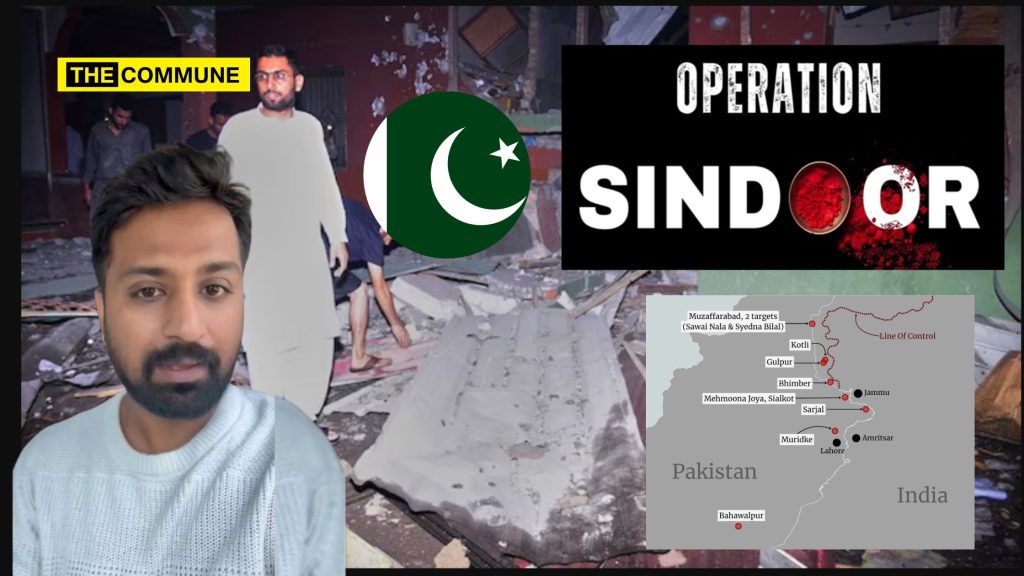
Film critic and alleged journalist Logesh Balachandran has come under intense public criticism and reportedly deactivated all his social media accounts after posting a controversial video in which he appeared to question India’s military response to the Pahalgam terror attack. The video, seen by many as hypocritical and insensitive, drew sharp rebuke from netizens, who accused him of sympathizing with terrorists and undermining national sentiment.
On 22 April 2025, a horrifying terror attack in Pahalgam, Jammu and Kashmir, specifically targeting Hindu tourists, claimed 26 innocent lives. This massacre deeply shook the nation and was widely seen as a turning point in India’s policy on cross-border terrorism. In response, the Indian government launched a strategic military retaliation—‘Operation Sindoor’—a precision strike against key terror training camps across Pakistan and Pakistan-occupied Kashmir (PoK).
Carried out at 1:44 AM on 7 May 2025, the coordinated strike involved the Army, Navy, and Air Force, targeting nine terrorist locations operated by banned groups Jaish-e-Mohammed (JeM), Lashkar-e-Taiba (LeT), and Hizbul Mujahideen (HM). These operations were conducted entirely from Indian territory and were described by the Defence Ministry as “focused, measured, and non-escalatory,” carefully avoiding direct engagement with Pakistani military assets.
The precision military strikes targeted nine key terror locations linked to Jaish-e-Mohammed, Lashkar-e-Taiba, and Hizbul Mujahideen, all conducted from Indian territory. The operation was a resounding success.
But amid this moment of justice, a handful of Pakistani sympathizers and terror apologists emerged—those who are conveniently silent when terrorists slaughter innocent Indians but suddenly find their voice when India hits back. Logesh Balachandran was one of them. His patronizing message about “life and war” felt less like a call for peace and more like a veiled attempt to guilt-trip a grieving nation. Netizens weren’t having it—and rightly so. His video was slammed for its shameless double standards, and the fierce backlash forced him to disable all his social media accounts.
Sympathizing with human life is one thing. But preaching morality while terrorists butcher innocents and justifying their cause as “life is life” is pure hypocrisy – a typical Dravidianist trait. Standing up for human lives should never mean defending those who are prepared to take them. Giving such dangerous narratives a platform is irresponsible and disgraceful.
Dravidianist Speaks
In his now-deleted Instagram video, Logesh criticized the public for celebrating the military strike, saying, “What are you celebrating? What is there to celebrate? It was a terror attack, and the people in power have made a decision to seek revenge. That’s okay, but why are you celebrating? There is nothing to be proud of. We lost lives in Kashmir, and now they are seeking revenge, which will inevitably cost many more lives. Obviously, it’s a war. There are many innocent lives at stake. Is life only valuable if you die here, and not if you die there? No matter which country you go to, life is still life, right? We have our children and our families, and they have their loved ones, too. What did our parents teach us when we faced a problem? What would our parents say if someone attacked us? Would they tell us to go and destroy their family? No, right? Revenge is not a solution; war is not a solution. How can you all casually celebrate this? At least leave it to those in power. They will see it; just leave it to them. People are struggling to meet their daily needs; war is not the solution. Understand that only when our family is attacked is it considered an attack. Blood is blood, no matter who gets hurt. I don’t understand when you will realize that the world is one. I cannot tolerate the atrocities of celebrities who irresponsibly and insensitively say, ‘The mission is not completed; the mission will continue.’ What is all this? What are we going to do if the mission continues? Stop there! We have taken revenge for one attack. In this world, all are one.”
இந்த மாதிரி குரல்கள் தமிழ்நாட்டுல இருந்து மட்டுமே வரும் .. ஏன்னா இது பெரியார் மண் …
ஜோம்பிஸ்க்கும் சங்கிகளுக்கும் ஜனநாயகம்னா எவ்ளோ விலைனு கேப்பானுங்க pic.twitter.com/v4HNEjJ1i1— 🅿️🅰️🅱️L🅾️ 🫶🫶 (@pablo_twtz) May 7, 2025
Many viewed his remarks as tone-deaf and poorly timed, especially coming in the wake of a national tragedy. While Logesh framed his comments as a plea for peace and universal humanity, critics argued that equating the Indian military’s response to terrorism with acts of aggression blurred the moral lines between aggressor and defender. His statement was also criticized for indirectly suggesting moral equivalence between civilian victims and terrorists sheltered across the border.
Following intense backlash on social media, with many calling him a “terror sympathizer” and “disconnected from ground reality,” Logesh removed his video and deleted his social media accounts. Netizens accused him of misplaced empathy and hypocrisy, pointing out that such moral sermons were conspicuously absent when Indian civilians were slaughtered in terror attacks.
While the Indian government and opposition parties largely stood united in supporting Operation Sindoor, voices like Logesh’s have sparked a debate on the line between peace advocacy and national solidarity in times of crisis.
Subscribe to our channels on Telegram, WhatsApp, and Instagram and get the best stories of the day delivered to you personally.