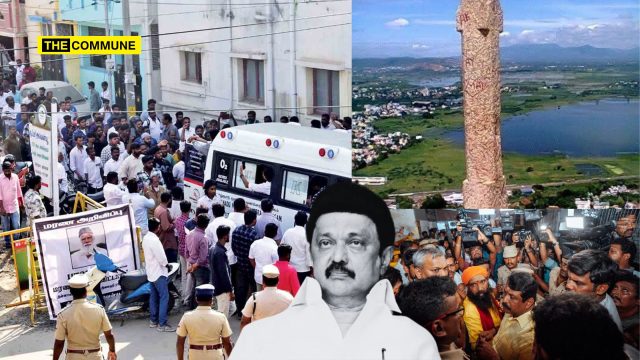
Just this past week, the state of affairs in Tamil Nadu was discussed in national news – the DMK government refused to permit devout Hindus from lighting the Karthigai Deepam at the Deepathoon on Thirupparankundram Hill near Madurai.
The development sparked widespread debate, especially when placed alongside visuals from November showing thousands participating in the funeral procession of SA Basha, a key convict in the 1998 Coimbatore serial blasts. Critics have accused the State of applying inconsistent standards to public gatherings.
Deepam Blocked Despite Court Order
A Madras High Court division bench had permitted the Karthigai Deepam to be lit at the Deepathoon, a stone formation documented in earlier government publications and historically associated with Deepam lighting. The bench explicitly dismissed the State’s claim that allowing the lamp could trigger communal tension, holding that lawful religious practice cannot be restricted on vague apprehensions.
However, on the day of the festival, police erected barricades, issued last-minute restrictions, and prevented devotees including the petitioners who secured the order from reaching the spot. HR&CE officials argued in court that the pillar was merely a “survey stone,” contradicting archival descriptions from the department itself.
The government moved an urgent appeal but continued to enforce restrictions even after the bench’s directive. This resulted in the Deepam remaining unlit at the sanctioned location.
Despite a second order asking for the Karthigai Deepam to be lit the next evening, the government refused to permit devotees on to the hill.
Contrast With Funeral of Terror Bomb Blast Convict
Just a year earlier, Tamil Nadu witnessed an entirely different administrative posture during the funeral of SA Basha, convicted for the 1998 Coimbatore blasts that killed 58 and injured hundreds. After his death in a Kerala prison, his body was brought to Coimbatore, where large crowds, long processions and coordinated mobilisation by Islamist organisations were seen.
Police presence focused on traffic and crowd management. No restrictions were placed on the scale of the gathering, and the State issued no public advisory discouraging the large procession for a convicted terrorist.
While no political party demanded a ban on funeral rites, the permissive environment surrounding the event drew questions once the Thirupparankundram restrictions surfaced.
Critics have argued that the State adopted a lenient approach to a mass mobilisation for a terror convict while taking a prohibitive approach toward a court-permitted Hindu festival practice – that would not have harmed anyone.
Subscribe to our channels on WhatsApp, Telegram, Instagram and YouTube to get the best stories of the day delivered to you personally.