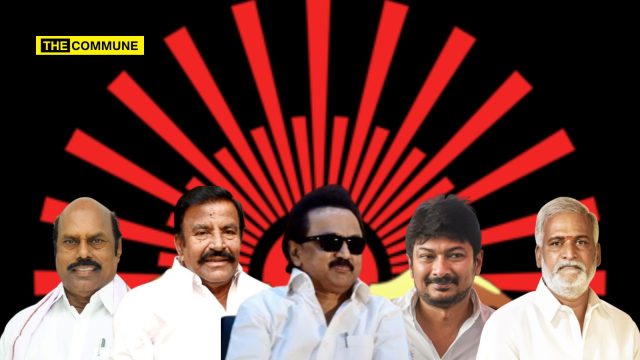
When the DMK talks about the “Dravidian model”, it frames itself as the defender of Tamil identity and social justice. But a closer look at the party’s 2026 Assembly candidate list tells a more complicated story: Those with Telugu‑origin enjoy seat shares far above their population, while several native Tamil communities have no representation at all.
This is not about language chauvinism. It is about whether a party that claims to speak for “all Tamils” is quietly privileging a small, non‑Tamil elite at the expense of many Tamil communities that rarely find a voice in the legislature.
How Many Non‑Tamil Candidates Has DMK+ fielded?
Based on caste–wise breakdowns of the DMK alliance list circulating among analysts (cross‑checked across multiple documents), the 188 general‑category candidates fielded by DMK+ in 2026 include the following non‑Tamil groups:
Kannada‑origin (7)
- Baduga – 2
- Vokkaliga – 4
- Devanga Chettiyar – 1
Telugu‑origin (29)
- Kamma Naidu – 11
- Balija / Gavara – 7
- Reddy – 5
- Arunthathiyar (SC, Telugu‑origin) – 6
Malayali (1)
- Nair – 1
That is 37 non‑Tamil‑origin candidates out of 234 total Assembly seats – about 15–16% of the House, if they all win.
— tamilvote4tamilsonly (@Dheerangounder1) April 9, 2026
Telugu candidates pic.twitter.com/9rIM431Cuk
— tamilvote4tamilsonly (@Dheerangounder1) April 9, 2026
By contrast, several long‑settled Tamil communities show zero representation in the same DMK+ list: Udayar, Vannar, Navithar (barbers), Kuyavar (potters), Asari (metal‑workers), Vettuvar, Oorali and Paravar all have no MLA in the alliance slate. Brahmins are at zero as well, but that vacuum is not being filled by overlooked Tamil OBC/BC groups – it is disproportionately filled by Telugu‑origin Naidus and allied castes.
Source pic.twitter.com/k5ChZxSkvA
— tamilvote4tamilsonly (@Dheerangounder1) April 9, 2026
What Does Census Say About Telugu Speakers In Tamil Nadu?
The 2011 Census Language Atlas provides the clearest hard number:
- Telugu mother‑tongue speakers in Tamil Nadu – 4.23 million (≈5.9%).
- Tamil speakers – about 88.35% of the state.
- Other languages (Kannada, Malayalam, Urdu, etc.) are all in the low single digits.
Only 6% of Tamil Nadu speak Telugu as their mother tongue according to official 2011 census.
My guess is post 2026 census will reflect a slight decrease. https://t.co/l0HVTYkyjR pic.twitter.com/sACmypHrRt
— AgentSaffron ANTI WAR OPEN HORMUZ STRAIT (@AgentSaffron) April 25, 2025
A district‑wise map of Telugu speakers (again based on 2011 data) shows:
- No district in TN has a Telugu‑majority population.
- A few western and northern districts – Krishnagiri, Tiruvallur, Coimbatore, Salem have taluks where Telugu speakers reach 15–25%.
Map of Telugu speakers in Tamil Nadu, as per 2011 census, most are concentrated in Northern districs and Kongu. Coimbatore, Krishnagiri, Tiruvannamalai, Vellore, Kancheepuram have a good chunk of Telugus. I guess most Telugus in Krishnagiri dt, would be in Hosur. pic.twitter.com/C8g9SLUDZz
— Lone Wolf Ratnakar (@SadaaShree) February 27, 2023
Even if you consider Hosur which is close to Karnataka, it is the Tamils who are in majority.
Build up that hosur has majority telugu is not true.tamils are the majority in all 234 constituencies pic.twitter.com/etuYVNnT7g
— tamilvote4tamilsonly (@Dheerangounder1) April 9, 2026
So, even allowing for some under‑reporting (Telugu‑origin families ticking “Tamil” in the census), a reasonable upper bound for Telugu‑origin people in Tamil Nadu is still under 10% of the population.
Importantly, a large part of the Telugu‑speaking population in western TN comes from Dalit sub‑groups like Arunthathiyars. An analysis of SC sub‑group data from the 2011 Census shows sizeable Arunthathiyar populations in Coimbatore (3.2 lakh), Tiruppur (2.4 lakh), Erode (2.3 lakh), Namakkal (1.85 lakh), Salem (1.75 lakh), Dindigul (1.36 lakh) and Karur (0.74 lakh).
60% Telugus in western district
Arunthathiyar Population (District-wise)
Coimbatore → 3,19,581
Tiruppur → 2,43,274
Erode → 2,32,744
Namakkal → 1,85,083
Salem → 1,75,035
Dindigul → 1,36,894
Karur → 73,905
Due to them telugu Nos more in western TN than Chennai .. https://t.co/ugE1qtFZoA pic.twitter.com/AULZujL0F7— Vellalan_Paramasivam_Gounder (@VellalarWorld) April 10, 2026
These communities are not the same as the land‑owning Kamma, Balija or Reddy Naidus who dominate the general‑seat lists.
They are not a majority in any of the 234 constituencies.They get 4 times the seats compared to their miniscule population.Tamilnadu is being fooled pic.twitter.com/6k9vSh5CMM
— tamilvote4tamilsonly (@Dheerangounder1) April 9, 2026
Seat Share Vs Population Share: Are Telugu Over‑Represented?
Older caste‑wise census data (1921) give approximate population shares for some Telugu‑origin castes in the old Madras region.
— tamilvote4tamilsonly (@Dheerangounder1) April 9, 2026
These are not current official numbers, but they are widely cited in historical work on South Indian caste demography. Used cautiously, they give a sense of scale.
Against that backdrop:
Kamma Naidu – 11 seats in the DMK alliance list, which is ≈4.7% of the Assembly (11/234). That is around four times their 1921 population share.
Balija / Gavara – 7 seats, plus several Balija‑background candidates labelled generically as “Naidu”, which almost certainly pushes their representation above their likely 2–2.5% share.
Reddy – 5 seats, again around 4× what a 1–1.2% group would receive under strict proportionality.
Add them together:
Kamma + Balija/Gavara + Reddy + Arunthathiyar ⇒ 29 Telugu‑origin seats.
That is ~12–13% of the Assembly for castes collectively rooted in a language group (Telugu) that constitutes roughly 6% of the state population by mother‑tongue.
— tamilvote4tamilsonly (@Dheerangounder1) April 9, 2026
Even if we assume that Telugu‑origin people are under‑counted in the census because many now identify as Tamil, the direction of the skew is clear: Telugu‑origin elites, especially Naidus, are significantly over‑represented in DMK’s 2026 ticket relative to their demographic weight.
Native Tamil Communities with Little or No Voice
Just as striking as who is over‑represented is who is absent. It is noteworthy that multiple native Tamil communities receive no seats at all in the DMK alliance list:
- Udayar
- Vannar
- Navithar
- Kuyavar
- Asari
- Vettuvar
- Oorali
- Paravar
These are not microscopic groups; they are historically rooted occupational communities visible across rural and peri‑urban Tamil Nadu.
Political parties need to understand that tamils are not at all believing that telugus have become tamils as we see from their behaviour outside and in social media that they are telugus by heart we condemn political parties who give over representation for telugu ignoring tamils pic.twitter.com/LOHzrCCDoA
— tamilvote4tamilsonly (@Dheerangounder1) April 9, 2026
Yet they do not appear even once in the alliance’s candidate slate, while three Telugu‑origin elite castes share nearly thirty seats between them.
This is the heart of the representational critique: in a state where Tamil speakers form nearly 90% of the population, and where entire Tamil communities have no MLAs at all, the ruling Dravidian party has chosen to give double or quadruple proportional representation to select non‑Tamil elites.
Asymmetry With Neighbouring States In Southern India
The pattern looks even more unusual when seen in a regional context.
According to available legislative profiles and media reports:
- Tamil‑origin MLAs in Kerala – 1 (Devikulam)
- Tamil‑origin MLAs in Karnataka – 0.
- Tamil‑origin MLAs in Andhra Pradesh – 0.
- Tamil‑origin MLAs in Telangana – 0.
This, despite sizeable Tamil populations in border districts of Andhra and Karnataka and in cities like Bengaluru.
Despite significant tamil population in border areas of andhra, no single tamil person given mla seat in andra but our politicians are giving 29 seats to telugus.
We tamils are fools or made fools pic.twitter.com/eVJzln6X3C— tamilvote4tamilsonly (@Dheerangounder1) April 9, 2026
Yet in Tamil Nadu, non‑Tamil‑origin MLAs from Telugu, Kannada and Malayali backgrounds could number well over 30 if the DMK alliance returns to power, purely on the basis of 2026 tickets.
No one is arguing that representation must be reciprocal across states, but the asymmetry is stark: Tamil Nadu’s Dravidian party is far more generous to non‑Tamil elites than neighbouring states are to Tamils.
Is This The “Dravidian model”?
None of this data proves that individuals from Telugu or Kannada backgrounds are unfit to represent Tamil constituencies. People migrate, assimilate and identify in complex ways. Many Naidu families have lived in Tamil Nadu for generations.
The question is different: who, in practice, benefits from the Dravidian model’s promise of representation and social justice?
If Telugu‑origin Naidu elites Kamma, Balija, Reddy receive disproportionate access to safe seats and cabinet berths,
While entire Tamil communities such as Udayar, Vannar, Asari, Paravar and others have no MLAs at all,
And if Tamil minorities in neighbouring states receive little to no legislative representation, then the DMK’s ticket distribution begins to look less like a neutral social‑justice project and more like a political bargain that favours specific non‑Tamil elites within Tamil Nadu.
Telugu speakers are about 6% of Tamil Nadu by the 2011 Census, yet the DMK alliance has allocated roughly 12–13% of Assembly seats in 2026 to Telugu‑origin castes, about double their language‑group population share and roughly four times the historic share of some Naidu sub‑castes, while many native Tamil communities have no representation at all.
For a party that has built its legitimacy on Tamil pride and egalitarianism, that imbalance is not a minor detail. It goes to the core of what the “Dravidian model” really prioritises and whom it quietly leaves out.
Subscribe to our channels on WhatsApp, Telegram, Instagram and YouTube to get the best stories of the day delivered to you personally.