


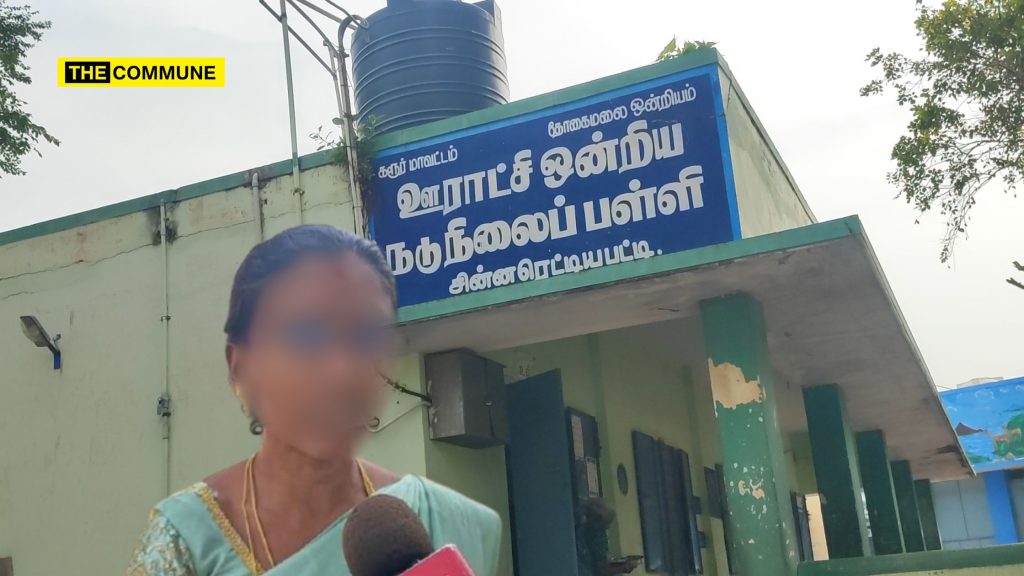
A case of alleged caste-based discrimination has surfaced from Karur district, where a Dalit woman employed under the Tamil Nadu government’s breakfast scheme was reportedly barred from cooking at a government school after objections from a section of parents belonging to dominant castes. The incident has reignited concerns over the persistence of caste-based exclusion despite decades of DMK’s Dravidian model governance that they claim to be based on ‘social justice’.
The affected worker, Nirosha (35), a resident of Ponnampatti village and a member of the Arunthathiyar community, had been working as a cooking assistant under the Chief Minister’s Breakfast Scheme at the Chinnareddiyapatti Panchayat Union Middle School, near Thogaimalai, for the past four months.
Speaking to reporters, Nirosha alleged that on Tuesday, 16 December 2025, the school’s headmistress, Bhanumathi, summoned her and told her not to return for cooking duties. According to Nirosha, the headmistress said that if she continued cooking, students from dominant caste families would refuse to eat the food. The following morning, Nirosha found another woman engaged in cooking in her place.
When she approached the Thogaimalai Block Development Office and contacted Sathya, the Block Women’s Welfare Scheme Manager, she was allegedly informed that a replacement had already been appointed and that she should not report for duty. Nirosha further claimed that when she went to meet the official in person, she was made to wait at the office the entire day and sent back without being heard.
Following this, Nirosha lodged formal complaints with the Karur District Collector, the Superintendent of Police, and the Thogaimalai Police Station, alleging caste discrimination, abuse of authority, and denial of livelihood.
The incident prompted a field inquiry by a media team, which interacted with all concerned parties.
“This is not just about me,” Nirosha said. “Many women like me have suffered similar caste-based humiliation. I decided to complain so that this does not continue for future generations. Even today, those in authority indulge in caste oppression. Educated government officials behaving this way is unacceptable.”
She added that even if some parents held caste prejudice, it was the responsibility of teachers, who educate children daily to counsel parents and students against discrimination, rather than removing her from work. “Instead of teaching equality, they told me not to cook and pushed me out,” she said.
Nirosha alleged that the headmistress misused her authority and that the block-level women’s welfare official acted in collusion. Although she has now been asked to rejoin work following her complaint, she insists that disciplinary action must be taken against those responsible. “Only then will such incidents stop,” she said.
பட்டியலின பெண் என்பதால் பள்ளியில் சமைக்க கூடாதா? அரசு அதிகாரியே இதை சொல்லலாமா… மனம் நொந்து பேசிய சத்துணவு பணியாளர்…!#Karur #GovtSchool #sathunavu #TNGovt #ViralVideo #TamilNews #NewsTamil #NewsTamil24x7 pic.twitter.com/kSQXoOd81u
— News Tamil 24×7 (@NewsTamilTV24x7) December 21, 2025
The headmistress, Bhanumathi, declined to comment on the matter.
The Karur District Education Officer, when approached, said that an inquiry had been conducted with the headmistress and that a report would be submitted to the Chief Educational Officer and the District Collector.
The incident has drawn comparisons to earlier caste-based controversies linked to the same scheme in Karur district. Shortly after the breakfast scheme was launched, objections were raised in Velanchettiyur Panchayat Union Primary School, near Aravakurichi, against a Dalit woman cooking meals. At that time, then District Collector Prabhu Shankar personally visited the school, ate the food prepared by the Dalit worker, and warned villagers against caste discrimination.
Despite Tamil Nadu being touted by the Dravidianists as a leading state in social welfare and education, activists point out that incidents such as the Vengaivayal drinking water contamination, the Nanguneri caste-based murder attempt on a student, the forced humiliation of a Dalit government official by a DMK councillor in Tindivanam, and the hand amputation of a Dalit youth in Sivaganga for riding a Bullet motorcycle show that caste violence remains deeply entrenched.
Source: ETVBharat
Subscribe to our channels on WhatsApp, Telegram, Instagram and YouTube to get the best stories of the day delivered to you personally.