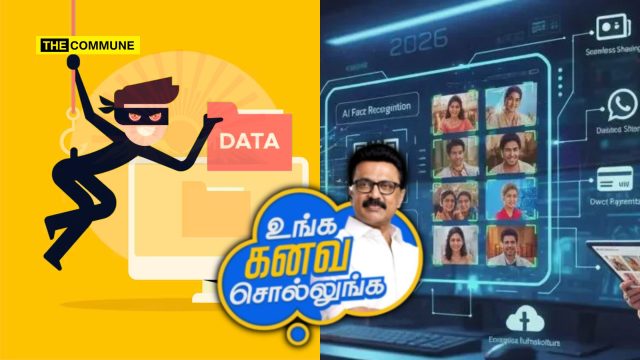
On 17 March 2026, AIADMK MP C. Ve. Shanmugam (CVS) sparked a controversy by mocking CM MK Stalin’s flagship survey scheme – “Unga Kanava Sollunga” (Tell Your Dream) saying at a public event, “I want Nayanthara, will you fulfil?” The remark drew widespread condemnation for being sexist. The backlash consumed Tamil Nadu’s media cycle entirely on March 17–18.
But on 18 March 2026, recently affected by DMK’s cyber goons, Dravidian Stockist ‘writer’ Meena Kandasamy posted a detailed thread arguing that the CVS controversy, while condemnable, had completely eclipsed a far more serious issue: that the Ungal Kanavu Sollunga (UKS) scheme is one of the largest data privacy violations ever carried out by an Indian state government. The following morning, digital rights and fintech policy researcher Srikanth Lakshmanan who had flagged this same issue when the scheme was first announced in January, published a thread demonstrating this was not an isolated lapse but the culmination of a four-year pattern of DMK data extraction and surveillance of Tamil Nadu’s population.
What Is the ‘Unga Kanava Sollunga’ Scheme?
Launched by CM Stalin on 9 January 2026 at Ponneri, Tiruvallur, the scheme was presented as a welfare outreach programme to assess government scheme effectiveness and collect citizens’ “dreams” for future policy. The operational structure:
- 1.91 crore households covered across Tamil Nadu
- 55,000–73,336 SHG (Self Help Group) members deployed as field surveyors — private citizens, not government employees
- Each surveyor visited 30 households per day, collected filled forms, and uploaded data via a dedicated mobile app developed by Tamil Nadu e-Governance Agency (TNeGA)
- Each family received a unique Dream Card with a tracking ID
- Survey ran from January 9 to February 10, 2026
- Total taxpayer cost: ₹43.52 crore, of which ₹21 crore was allocated to Tamil Nadu Corporation for Development of Women (TNCDW)
What Data Was Collected?
The four-page survey form demanded:
- Ration card number, district, taluk, residential address, mobile number
- Caste category – SC, ST, MBC, DNC, BC, OC
- Name, age, gender, educational qualification and occupation of every family member
- Which of 65 government welfare schemes the household benefits from
- Feedback on scheme delivery effectiveness
- The family’s top 3 personal aspirations
Now that the Unga Kanava Sollunga scheme is in the spotlight for all the wrong reasons, I want to highlight something which went completely under the radar. And before trolls jump in, yes I do think CVS statements were problematic and condemnable.
I personally think that what… pic.twitter.com/JTES5rsCCw
— Dr Meena Kandasamy மீனா கந்தசாமி (@meenakandasamy) March 18, 2026
The Core Allegation: Mass Pre-Election Data Extraction
The substantive allegation, stated by both Meena Kandasamy and Srikanth Lakshmanan — is not merely about data privacy in the abstract. It is specific: ₹43.52 crore of public money was used to build a granular voter profiling database of 1.91 crore Tamil Nadu families, using private SHG volunteers with no statutory data protection obligation, timed precisely to the pre-election mobilisation window ahead of the 2026 Tamil Nadu Assembly election.
As Srikanth Lakshmanan put it in January 2026, when the scheme was announced: “Household surveys in AP, TS were common. Also had data malpractices of leaking this data to the ruling party. What was also common was incumbent govt was never re-elected. (Naidu, Jagan, BRS). So ₹43 Crore of taxpayer money to leak data to IT Cell?”
Household surveys in AP, TS were common. Also had data malpractices of leaking this data to the ruling party.
What was also common was incumbent govt was never re-elected. (Naidu, Jagan, BRS).
So ₹43 Crore of taxpayer money to leak data to IT Cell? #DataSanghi #DravidianModel https://t.co/G9EFfnombT
— Srikanth.CashlessConsumer | ஸ்ரீகாந்த் (@logic) January 1, 2026
The specific structural risk: 55,000 private individuals now hold, on their phones, via the UKS app, the caste identity, ration card numbers, mobile numbers, welfare dependency status, and personal aspirations of nearly 2 crore Tamil Nadu families, with no law governing what they can do with that data after the survey concluded.
Srikanth Lakshmanan’s Thread Exposes A Four-Year Pattern of DMK Data Abuse
What makes the X thread especially significant is that it does not treat UKS as an isolated incident. It documents a systematic and escalating pattern of data extraction under the DMK government since 2021, which the UKS survey is merely the latest and largest expression of. Here is the full documented timeline he presents:
1. June 2021 – The TNPDS Hack: Zero Accountability
The Tamil Nadu Public Distribution System (TNPDS) database was hacked and defaced. The hacker had access for 15 full days, during which he exfiltrated personal data: UID, ration card number, mobile number at 36 paise per record. The state government issued zero response and no audit was ordered.
TN PDS defaced (and data breached?) https://t.co/QPY7P2CJbs
– @nanduhari of @Technisanct https://t.co/0t1oFeFX1h
— Srikanth.CashlessConsumer | ஸ்ரீகாந்த் (@logic) June 30, 2021
2. August 2021 – Budget Rewards More Data Collection Despite Hack
Rather than funding cybersecurity following the TNPDS hack, the DMK’s first budget increased funding to the State Farmer Database (SFDB) and DeTN (Digital Tamil Nadu); the same surveillance architecture under the guise of “data-driven welfare delivery.” The TNPDS hack was not mentioned once in the budget.
Because @AdmkFails spent ₹31.69 Crores in 2020-21 and @CMOTamilnadu will be spending ₹15.81 Crores, #TNPDSHack will not be spoken about as we will continue to fund surveillance via #SFDB. #TNBudget2021 pic.twitter.com/djMgxm2PXH
— Srikanth.CashlessConsumer | ஸ்ரீகாந்த் (@logic) August 14, 2021
3. 2021 Onwards – SFDB: The ‘State Farmer Database’ as Mass Surveillance Spine
The SFDB is identified by Srikanth as the core surveillance infrastructure that UKS is built upon. He flags that it has been used to collect 360-degree citizen profiles, and that its household data was shared with JPAL (Abdul Latif Jameel Poverty Action Lab) researchers with Tamil Nadu’s population, in his words, being treated as “rats” for Nobel-linked research experimentation, without adequate public consent or data governance.
The Unga Kanavu Sollunga aka #SFDB ‘household re-survey’ that @meenakandasamy highlighted in original thread – has a long history of handing over granular data of TN population for experimentation by ‘Nobel’ researchers. TN population is not rats!
— Srikanth.CashlessConsumer | ஸ்ரீகாந்த் (@logic) March 19, 2026
4. November 2022 – TANGEDCO Aadhaar Linking: Unconstitutional GO, Then Data Loss
The DMK government issued a GO mandating Aadhaar linking to electricity meters which Srikanth calls “grossly unconstitutional.” The implementation was so incompetent that citizens who completed the mandatory linking in December 2022 were asked to do it again in January 2023 because TANGEDCO had lost the data.
The Nov 2022 to link electricity is grossly unconstitutional. “GO”. The implementation of the linking was another joke – where people who were forced to link in Dec 2022, were asked to link again, because TANGEDCO ‘lost’ the data. https://t.co/wjdiakaNGC
— Srikanth.CashlessConsumer | ஸ்ரீகாந்த் (@logic) March 19, 2026
5. 2022-2023 – Tamil Nadu Becomes India’s Most Aggressive Aadhaar-Linking State
Through a systematic survey of gazette notifications, Srikanth documented that Tamil Nadu under DMK became more aggressive than any other state in mandatory Aadhaar linking to welfare schemes, education records, electricity, and more. He coined the term #DataSanghi for what he describes as the DMK being “more regressive on data than the BJP central government” while performing progressiveness in its anti-BJP rhetoric.
2022 – TN (specially progressives) were kept busy with #JaiBhim – but state – did everything anti-social justice when it came to data.#Aadhaar linking this, that, everything. TN infact was first state to mandatory link electricity meter to Aadhaar. #SFDB https://t.co/b4q2HuWtqO
— Srikanth.CashlessConsumer | ஸ்ரீகாந்த் (@logic) March 19, 2026
6. May 2024 – Tamil Nadu Police Data Breach: 800,000+ Records Exposed
A breach by a hacker named “Valerie” exposed over 800,000 Tamil Nadu police records -FIRs, police officer IDs, 54,000+ officer photographs, home addresses. Srikanth wrote to IT Minister PTR Palanivel Thiagarajan demanding an independent audit. Again: zero response.
The breach that changed everything. 800,000+ records exposed by “Valerie” — FIRs, police IDs, 54,000+ officer photos, addresses.https://t.co/OVjslzeLFC
Police is anyway above law, so no audits. Jokers.
— Srikanth.CashlessConsumer | ஸ்ரீகாந்த் (@logic) March 19, 2026
7. 2024 – Telangana Model Warning Ignored
Srikanth had explicitly warned IT Minister PTR Madurai in February 2024 that Telangana’s similar “360-degree beneficiary database” model had collapsed with fraudsters exploiting it to siphon money from PM-KISAN and Rythu Bandhu schemes. He urged Tamil Nadu to shut SFDB and conduct a third-party audit. No action was taken.
Dear @ptrmadurai – This is #Telangana Model falling apart. 360 databases for beneficiary has been exploited by fraudsters at scale, in both #PMKISAN and #RythuBandhu.
Please shut #SFDB and order for 3rd party audit of data quality pic.twitter.com/iYUaDxbltd https://t.co/Xn0RMHMHHc
— Srikanth.CashlessConsumer | ஸ்ரீகாந்த் (@logic) February 16, 2024
8. September 2025 – Chennai One App Tender Fraud
Srikanth filed a detailed request for an independent audit of the Chennai One app implementation by CUMTA (Chennai Unified Metropolitan Transport Authority), alleging tender fraud in vendor selection. No response from TNeGA or the IT Ministry.
Tender fraud on @Chennai_One – No response.https://t.co/m7ZcneY3Gl
— Srikanth.CashlessConsumer | ஸ்ரீகாந்த் (@logic) March 19, 2026
9. October 2025 – Zoho/CM Cell Tender Violation
Zoho was found to be hosting the Tamil Nadu government’s CM Helpline content management system in violation of tender requirements – a matter reported by Medianama. Srikanth flagged this as another instance of TNeGA’s structural inability (or unwillingness) to identify and act on vendor fraud.
Because – tender fraud / incapacity to even identify a fraud is structurally lacking in @TNeGA_Official for years. This was #CMCell tender fraud by @Zoho – Again no response. Still Halon’s razor? I don’t know, may be malicious all along https://t.co/lUIPUbMjEb
— Srikanth.CashlessConsumer | ஸ்ரீகாந்த் (@logic) March 19, 2026
10. January 2026 — UKS Survey: The Culmination
Against this backdrop of unaddressed hacks, unconstitutional data mandates, ignored warnings, and repeated data losses, the UKS survey was launched using executive orders alone, with no legislative authorisation, and no law governing the privacy of the data collected. As Srikanth notes: “It’s with this baggage, the Unga Kanavu Sollunga lacking legislation required to violate privacy under Puttaswamy was implemented using volunteers through executive orders.”
Its with this baggage – the Unga Kanavu Sollunga – UKS aka #SFDB resurvey, lacking legislation (required to violate privacy under Puttaswamy) – was implemented using volunteers through executive orders. https://t.co/9kbWul1nKN
— Srikanth.CashlessConsumer | ஸ்ரீகாந்த் (@logic) March 19, 2026
The Legal Violation At The Heart Of UKS
The Puttaswamy judgment (2017) of the Supreme Court declared privacy a fundamental right. For any state action that involves collection and processing of personal data especially sensitive categories like caste, welfare dependency, and household economic status, there must be a law passed by the legislature authorising it, not merely an executive order.
The UKS survey was authorised by an executive order from the Revenue and Public Administration departments. It was implemented through a mobile app by TNeGA. And the data was collected by 55,000 private SHG members – none of whom are government employees, none of whom are bound by official secrecy provisions, and none of whom face any legal consequence for misusing the data they now hold on their phones.
In addition to what I tweeted on Unga Kanava Sollunga (see below).. Many folks tell me that the SHG volunteers never visited them at home, instead received calls on their mobile phones to visit their ration shop where they were asked details & this form was filled by the… https://t.co/tVVHBN3kMi pic.twitter.com/mF6T05yoYn
— Dr Meena Kandasamy மீனா கந்தசாமி (@meenakandasamy) March 19, 2026
The Media Failure
The Dravidianist mainstream Tamil media gave DMK a complete free pass on data governance because DMK fluently speaks the language of anti-BJP federalism. Even mainstream media interviewed people like PTR Palanivel Thiagarajan but never touched upon this issue.
The CVS controversy is the perfect illustration: a reportedly sexist remark consumed 48 hours of airtime, while ₹43.52 crore spent on what can be called a constitutionally impermissible mass data extraction operation affecting 1.91 crore families went entirely unexamined.
What stands out most in this episode is not just the scale of the ‘Unga Kanava Sollunga’ exercise, but the near-total silence of large sections of the media that have historically been vocal on data privacy concerns.
The silence of The News Minute on the ‘Unga Kanava Sollunga’ exercise is not just conspicuous—it is telling. This is the same platform that once positioned itself as a watchdog on data privacy and electoral integrity, running strong, alarmist coverage when similar allegations emerged elsewhere. But when a state-backed operation in Tamil Nadu involves the collection of granular personal data from nearly two crore families through non-state actors, that outrage seems to evaporate. The standards haven’t just shifted—they appear to have collapsed entirely. What was earlier framed as a grave threat to democracy now struggles to merit even basic scrutiny. At some point, this stops being an editorial choice and starts looking like selective vigilance dressed up as journalism.
The Government’s Own Admissions
The government inadvertently confirmed the data concerns through its own actions. In January 2026, DT Next reported that residents were hesitating to share mobile numbers, ration card details, and caste data with surveyors, and the government had to issue instructions telling field workers not to compel reluctant households. This is an implicit admission that the public did not trust the data collection process and for good reason.
School Education Minister Anbil Mahesh confirmed the full operational structure: 50,000 SHG volunteers fanned out to 1.91 crore homes, pushed four-page forms asking families to declare every welfare benefit and list their top three “dreams,” collected the completed forms days later, and uploaded everything via the app.
Bottom Line
The UKS scheme is not a welfare initiative with a poorly chosen name. It is, on the available evidence, the largest pre-election data extraction operation conducted by any Indian state government in recent memory – collecting the caste identity, economic status, welfare dependency, mobile numbers and personal aspirations of 1.91 crore Tamil Nadu families through private volunteers, with no statutory authorisation, no data protection framework, and no accountability mechanism. It sits atop a four-year documented pattern of DMK data governance failures that include a major PDS hack with zero accountability, unconstitutional Aadhaar mandates, police data breaches, ignored expert warnings, and serial tender violations. The CVS controversy was a distraction. This is the story.
Subscribe to our channels on WhatsApp, Telegram, Instagram and YouTube to get the best stories of the day delivered to you personally.