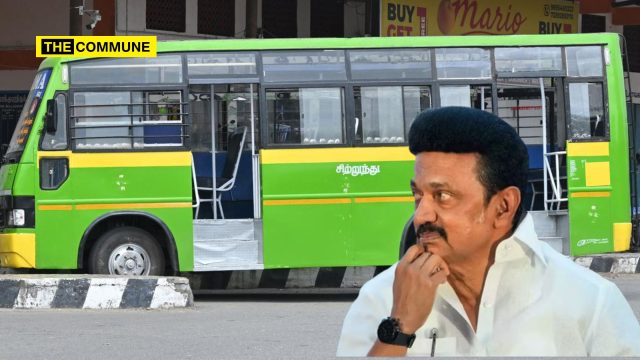
Two months after Chief Minister M. K. Stalin launched Tamil Nadu’s new private mini-bus scheme with the promise of revolutionizing suburban transport, the initiative has largely failed to get off the ground. Despite being touted as a transformative solution to fill gaps in public transport, the scheme is facing multiple operational challenges and implementation lapses.
Launched on 17 June 2025, the plan aimed to cover 25,708 km across the state, primarily focusing on areas not served by the Metropolitan Transport Corporation (MTC). Yet only 1,000 operators have come on board, and a little over 1,000 out of 2,000 sanctioned routes have active bus services.
Poor Planning, Lack of Oversight
One of the biggest flaws in the rollout was the lottery-based permit allocation system, which issued approvals to applicants without verifying their financial capability, experience, fleet size, or willingness to serve underserved regions. As a result, many permit holders are operating second-hand buses purchased from Kerala, costing around ₹10 lakh each. Most of these vehicles are past their prime and lack basic safety and monitoring features like GPS tracking.
Currently, only around 60 of the 150 designated routes in Chennai have any functioning service. In several cases, multiple permits were issued for the same busy route, while other areas remain uncovered.
Operators are largely left to their own discretion. They choose their own schedules, stop only where convenient, and in many cases, do not operate on weekends due to low ridership. For example, in Virugambakkam, only four out of the planned nine routes are operational. In OMR, Radial Road, Sholinganallur, Tondiarpet, Ambattur, and similar high-density areas, there is little to no presence of these minibuses.
Public Confusion and Lack of Transparency
The scheme also suffers from a complete lack of visibility and public information. There is no central website or database listing routes, bus stops, or schedules. Buses have no identifiable signage, route numbers, or indicators to suggest they are part of a government-supported public transport scheme, rendering them almost invisible to potential passengers.
Passengers and even officials report confusion. Permit holder Lokesh Kupparao, operating between Meenambakkam and Keelkattalai (6.2 km), only runs his bus up to Pallavaram (4 km) due to low demand beyond that point. He also lacks a hard copy of his permit receiving only an SMS approval and has just one bus covering the entire stretch in a circular route format.
Similarly, Harsh Senthil, who operates on the Chennai-One to Narayanapuram route, confirmed he doesn’t run buses on weekends due to poor turnout.
No Accountability, No Monitoring
The transport department has failed to establish any robust system to monitor compliance or quality. Regional Transport Officers (RTOs) were left to manage route approvals without a coordinated state-level plan. There is no centralised data on route usage, and enforcement appears weak.
While some RTOs, like Arunachalam from Meenambakkam, claim that inspections are underway to identify non-complying operators, the on-ground situation tells a different story. Many routes remain inactive, and buses rarely follow any fixed schedule or stop list.
Officials Say It’s “Still Evolving”
In response to growing criticism, Transport and Road Safety Commissioner R. Gajalakshmi defended the scheme, calling it a “work in progress.” She noted that operators need time to procure buses, and the department is working with RTOs to remove underperforming routes and introduce new ones based on local needs. The government also plans to introduce 1,000 more buses to improve coverage in the coming months.
The private mini-bus scheme is currently facing several critical challenges that hinder its effectiveness and outreach. Out of the 2,000 sanctioned routes, only around 1,063 are currently functional, and just about 1,000 buses are in operation. Despite the scheme’s objective to serve areas lacking public transport, a significant number of these regions remain unserved. Unlike the MTC, the private buses do not offer night services, limiting commuter options during off-peak hours. Additionally, the absence of GPS tracking, clear route signage, and publicly available information on routes or schedules has left passengers confused and unaware of available services. Most operators run only a single bus per route, and many skip operations on weekends due to low footfall, further reducing accessibility. Perhaps most concerning is the lack of a centralized monitoring or enforcement mechanism to ensure compliance and quality, leading to inconsistent service and undermining the scheme’s overall credibility.
What was promoted as a landmark initiative to revolutionize public transport has, so far, become a case study in poor execution. Without proper planning, transparency, or enforcement mechanisms, the private mini-bus scheme is failing to meet the commuting needs it was designed to address. Unless the government takes swift corrective steps including rigorous oversight, public communication, and better operator vetting the scheme risks being remembered as a missed opportunity in Tamil Nadu’s transport reform journey.
New private mini-bus scheme launched by chief minister M K Stalin two months ago fails to take off.
The new comprehensive minibus scheme, unveiled by chief minister M K Stalin two months ago, and hyped as a gamechanger for suburban commute has turned out to be a non-starter, as… pic.twitter.com/hLW18bHANy
— Omjasvin M D (@omjasvinMD) September 11, 2025
Subscribe to our channels on Telegram, WhatsApp, and Instagram and get the best stories of the day delivered to you personally.