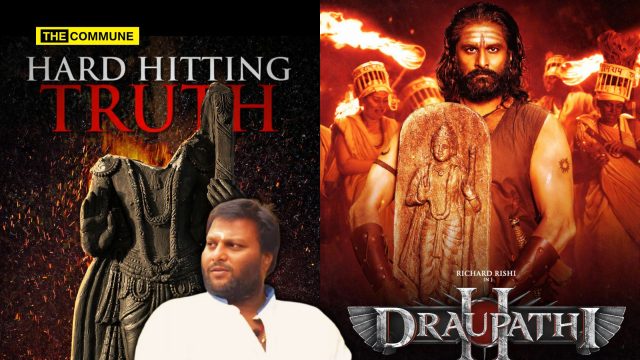
After four hard-hitting films that took social issues head-on, director Mohan G returns with a historical that is not interested in comfort, consensus, or cosmetic neutrality. Draupathi 2 is not merely a sequel, it is a continuation of a worldview: that history matters, memory matters, and silence has a cost. When cinema in Tamil Nadu predominantly revolves around fake manufactured Dravidianist tropes, Draupathi 2 stands out as the lone film rooted in civilisational consciousness.
Story & Premise
The film opens in contemporary Tamil Nadu, where a familiar but rarely discussed reality confronts the audience – ancestral Hindu land abruptly falling under Waqf claims, leaving rightful heirs dispossessed and helpless. Against this backdrop, two young women from abroad arrive in the village, hoping to renovate a dilapidated temple. One of the women becomes possessed, serving as the narrative bridge between the present and the 14th century. With this, the film establishes a link between Draupathi 1 and Draupathi 2.
What unfolds is the tale of Veera Simha Kadava Raya (also played by Richard Rishi), a warrior who protected his land, people, and temples during the turbulent period when southern India was not insulated from Islamic invasions, contrary to popular belief.
History Without Apology
One of Draupathi 2’s greatest strengths is its refusal to sanitize history.
Tamil cinema has produced historical fiction before, but it has largely shied away from depicting the brutalities of Islamic invasions, especially in the south. Mohan G breaks that silence.
Yes, we may have heard of Malik Kafur’s invasions, the brutalities, the looting of temples, the massacre of 12,000 Vaishnavites in Srirangam and so on… but that is just a portion of what happened in Tamil Nadu. What happened after is long forgotten.
Mohan G has woven history of the Madurai Sultanate & the Delhi Sultanate and into his story to achieve the impact he sought out to bring in the film.
The film places Vallala Maharaja (Vallalar III) at the centre of resistance, a ruler of the Hoysala dynasty remembered not only in chronicles but also in living Hindu geography, such as the gopuram he commissioned at the Arunachaleswarar Temple in Tiruvannamalai.
Women, Faith, And Nation
What marks the film out within Mohan G’s own filmography is the way it handles women and the idea of feminism. His films have always carved space for women as moral centres, but here the bar is raised: there is a scorching moment where a woman asks how she can worry only about her husband’s safety when so many women are facing Islamist violence.
Whether it is a mother enduring painful labour to ensure her child is born at the right moment, destined for valour, or a woman willing to give up her own life for honour and the nation, the film places women at the moral centre of history.
The film’s value system is explicit: the nation comes first, then personal comfort, and women are no less compared to men in defending dharma. The confrontation where Kadavarayan offers his life to Vallala Maharaja and is backed, unflinchingly, by his pregnant wife Draupathi, delivers genuine goosebumps; it becomes a statement on shared sacrifice, and Vallala’s subsequent reflection on women’s power deepens that emotional hit rather than feeling like token rhetoric. The interaction between Draupathi and Vallala Maharaja is simply one of the film’s most powerful emotional high points especially when he says, “Not only must the courage of men be praised, but also the sacrifice of women like you.”
In Karnan, the Kaatupechis exalted to the status of gods are victims of injustice. In Draupathi 2, it draws upon the memory of women who laid down their lives resisting invaders, later venerated as village goddesses and protectors of their people. In doing so, it pushes back against the Dravidianist ecosystem’s attempt to pit local folk Hindu deities against so-called “Brahminical” Hindu gods. The film presents this as a living tradition of remembrance and resilience.
Sequences That Stood Out
While the entire film was good, there were some scenes that stood out.
In a scene from the initial parts of the film, one character mocks another for still doing his “kula thozhil”, the other retorts, “It is my ancestral occupation, how can I let go of it?” – this seemed like a dig on the ruling DMK government’s stand against the Vishwakarma Scheme of PM Modi.
The sequence in which Vallala’s forces encircle the invaders’ territory (Battle of Kannanur) and choke them without overt violence is conceptually strong, and his eventual capture and execution are staged to feel brutal without resorting to indulgent gore, keeping the focus on humiliation and betrayal instead of splatter.
The film features use of guerrilla style tactics to attack the enemy, they are ingenious.
Some hidden nuances like when Vallala Maharaja says “Vandheri Sultan” – it refers to the foreign invader, the use of Vandheri is important here as the Dravidianists often use this as a slur against Brahmins.
The appearance of the Ramnami tribe in the trailer initially leaves the viewer curious about how they fit into the story. The film answers that question with a powerful sequence that weaves in their deep devotion to Lord Rama. The Ramnamis are shown worshipping a khandith—a beheaded idol of Lord Rama—not as a symbol of defeat, but of faith that refuses to die. With the help of Kadavarayan, they perform Pran Prathishta once again, restoring the deity and the sanctity of worship. Mohan G seems to have been touched by their faith that he found a way to include them in the film. This stands in stark contrast to how Dravidianist filmmakers often deploy imagery like the beheaded Buddha—stripped of context and frozen in victimhood—to suggest an alleged ‘Brahminical’ onslaught.
The film clearly shows how Hindus were treated – be it the use of the word ‘kaffir’, the emphasis on worshipping one God, and how Islamic invaders were interested in wealth and viewed Hindus as ‘stone worshippers’.
Dialogues like “This is Annamalaiyar’s land”, “There is only one clan, but not just one God” – These are important highlights of the film that emphasise the Hindu identity and a direct dig at monotheistic cultures and the Dravidianist ecosystem.
While they do not show the torture of the Prince Virupaksha, he is visibly broken and yet he does not agree to the Islamist’s order of converting to save his life – that was good but could have been powerful.
Overall, the Hindu symbolism is present, unapologetically.
Performances, Music, & Action
The film rests on Richard Rishi and Rakshana Indhudhar who plays Draupathi, and both rise to the challenge, fiercely. In fact, Rakshana embodies Draupathi in her scenes. Both share almost equal screen time and emotional load; they carry the conviction that the screenplay needs.
Natty, as an ageing Vallala Maharaja, brings gravitas without theatrics.
Action sequences were par excellence – very well choreographed and were not even a bit sloppy.
Ghibran’s music is a triumph, it is fantabulous. From war themes to devotional blends that fuse Middle Eastern motifs with Rama bhakti, the score elevates the film consistently. The new singer singing Emkoney is a pleasant surprise, it is seamless and soulful. Background score is outstanding and shows why people hated Chaava but will love Draupathi 2’s score – the music elevates the film, the story, and the characters. Kadavarayan’s entry scene is especially whistle-worthy music.
Ghibran’s use of the violin is praiseworthy, it just amplifies the scenes notches higher. The after-seige celebration song is predominantly the flute, amazing use of instruments. Tarasuki featuring Ulugh Khan is peppy and foot-tapping.
Not Without Flaws
The film is not without shortcomings. The English subtitles are poorly translated. There is a notable use of AI in the film while narrating sequences but given the budget, it is understandable.
There are noticeable continuity lapses in a few scenes.
The second half lags a bit, with antagonist Damghani portrayed more as a womaniser than the brutal tyrant that he really was – a few more brutality scenes would have done great justice.
The film’s emphasis on religious conversion is alright, but it becomes the central theme – the brutalities should have been shown a bit more, atleast what we saw in Chaava, show it without showing it.
The rivalry between Tughlaq and Damghani is introduced but not sufficiently explored, leaving noticeable loose ends.
Ulugh Khan’s (Tughlaq) item song also felt out of place with him dancing to choreographed steps.
Yet these flaws do not dilute the film’s intent or impact.
A Counter To Dravidianist Filmmakers
Draupathi 2 stands apart from the strain of contemporary Tamil cinema dominated by filmmakers like Pa Ranjith, whose work often function less as cinema and more as ideological pamphlets. Where his films flatten history into grievance narratives and reduce Hindu civilisation to a villainous abstraction focusing on manufactured “Brahminical” evil, Mohan G does the opposite, he restores complexity, agency, and memory. Instead of manufacturing outrage through selective victimhood and modern political templates imposed on the past, Draupathi 2 insists on historical continuity, civilisational context, and lived faith.
In Thangalaan, Pa Ranjith focused on how Brahmincal forces suppressed Buddhism in India, and specifically how a king beheads a Buddha statue after being urged by a Brahmin priest – Ranjith, who showed such manufactured “atrocities” against Buddhism turned a blind eye to the desecrations and brutalities of the Islamic invaders towards Hindus. A Mari Selvaraj or a Pa Ranjith would never dare touch a topic such as the one in Draupathi2.
Draupathi 2 – Tamil Cinema’s Kantara Moment
“Draupathi 2” is, in many ways, the Tamil land’s answer to what “Kantara” did for coastal Karnataka. Where “Kantara” fused daiva tradition, land, and lineage into a cinematic ritual, “Draupathi 2” binds temple, territory, and ancestry into a fierce act of remembrance. Draupathi 2 argues, clearly and unapologetically, that today’s Hindus exist because of the sacrifices of forgotten ancestors; faith endured because ordinary people chose suffering over surrender, just as in Kantara the deity’s pact with the people is renewed through blood, devotion, and memory.
This is not just a film about the past, but a reclamation of erased histories that makes the viewer consciously grateful for what we are today: Hindus in a free country, still able to stand before the same deities in the same temples, in the same forms our ancestors once worshipped, much like Kantara’s villagers guarding their sacred grove and daiva from encroachment. Mohan G does not claim invention, he claims remembrance. He stages forgotten kings, buried murtis, and silenced resistances the way Rishab Shetty staged daiva kola: as living, throbbing memory that refuses to be domesticated into footnotes.
For that alone, “Draupathi 2” deserves to be watched, argued over, and passed down, preferably in theatres, and with families who will talk about it on the way back, the way Kantara became a conversation in homes about land, gods, and gratitude. This is cinema as memory. And memory, as the film reminds us, is resistance and in its own Tamil idiom, no less potent than Kantara’s.
Hydra is a political writer.
Subscribe to our channels on Telegram, WhatsApp, and Instagram and get the best stories of the day delivered to you personally.