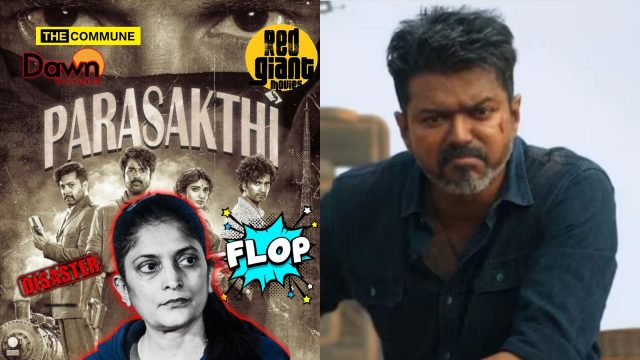
Director Sudha Kongara, whose latest film Parasakthi has failed to impress audiences or sustain box-office momentum, has now chosen a familiar escape route – blaming “anonymous social media handles” and, more pointedly, fans of actor Vijay for the film’s poor reception.
Instead of introspection on why a heavily marketed, politically loaded period drama failed to resonate beyond a narrow ideological base, Kongara has alleged a “targeted attack” and “slander” campaign, positioning herself as a victim rather than addressing the film’s creative and ideological bankruptcy.
From Flop Film To Manufactured Victimhood
In an interview to The Hollywood Reporter India, Kongara lamented that “just allowing your film to speak doesn’t seem to be enough” anymore and expressed hope that the film would somehow “take off during the Pongal weekend” despite clear audience rejection from day one.
She went on to claim that her film was being deliberately misrepresented online, saying there was “slandering, defamation of the worst kind, hiding behind unknown IDs.” While refusing to explicitly name those responsible, Kongara made it abundantly clear where she wanted the blame to land – Vijay’s fanbase.
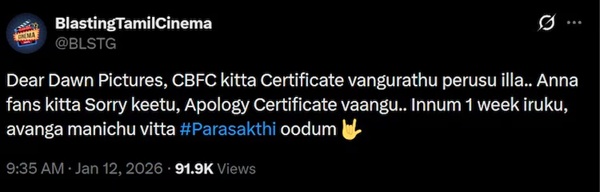
To bolster this narrative, she cited a post from an X handle that mocked the film’s CBFC troubles and sarcastically suggested apologising to Vijay’s fans to save the film. This single troll post was elevated by Kongara into supposed evidence of an organised conspiracy, conveniently ignoring the far more uncomfortable reality: Parasakthi failed because audiences rejected its preachy politics and distorted historical narrative.
A DMK-EVR Propaganda Exercise Disguised As Cinema
Marketed as a “revisionist alternative history” of the 1965 Anti-Hindi agitation, Parasakthi is less a historical drama and more an ideological pamphlet rooted in EV Ramasamy’s toxic Dravidian rhetoric. The film portrays the agitation through a crude binary of virtuous Tamil revolutionaries and cartoonishly evil state representatives, flattening a complex historical moment into DMK propaganda cinema.
Kongara herself admitted that the film deliberately rewrites history, claiming that “genocide” occurred because the state failed to communicate Tamil opposition to Hindi – a claim not supported by historical scholarship but regularly pushed by Dravidianist polemicists.
The result is a film that speaks not to history, but to DMK’s long-standing victim card politics, alienating neutral audiences who expect nuance rather than ideological sermons.
CBFC Excuses And Manufactured Outrage
Adding to the post-release melodrama, Kongara also attempted to shift blame onto the Central Board of Film Certification, portraying routine certification cuts as censorship excesses. In a pre-release interview, she claimed the CBFC was democratic. However, when asked about it, she said, “When I did that interview I had not gotten my cut list. I had just been told that I would be certified but only audio cuts would be asked. Two days away from release, I got the cut list at 11 AM, and tomorrow is all I have before I cut and give the film, because the day after is the release. Where is the time to fight this cut list? “
She claimed exhaustion from last-minute modifications and complained about reductions in violent scenes and muted dialogues referencing political figures.
Yet even she conceded that none of the cuts affected the film’s core narrative. The CBFC merely demanded disclaimers for “constructed” scenes and moderation of explicit violence, standard practice.
The sudden outrage appears more about constructing yet another external villain to deflect from the film’s failure.
Box Office Reality Vs Ideological Echo Chambers
Despite negative reviews and weak audience turnout, the film’s producers have made the predictable claim that Parasakthi is “profitable for all exhibitors.” This assertion stands in stark contrast to ground-level reports of empty theatres and poor word-of-mouth, even within Tamil Nadu’s DMK-dominated media bubble.
Starring Sivakarthikeyan, Ravi Mohan, Atharvaa and Sreeleela, the film had every commercial advantage. What it lacked was honesty, both in storytelling and in post-release accountability.
Blaming Vijay Fans Won’t Save Bad Cinema
By framing audience rejection as a politically motivated smear campaign, Sudha Kongara has revealed precisely why Parasakthi failed. It was never meant to engage audiences – it was meant to lecture them. When audiences walked away, she chose to blame “Vijay fans” instead of confronting the reality that ideological cinema without craft, balance, or respect for viewers will not survive outside party loyalist circles.
In the end, Parasakthi stands exposed not as a brave historical drama, but as yet another EVR-inspired DMK propaganda film which places the DMK patriarch Karunanidhi in the limelight anf forgetting the actual martyrs and warriors. Parasakthi is a film that collapsed under the weight of its own arrogance and then went searching for scapegoats.
Subscribe to our channels on Telegram, WhatsApp, and Instagram and get the best stories of the day delivered to you personally.