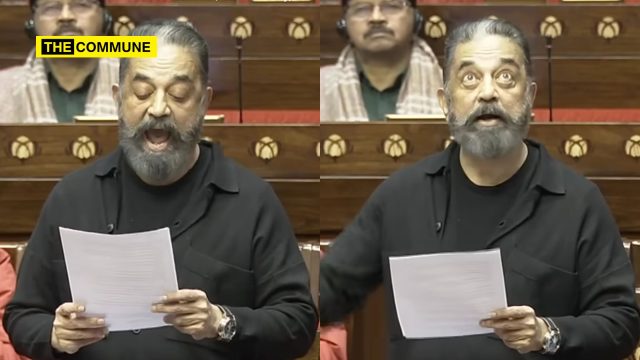
DMK stooge and MNM party founder, Rajya Sabha MP Kamal Haasan made his maiden speech in the Upper House today, 4 February 2026.
As with his posts on social media platforms, this speech came across as highly incoherent, confusing and pathetic.
His approximately 12-minute speech was not a speech in any meaningful parliamentary sense. It was a self-indulgent, metaphor-stuffed monologue that left an ordinary listener asking one basic question again and again: What exactly is he talking about?
The speech moved rapidly between unrelated themes: personal gratitude, cinema, Tamil identity, constitutional ideas, historical figures, electoral issues, generational commentary, and philosophical reflections. These shifts occur without clear transitions or explanation.
For a common listener, this is garbled nonsense. It is not clear what the central argument is meant to be, or how one part of the speech connects logically to the next. In fact, it felt like multiple half-written speeches stitched together without a spine. There is no guiding thread, no structured progression, no sense of destination. One couldn’t tell where the speech began, where it peaked, or where it ended.
And 5 minutes in is only when the listener realises that Haasan is supposedly speaking about voter deletion and electoral roll errors. Even then, the issue arrives buried under metaphors and autobiography.
Instead, we get vague claims of “living dead,” speculative numbers, and sweeping alarms, without explanation, evidence, or procedural demand. The result is anxiety without understanding.
Haasan leans heavily on dramatic language: “living dead”, “emotional tornado”, “juggernaut of democratic India”, “resurrection without miracles”.
These phrases may sound poetic, but for an ordinary citizen they obscure rather than illuminate. They sound impressive but do not explain anything clearly. A parliamentary speech is meant to inform, persuade, and move action. This one performs and stops there.
Large portions of the speech are consumed by Haasan’s personal story: his childhood, his ideological journey, his emotions, his trembling, his rationalism, his mentors, his sense of loss.
From a layman’s perspective, this becomes exhausting. The House is not there to hear a personal manifesto or emotional memoir. It exists to hear public grievances articulated with precision.
Instead of placing citizens at the centre, Haasan places himself there.
Haasan claims to be a high-school dropout, unqualified in economics, a “pedestrian” in lofty politics. Yet in the same breath, he presents himself as the ideological heir of giants, a moral sentinel of democracy, and a voice warning governments of their mortality.
This contradiction does not read as humility. It reads as performance – self-effacing rhetoric paired with self-elevating posture. To a common listener, it rings hollow.
For a maiden speech in the Upper House, this lack of discipline is not endearing. It is embarrassing.
Ultimately, the speech sounds less like a legislative intervention and more like a cinematic monologue – heavy on cadence, symbolism, and self-drama, light on precision and accountability.
Another source of confusion is the constant switching between languages. The speech begins in English, moves into Tamil references, then unexpectedly introduces French (to explain the meaning of “Durai”, briefly brings in Telugu, and later returns to Tamil. None of these shifts are explained or connected to the issue being discussed.
For an ordinary listener, this creates unnecessary distraction. Instead of helping different audiences understand the point, the language changes interrupt the flow of the speech and make it harder to follow what is being said and why it matters in a parliamentary context.
This was not a bold debut but a missed opportunity.
For all its emotion and references, Kamal Haasan’s maiden Rajya Sabha speech failed at the most basic level: it did not clearly say what needed to be said, to whom, or for what action.
In a House meant for lawmaking and accountability, nonsense delivered eloquently is still nonsense.
Subscribe to our channels on WhatsApp, Telegram, Instagram and YouTube to get the best stories of the day delivered to you personally.