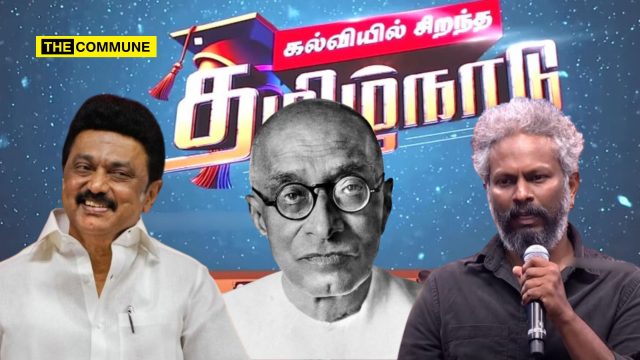
The Dravidianist Kollywood ecosystem, including directors and film stars, appears to have entered in a free PR engine for the DMK and its ideological narrative as the 2026 Assembly elections loom. This was made all too evident during the ‘Kalviyil Sirantha Tamil Nadu’ (Tamil Nadu that Excels in Education) event held in Chennai on 25 September 2025.
Organized by the Tamil Nadu government, the event was a platform to showcase various welfare initiatives, including the Chief Minister’s Breakfast Scheme, the Naan Mudhalvan Scheme, and the Puthumai Penn–Tamil Pudhalvan Scheme. Beneficiaries of these schemes were invited to share their success stories, seemingly to validate the government’s commitment to social welfare. Among the attendees were figures like Telangana CM Revanth Reddy, Deputy CM Udhayanidhi Stalin, Education Minister Anbil Mahesh Poyyamozhi, actor Sivakarthikeyan, and directors Mysskin and Thiagarajan Kumararaja.
However, rather than focusing on the supposed educational progress these schemes promote, the Kollywood figures used the stage to advance a divisive Aryan-Dravidian narrative, effectively framing the discussion within the lens of ancient flawed racial theories. Director Thiagarajan Kumararaja, in particular, took the opportunity to launch into a tirade against Brahmins, accusing them of historically preventing the supposed Dravidian community from accessing education. With little more than symbolic gestures, he implied that there is a deliberate conspiracy to keep education from the marginalized.
Kumararaja’s comments drew heavily from mythology, citing a 2000-year-old song written by a Pandyan king to push his point. The song, according to him, suggests that when the marginalized learn, they force the privileged to lower their social standing and join them. He then contrasted this with what he described as the “Aryan ideology,” portraying figures like Dronacharya, Kripacharya, and even Rajagopalachari (Rajaji) as historical agents of oppression who supposedly created barriers to education for the lower classes. For Kumararaja, these figures embodied a long-standing strategy to suppress knowledge, and his message was clear: the Brahminical order had been the source of inequality in education from time immemorial.
Kumararaja’s analogy about Karna’s plight in the Mahabharata was perhaps the most overt. He described how Karna, born to lower social status, was denied education by Dronacharya, and how the system forced him to lie about his identity to gain access to learning. When Karna’s true status was revealed, the mythological figure was cursed by Kripacharya, symbolizing the eventual unraveling of all he had learned. To Kumararaja, this was more than a historical anecdote; it was an allegory for what he claimed was happening today with the national education policy – an attempt, he argued, to once again block access to education for the marginalized.
Kumararaja continued, railing against the political status quo and decrying what he saw as an ongoing effort to suppress the educational empowerment of the lower castes. He claimed that just as Karna had been deprived of his knowledge, the new education policy would similarly deny the marginalized access to opportunities. His criticism went beyond the content of the policy itself, accusing it of intentionally withholding funding from the state, preventing Tamil Nadu from fully benefiting from the resources it was due.
In an emotionally charged moment, Kumararaja even credited the Tamil Nadu Chief Minister for “rescuing” the state from these systemic blocks, portraying him as the only figure working to bring the people of Tamil Nadu out of a state of perpetual subjugation. His gratitude, however, seemed more like a political endorsement than genuine praise, with the clear implication that the DMK was the sole party standing up to what he painted as a centuries-old conspiracy to keep the masses uneducated and subordinated.
What was striking about this event and indeed, about the roles Kollywood figures play in these affairs was the way in which they leveraged the platform to push a political narrative rather than focusing on the practicalities of education or welfare. Far from being a neutral, celebratory event for Tamil Nadu’s educational achievements, it quickly devolved into an ideological spectacle. In doing so, these film stars and directors not only underscored their alignment with the DMK but also ensured that the ideological battles over education and caste would take center stage in the lead-up to the 2026 elections.
Director Thiagarajan Kumararaja’s said, “A Pandyan king wrote a poem about education 2,000 years ago. Mr. Balakrishnan has spoken about it in many places. The last four lines are very important, “Vetrumai porunthiya naarpaal ullum, Keelpal oruvan karpin melpal oruvanum avan kan padume.” (Even among the four castes, if a person from a lower caste learns, a person from a higher caste will seek him out)
Education has two qualities. One quality is what he is talking about now, if a person from a lower class gets an education, it will force a person from a higher class to respect and associate with them. This is the first reason. The second thing… What does education do is… mentioned in a song from the book Viveka Chintamani, “It cannot be taken by flood, nor burned by fire, nor taken by kings. It will not decrease when given.”
Why do we study? We study to get a good job, earn money, and take care of our family, parents, and children. If I give away one crore rupees to someone, they can live happily, but I will no longer have that one crore. But with education, when we earn money, the knowledge keeps me wise and also makes the receiver wise. The knowledge I have reaches them and makes them my equal or elevates me to their level. This is why from ancient times until now, people have been prevented from getting an education. This is a very, very important point. We must think about why we, who were so educated, lost our education in the middle.
There are two ideologies regarding education. One is the Dravidian ideology that everyone should be educated, and everyone should be intelligent. From the time of the Pandyan Neduncheliyan to the Bharathiyar in the last century, he also said, “Even though you build a thousand inns and a thousand temples…” and at the end of it he said that a greater virtue, a crore times greater, is to provide education to a poor person. Such a virtuous act is providing education. Now, what happened with the Aryan ideology? A boy who wanted to learn went to a teacher and asked to be taught, but he was asked what caste he belonged to and was refused. But when he taught himself archery and stood before him, the teacher took his thumb. When Karna wanted to learn from him, he asked Karna what caste he was and sent him away. When Karna asked Kripacharya, he lied and said he was from a high-class family to learn from him, but when Kripacharya found out he wasn’t, he cursed him, saying all the knowledge he learned would leave him one day, and he took it away from him.
From Dronacharya and Kripacharya to Rajagopalachariar, they have been preventing us from getting an education. But against this ideology, which says there should not be equality, a party and an ideology that says there should be social justice and equality is in power, and they are putting in place as many schemes as possible to make sure everyone gets an education. They provide morning meals, and there are programs like Naan Mudhalvan and Tamil Pudhalvan. They have a series of schemes to make sure everyone gets an education. They even provide laptops and bicycles to people for free. They want you to get an education and rise up. To prevent this, just as they asked for the thumb and cursed Karna with amnesia, they have now brought in a new education policy to stop you from studying. And because we said we would not accept this, they are refusing to give us the 2150 crores that are rightfully ours.
Now, when a party that we disagree with politically is in power at the union, the Chief Minister has worked hard to save the people of Tamil Nadu, like someone who has been thrown into water with their hands and legs tied yet still manages to swim and save others. I express my heartfelt thanks to this Chief Minister. Thank you.”
Subscribe to our channels on Telegram, WhatsApp, and Instagram and get the best stories of the day delivered to you personally.