


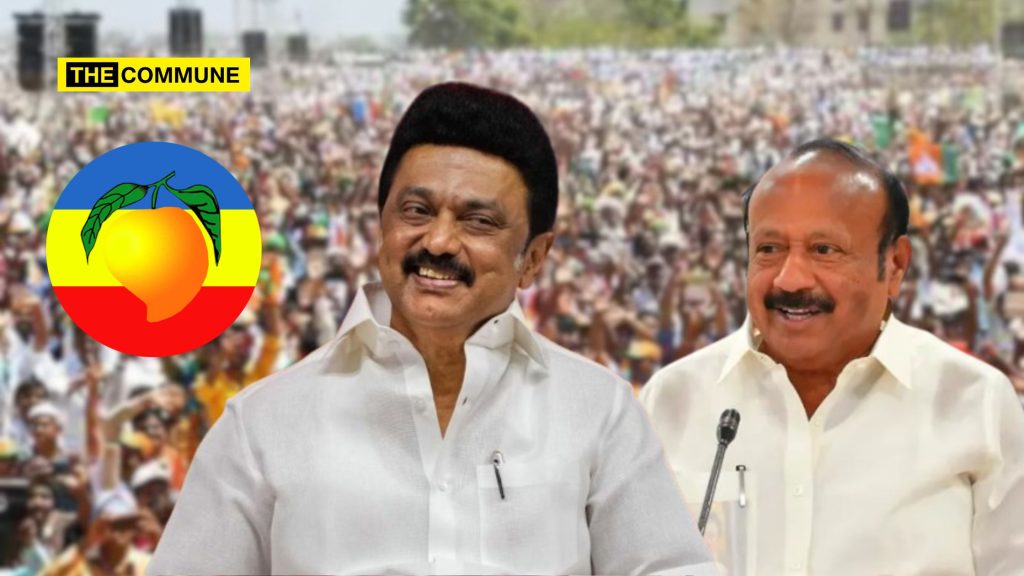
With just about ten months left until the 2026 Tamil Nadu Assembly elections, the DMK appears to be strategically recalibrating its caste equations, playing its cards with calculated precision. Facing a growing anti-incumbency wave and a reorganized opposition under the NDA — including a resurgent AIADMK — the ruling party is now pulling out all stops to secure a decisive mandate.
A key move in this political maneuvering is the appointment of Minister M.R.K. Panneerselvam as the DMK’s zonal in-charge for the Cuddalore, Villupuram, and Kanchipuram districts. This appointment is widely interpreted as a follow-up to the sidelining of former Higher Education Minister K. Ponmudi, who had served as a prominent non-Vanniyar Udayar face for the party in northern Tamil Nadu.
Historically, Ponmudi’s presence served as a caste-balancing counterweight in regions where the Vanniyar community, and by extension the PMK, holds sway. The DMK has long depended on such balancing acts, especially since the PMK’s rise. But now, with shifting voter dynamics and emerging challengers like actor Vijay and Naam Tamilar Katchi’s Seeman, the DMK feels compelled to rethink this strategy ahead of 2026.
There is growing concern within the DMK that its Scheduled Caste support base, which shifted from AIADMK in 2021, may not hold firm. These votes, vulnerable to defection, could align with the NDA or gravitate toward charismatic independents. To counter this, the DMK is now setting its sights on winning over Vanniyar voters traditionally opposed to them.
Interestingly, the DMK was the first to float the idea of a possible PMK-DMK alliance. While this was never formally pursued, many saw it as a strategic ploy to rattle VCK chief Thirumavalavan, whose party forms part of the DMK-led alliance. The move appears to have served its purpose as a psychological tactic rather than an actual electoral realignment.
Visuals of PMK MLAs appearing cordial with Chief Minister Stalin, tensions with Tamil nationalist MLA Velmurugan, and visible cracks within PMK ranks — including internal dissent and confusion are all developments that could play in DMK’s favor come election time.
DMK and PMK have not allied since 2011, with PMK supporters developing strong anti-DMK sentiments. This hostility has been a key reason for PMK’s continued alignment with the NDA. The DMK is now aware that unless it softens this resistance, the Vanniyar vote could consolidate against it, strengthening the NDA’s position in northern districts.
Yet, there’s a deeper dilemma. Even if the DMK manages to consolidate non-Vanniyar votes, widespread dissatisfaction from its four years in power may hinder its ability to unify those blocs again. In such a scenario, a strong anti-incumbency sentiment combined with a united Vanniyar base could result in heavy electoral losses in the north.
Thirumavalavan’s recent comments criticizing the DMK and open to make any alliance read as political signaling an attempt to leverage his position amid a volatile alliance landscape.
Considering all these complexities, the DMK’s current posture appears to be one of tactical neutrality: not explicitly opposing the PMK, but not allying with it either. This middle path is seen as a calculated political investment one that echoes the approach once taken by Jayalalithaa, albeit with more subtlety.
By adopting a “soft-PMK” stance, the DMK is aiming to weaken the forces united against it. Even if internal frictions delay or complicate PMK’s alliance with the NDA, the very possibility could undermine their anti-DMK strength. In that, the ruling party’s political sacrifice may indeed become a crown jewel of its 2026 campaign strategy.
Subscribe to our channels on Telegram, WhatsApp, and Instagram and get the best stories of the day delivered to you personally.