On 12 April 2026, with the Madurai Central election weeks away and opponent Sundar C drawing growing crowds, DMK’s PTR Palanivel Thiagarajan took to his X handle with a campaign broadside he titled “A Lesson for the ‘Cinema Sangi’: Chapter 2.”
Focused on Ward 21 in the Aruldaspuram area of his constituency, the post listed what he described as proof of decade-long development: 34 roads built, smart classrooms at Thiru.Vi.Ka Corporation School, a breakfast scheme extended to Class 8 students at Vilangudi Panchayat Union Middle School since September 2023, a community hall at Kalathupottal, an upgraded Primary Health Centre with a scanning facility, and “countless other works.” He signed off with a defiant flourish: “I am a man from Madurai – who are you?”
The document PTR attached to the post, the official MLACD (MLA Constituency Development) data for Ward 21, was meant to settle the debate. Instead, it quietly opened one.
மதுரை மத்திய தொகுதிக்குட்பட்ட வார்டு 21 அருள்தாஸ்புறம் பகுதியில், திராவிட மாடல் நல்லாட்சி தொடர தேர்தல் பரப்புரை – 11/04/2026
“சினிமா சங்கிக்கு” மதுரை அறிமுகப் பாடம்: அத்தியாயம் 2
“இந்தப் பகுதியில் நான் 34 சாலைகளை அமைத்துக் கொடுத்திருக்கிறேன்,
திரு.வி.க. மாநகராட்சி பள்ளியில்… pic.twitter.com/DlTHnoil72
— Dr P Thiaga Rajan (PTR) (@ptrmadurai) April 12, 2026
What the Document Actually Shows
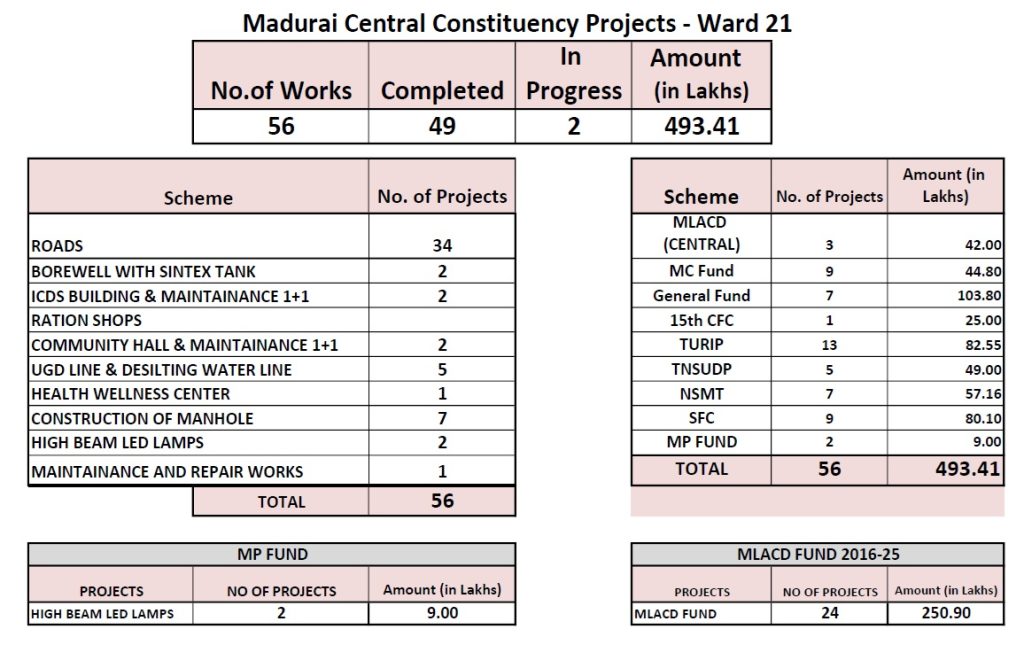
The MLACD fund data for Ward 21, covering 2016 to 2025, lists 24 projects with a total outlay of ₹250.90 lakh. PTR’s post claims “34 roads”, a figure that we are unable to independently verify within the MLACD data alone, as road works may also have been executed under other scheme heads.
What the MLACD record does confirm is that 16 of those 24 projects are BT (bituminous tar) road-laying works – straightforward resurfacing jobs ranging from ₹5 lakh to ₹20 lakh each. The community hall at Kalathupottal (₹25 lakh, 2024-25) and an ICDS building (₹11 lakh, 2021-22) are the only non-road, non-borewell entries across nine years of MLACD work in this ward.
Crucially, there is not a single drainage project, waste management initiative, or public toilet in the entire 24-entry MLACD record for Ward 21.
The distribution of works over time is equally telling. 21 of the 24 MLACD projects fall in the 2016-2021 period – when PTR was an MLA but in the opposition. Only three are recorded after 2021, when he became a ruling-party minister: one borewell (2023-24), the Kalathupottal community hall (2024-25), and the ICDS building at the cusp of the DMK government’s arrival (2021-22). Whether this reflects scheme cycles or a genuine slowdown in ward-level investment during the ruling years is a question the data alone cannot fully answer – but the pattern is stark: more ward-level work was recorded when PTR had less power than when he had the most.
India’s Dirtiest City. His Constituency. His Promise.
PTR once promised, during his 2021 campaign, to make Madurai “like Singapore.” In November 2025, the Central Government’s Swachh Survekshan 2025 report delivered its verdict: Madurai ranked as the dirtiest city in India among all cities with populations over ten lakh, scoring just 4,823 out of 12,500, finishing last among 40 comparable cities.
The sub-scores detail the extent of the collapse. Waste processing: 4%. That means 96 paise of every rupee’s worth of waste generated in the city goes unprocessed. Public toilet cleanliness: 3%. Door-to-door waste collection: 37% of households. This is not a city on its way to Singapore. This is a city that finished below every other major Indian city in every measurable category of cleanliness on the watch of the MLA who represented its central constituency and served as the state’s Finance Minister.
The ward-level complaint data mirrors this city-wide failure precisely. Of the 165 basic-needs petitions resolved in Ward 21 by PTR’s office, 55 were about underground drainage, 43 about streetlights, 29 about garbage, and 9 about drinking water – the four most elementary municipal services together accounting for 82% of all basic-needs petitions filed in the ward in 2026. The problems citizens complained about most were the ones entirely absent from PTR’s MLACD investment record.
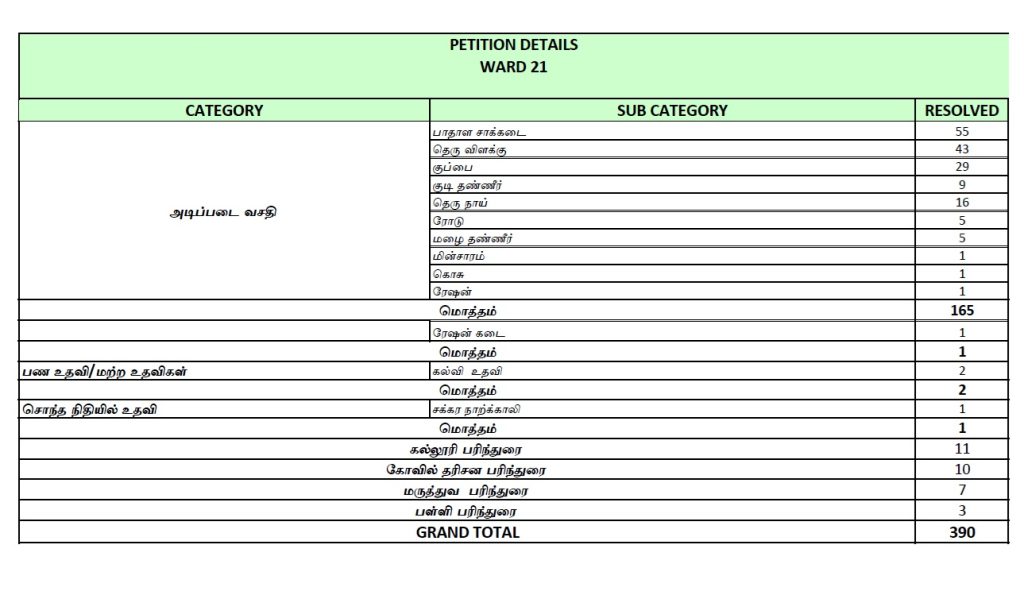
Zero drainage projects. Zero waste management. Zero public toilets.
26 Health Cards. 3,682 Beneficiaries. For a Constituency of Lakhs.
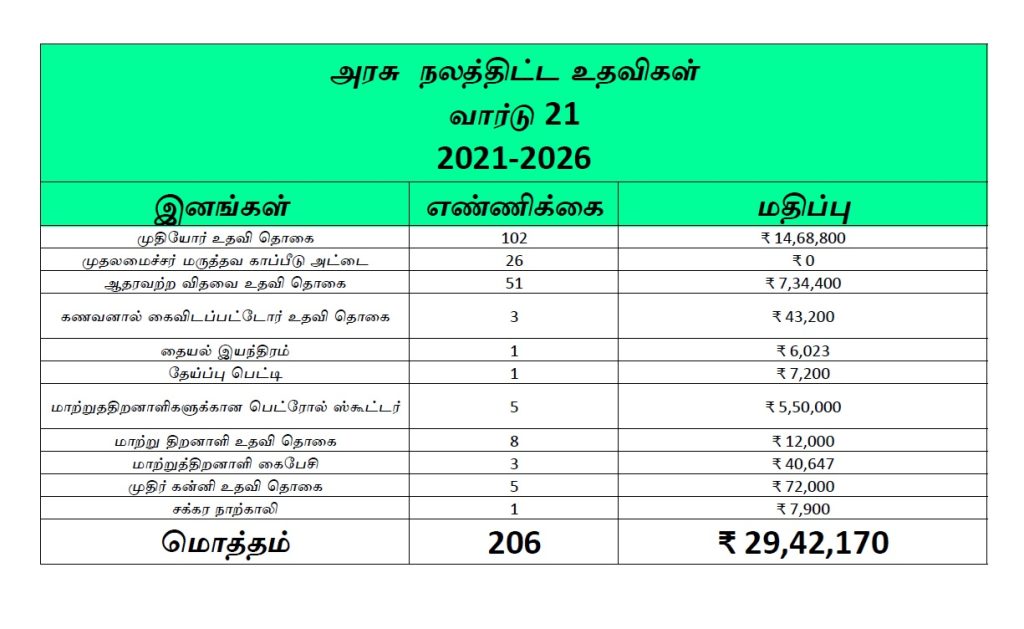
PTR’s document lists welfare beneficiaries for Ward 21 over the period 2021–2026. The Chief Minister’s Health Insurance cards distributed in Ward 21 across five years: 26. For a ward estimated at approximately 12,000 residents, that is a reach of under 0.3%. Even accounting for eligibility criteria, these are means-tested schemes and not universally applicable, the scale remains strikingly modest relative to the scale of need.
PTR’s document records 206 direct welfare beneficiaries in Ward 21 alone covering old-age pension, widow assistance, disability benefits, and similar schemes over the period 2021 to 2026, with a total disbursement of ₹29.42 lakh.
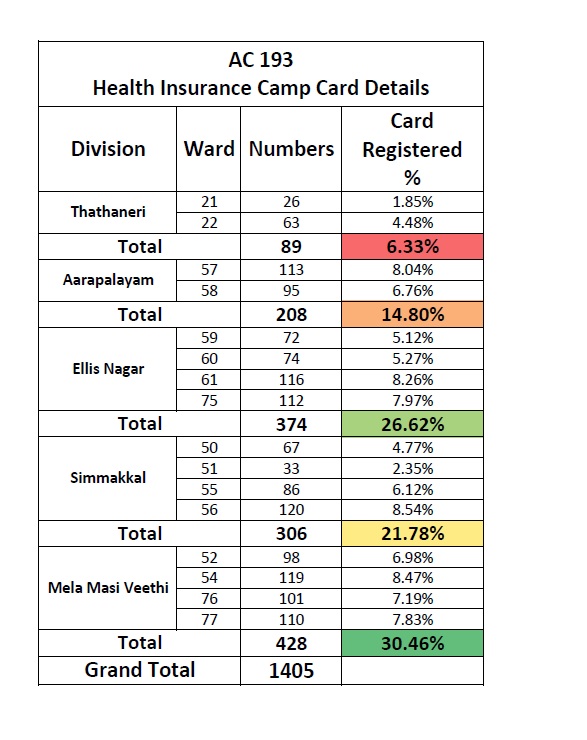
Across the entire Madurai Central constituency, the document records 1,405 Chief Minister’s Health Insurance cards registered at camp level with Ward 21 accounting for just 26 of those in a ward that had about 12000 people. Even accounting for eligibility criteria, the scale remains too modest for a constituency represented by a sitting Cabinet minister over two terms.
Sanitiser as Alcohol. ₹48,000 Crore Revenue. ₹20 Crore for De-addiction.
Beyond the ward data lies a more disturbing data point – one that PTR, as the man who read the state’s budget, cannot claim ignorance of. In 2025, it was reported that in Madurai district, people were drinking hand sanitiser because they could not afford TASMAC liquor prices. In PTR’s city. In the constituency he calls home.
TASMAC recorded ₹48,000 crore in revenue in the same period – a record high. The state’s de-addiction budget: ₹20 crore. The ratio 2,400:1 is a policy choice, not an oversight. PTR was the Finance Minister who signed off on these numbers. He knew the TASMAC revenue. He knew the de-addiction allocation. He knew the gap. The question is not whether he was aware. The question is what he did about it.
Dear @ptrmadurai,
You are probably the most transparent MLA in TN.. No sarcasm. Genuine respect. But the data itself raises questions.
Madurai was ranked the dirtiest city in India (Swachh Survekshan 2025). Score: 4823 out of 12500. Waste processing at 4%. Public toilet… https://t.co/CgLIykhkDG
— Ninja (@MrNinjaXz) April 12, 2026
The Minister Who Said He Could Not Do What He Envisioned
The sharpest challenge to PTR’s campaign document may not come from his opponents, but from his own recorded words. During the election campaign, PTR himself had stated publicly: “I had a deep desire to do so much for Madurai. However, I was unable to accomplish anything that I had envisioned. There may be various reasons for this. Yet, those involved in politics cannot always speak with complete candor.”
PTR has also admitted in the Tamil Nadu Assembly that his IT department had “no funds, no authority.” He was transferred out of the Finance Ministry, widely seen as a political demotion, following a leaked audio tape in which he was heard saying, among other things, that “within the DMK, the son and son-in-law have amassed ₹30,000 crore.” PTR denied the tape was authentic.
What the Ward 21 data ultimately reflects is a decade of incremental works, dominated by road relaying, alongside persistent gaps in basic civic infrastructure: no drainage investment, no public toilets, and a city that, by the Central Government’s own Swachh Survekshan ranking, became India’s dirtiest under his watch. The campaign document was meant as a lesson. The numbers embedded within it may teach a different one.
Subscribe to our channels on WhatsApp, Telegram, Instagram and YouTube to get the best stories of the day delivered to you personally.