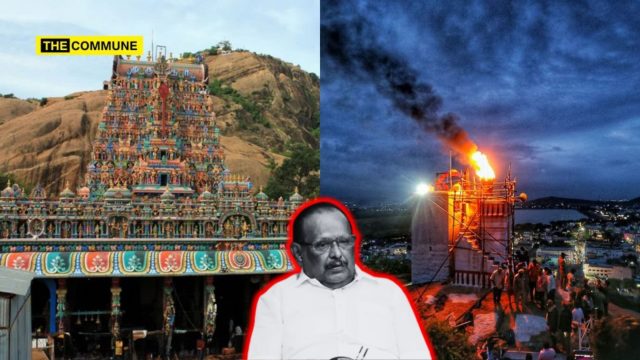
Hours after the Madurai Bench of the Madras High Court permitted the lighting of a lamp atop the stone pillar on Thirupparankundram hill, the DMK government signalled its intent to challenge the verdict before the Supreme Court, terming the order legally flawed and historically unfounded.
Speaking to the media, DMK Law Minister S. Regupathy criticised the ruling for allowing what he described as a practice that had never existed earlier, arguing that courts must rely on historical precedent before permitting religious customs at a particular site. Drawing a comparison with burial and cremation grounds, the minister said that customs are location-specific and cannot be shifted or newly introduced merely because a demand is made.
Speaking to the media, the DMK Minister said, “They asked that permission should not be given. But today, the judges, directing that only a few officials from the Hindu Religious and Charitable Endowments Department should go there under the leadership of the District Collector, and imposing restrictions on the general public, have issued an order allowing the lighting of the lamp on the Deepathoon. This order has been given today in violation of the law. Therefore, the Tamil Nadu Government and the Hindu Religious and Charitable Endowments Department are going to file an appeal against it. Generally, if something is to be permitted at a place — if one says a lamp should be lit at a particular spot — the judges should ascertain whether lamps were lit there earlier, whether there is evidence for it, and only based on such evidence should permission be granted.”
He continued, “But no such evidence exists. There was the rule of great leader Kamaraj, the rule of Rajaji, the rule of Puratchi Thalaivar MGR, the rule of Amma Jayalalithaa, the rule of Thalaivar Kalaignar. During all these governments, at no point did anyone come forward with a demand to light a lamp at the Deepathoon.”
Speaking about the issue raised during Jayalalithaa’s regime, he said, “When such a demand arose during Jayalalithaa Amma’s rule, it was opposed and permission was refused. But today, the judges say that since such a request has come before them, they are issuing an order allowing the lighting of the lamp at the pillar on Thirupparankundram hill. As of today, we cannot say anything about the judiciary or cast aspersions on it. However, on the basis that this is an act contrary to law, we have every right to approach the Supreme Court. Tamil culture and tradition must be protected. No one demanded this earlier. Granting permission just because someone has demanded it is completely wrong.”
He further said, “Introducing a practice that never existed earlier, through a court verdict, appears to have an ulterior motive. From our perspective, this is something we oppose entirely and is against the sentiments of the Tamil people.”
When asked about proof that the pillar was a survey stone, he said, “As far as we know, there is no historical proof or record of such a practice for even a hundred years. Was any evidence submitted that it was a Deepathoon? No. The stone was installed during the British period. Since it is on a hilltop, it was placed as a taller stone — that is what we have stated. Even if it existed during the Nayak period, is there any proof that a lamp was lit there — during the Nayak period, the British period, Rajaji’s period, or Kamaraj’s period? Why should the court introduce something today that never existed? That is the question of the Tamil people. There is no evidence whatsoever. There are no proofs that a lamp was ever lit at the Deepathoon. Tamil people will not accept this.”
He further said, “Some sections of people are trying to enter and play politics in this issue. Therefore, we have every right to file a case in the Supreme Court opposing this.”
He added, “The Tamil Nadu Government placed all facts before the court and argued. If something is supposed to happen at a particular place, it happens only at that place. For example, if a cremation ground exists in a village, bodies are cremated only there — not elsewhere. These are customs. Do not change customs. Why should a verdict be issued in a place where no such evidence exists, thereby attempting to create confusion in Tamil Nadu? That is our question.”
He added, “Anyone can make allegations against the government. But if the government had not prevented it that day, the situation would have arisen where people would have gone and lit the lamp. That is why the District Collector and the police imposed Section 144 in time and prevented people from going to the hilltop. The government has the right to protect law and order. If it had been allowed then, it would have become a continuing practice. That practice must not take root. Do not introduce a practice that never existed — that is our demand.”
When asked if lighting a lamp for one hour on one day in a year automatically cause communal riots, he said, “What kind of logic is that? What is the justification for bringing in something that never existed? What justification is there in demanding to light a lamp at a place where there was never such a custom?”
“Definitely there is a political motive. The Bharatiya Janata Party is acting with the objective of creating communal riots in Tamil Nadu in some form. Tamil Nadu people will not allow that. Everyone has the right to practise what they wish, according to custom and culture.”
Subscribe to our channels on WhatsApp, Telegram, Instagram and YouTube to get the best stories of the day delivered to you personally.