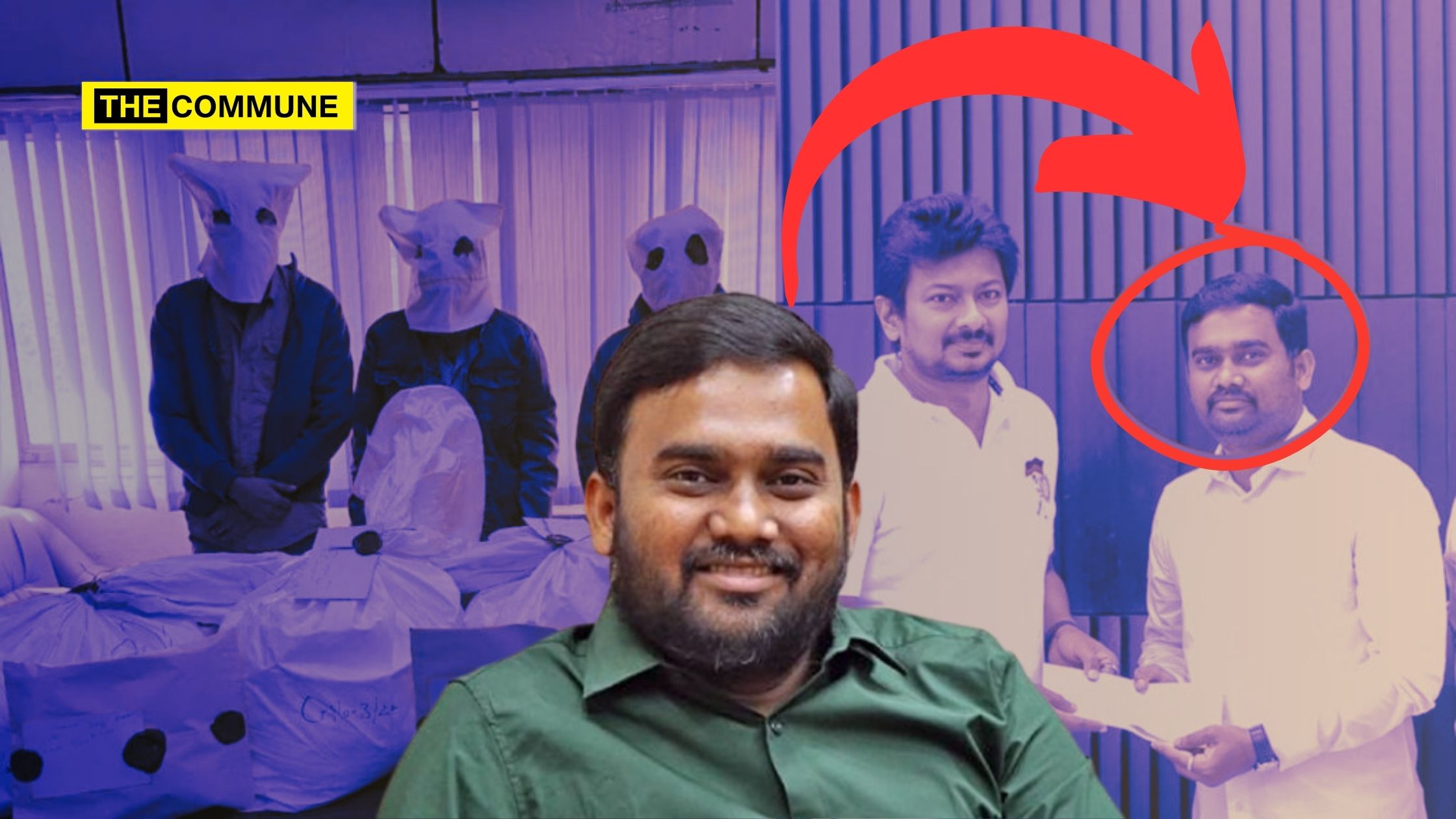
On Monday, 6 April 2026 – just weeks before Tamil Nadu goes to the polls – Income Tax officials descended on more than 10 locations across Chennai linked to expelled DMK functionary and alleged drug kingpin Jaffer Sadiq. The locations raided include his JSM Residency in Crescent Road, his Pattinapakkam residence, his Egmore and Purasawalkam lodges, and the home of Tamil film director Ameer – a co-accused in the Enforcement Directorate’s chargesheet.
Reports suggest officials carried away documents in bundles, with raids extending to as many as 40 locations across the city. This is not a new story. But the April 6 raids, timed against the election backdrop, are a reminder that the Jaffer Sadiq case is far from over – and that one of its most quietly troubling dimensions has barely received the attention it deserves.
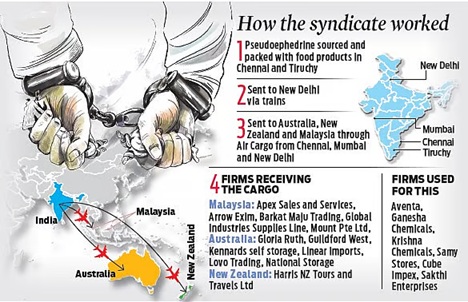
Look carefully at the companies through which the alleged Rs 2,000-crore pseudoephedrine trafficking network was routed, and you will notice something striking. The New Indian Express, in its November 2024 report on the ED chargesheet, listed the front firms that investigators say Sadiq used to move drugs, park money, and launder proceeds across 12 countries. The names on that list read like a directory of a Hindu business district: Aventa, Ganesha Chemicals, Krishna Chemicals, Samy Stores, Cube Impex, Sakthi Enterprises.
A man named Jaffar Sadiq Abdul Rehman, running front firms called Ganesha Chemicals and Krishna Chemicals. It is not a coincidence. It is a strategy.
The Art Of Borrowed Identities
India is a country where a firm name carries cultural weight. In Tamil Nadu especially, names invoking Ganesha, Krishna, Sakthi or Samy signal deep roots in the Hindu trading community. They evoke trust. They suggest a Tamil business family, a decades-old local enterprise, the kind of shop you deal with because your father dealt with them. When a narcotics network needs to move goods across borders without attracting suspicion, names like “Ganesha Chemicals” or “Sakthi Enterprises” serve as camouflage. They blend in. They don’t raise red flags.
This is not paranoia or selective reading. The ED’s own chargesheet states that Sadiq used these outfits as “front or cover businesses” to route proceeds from the drug trade. The NCB too has noted that consignments were sent under cover of legitimate exports from these firms – pseudoephedrine hidden in desiccated coconut, health-mix powder and similar items. The names of the companies were part of the cover.
A Pattern With Historical Precedent
The use of a borrowed religious or cultural identity to deflect scrutiny is not new to India’s security calculus. The most chilling example is perhaps the most famous.
When Pakistani terrorist Ajmal Kasab landed on Mumbai’s shores in November 2008 with his Lashkar-e-Taiba team to carry out the most devastating terror attack on Indian soil, he was wearing a kalava – the sacred red thread that Hindus tie on the wrist after prayer. The intention was transparent: if anything went wrong, a kalava on the wrist was to peddle the Hindu terror narrative. But Kasab was caught alive. We know his name, his faith, his country and his handlers. Had he not been caught alive, had no other evidence survived, the kalava on his wrist would have fed conspiracy theories for decades.
The kalava trick and the “Ganesha Chemicals” trick are separated by scale and context but rooted in the same instinct: wear a Hindu mask to move more freely in Hindu India.
We have seen umpteen number of examples – Shop name Ram juice centre but the QR code reveals an Islamic identity.
The Jaffer Sadiq Network: A Brief Anatomy
For those coming to this story fresh, here is the trail. The NCB arrested Jaffer Sadiq in March 2024 after a raid at the Delhi godown of his company Aventa yielded 50 kg of pseudoephedrine. Further investigation uncovered what investigators described as one of the largest drug trafficking operations run from Tamil Nadu: approximately 3,500 kg of pseudoephedrine – a key precursor for crystal methamphetamine – dispatched in 45 consignments to Australia, New Zealand, Malaysia, Dubai and other countries, with an estimated street value of over Rs 2,000 crore.
The ED followed up with a money-laundering investigation, filing a chargesheet in September 2024 that named 12 individuals and eight companies as accused, including film director Ameer. Laundered proceeds are alleged to have been parked in movies, hotels and real estate, with Sadiq’s film ‘Mangai‘ described as “entirely funded” by drug money.
The Madras High Court granted Sadiq conditional bail in April 2025 after he spent over a year in custody. But the cases – both NDPS and PMLA – are still pending trial.
Six Firms, Six Hindu Names
Returning to that TNIE infographic from November 2024 – the six firms listed as the operational backbone of this alleged drug-and-money network are:
- Aventa – the Delhi godown where the first NCB seizure happened
- Ganesha Chemicals
- Krishna Chemicals
- Samy Stores
- Cube Impex
- Sakthi Enterprises
Of the six, at least four carry names that carry unmistakable Hindu/Tamil cultural resonance. Ganesha, Krishna, Samy (a common colloquial form of Swami, used widely in Tamil Nadu), Sakthi – these are names of Hindu deities. They are the kinds of names that populate every street of every Tamil town. Nobody would look twice.
That is precisely the point. Here is a man who was the NRI wing organiser of DMK’s Chennai West district. A man who chose, when setting up his alleged front companies, to give them the names of Hindu gods and Tamil Hindu cultural symbols. A man who was protected by DMK’s political umbrella long enough to allegedly run 45 drug consignments across five countries over nearly a decade before arrest.
The borrowed Hindu business names were not incidental. They were infrastructure.
Investigators reportedly acted on inputs about possible cash distribution linked to Sadiq’s network in parts of Chennai. Even while out on bail, the alleged financial structures he built – the front firms, the properties, the hospitality businesses, the film investments – continue to be scrutinised. JSM Residency, raided on April 6, was already attached by ED in September 2024 and remains under probe.
For voters in Tamil Nadu heading to the polls, the question is straightforward: how did a man with this alleged network operate for so long, so openly, within the structures of a ruling party?
The Mask Always Slips
Ajmal Kasab’s kalava did not save him. The sacred thread on a terrorist’s wrist fooled no one once the guns started firing and the cameras caught his face. Jaffer Sadiq’s Ganesha Chemicals and Krishna Chemicals did not ultimately save him either. The godown in Delhi’s Basai Darapur, the 50 kg of pseudoephedrine, the financial trail through eight companies and 12 individuals, the documents seized in bundle after bundle in four Chennai locations on April 6 – all of it has stripped the mask away.
Subscribe to our channels on WhatsApp, Telegram, Instagram and YouTube to get the best stories of the day delivered to you personally.