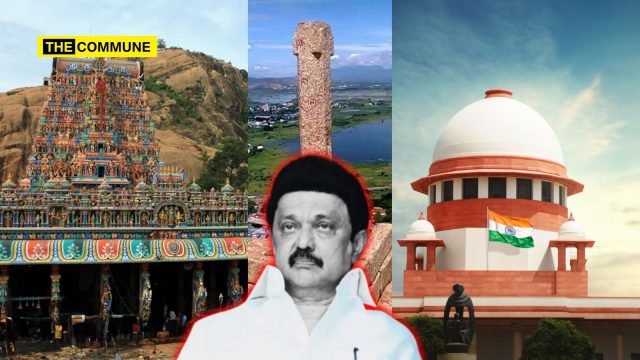
The DMK government in Tamil Nadu has decided to approach the Supreme Court to challenge the Madras High Court’s verdict permitting the lighting of the Karthigai Deepam at the ancient stone lamp pillar (Deepathoon) atop Thirupparankundram Hill, just hours after the High Court delivered its sharply worded judgment.
The decision was confirmed by DMK Law Minister S Regupathy, who stated that the State would “definitely” move the apex court against the ruling. His remarks came amid mounting political and legal reactions to the High Court’s observations, which strongly criticised the State for what it described as the politicisation of a religious and cultural issue.
Government Disputes Existence of the Practice
Responding to questions on the High Court’s findings, the Law Minister reiterated the government’s stand that no historical practice of lighting a lamp at the stone pillar exists.
“The government stand is that there is no lighting done in the stone pillar which is situated on the hill,” Regupathy said.
He claimed that public sentiment in Tamil Nadu did not support the assertion that the Deepam was traditionally lit at the site.
“Most of the Tamil people have the same feeling that there is no such previous incident of lighting the lamp at the top of the hill,” he said, adding that only “some people” were now attempting to politicise the issue.
According to the Minister, these demands were being raised not on the basis of tradition, but as part of a political narrative.
“Some of them now want to make politics out of this. They are interfering and saying that they want to light the lamp on top of the hill,” he stated.
High Court’s ‘Scathing Observations’
The government’s move follows a judgment by the Madurai Bench of the Madras High Court, which upheld a single judge’s order allowing the lighting of the Deepam at the Deepathoon. The Division Bench made strong remarks against the State and district administration, rejecting claims of law-and-order threats and calling such apprehensions an “imaginary ghost”.
The High Court also criticised the manner in which the issue was handled, observing that it should not have been allowed to escalate into a politically charged dispute. It noted that permitting the lighting of the lamp on a single day in a year could not reasonably be projected as a threat to public peace.
While upholding the ritual, the court directed that public access and the conduct of the ceremony be regulated in consultation with the Archaeological Survey of India, given that the hill is a protected site.
State Claims Politicisation by ‘Fringe Elements’
Following the verdict, government representatives maintained that the controversy was being fuelled by political groups rather than historical or cultural necessity.
According to the Law Minister and officials quoted after the ruling, surveys and records available with the State allegedly do not show evidence of the Deepam having been lit at the stone pillar in the past. They asserted that claims of an age-old tradition were not supported by official documentation.
“The government has been firm on its stand for the protection of people’s rights and sentiments,” Regupathy said, explaining the rationale behind challenging the High Court order.
Next Legal Battle Moves to Supreme Court
With the State confirming its intention to file an appeal, the dispute over Thirupparankundram is now set to move to the Supreme Court. The High Court verdict, which had emphasised historical continuity, temple rights, and administrative overreach, will now be tested before the apex court.
Until then, the issue remains legally unresolved, with the High Court’s order standing, even as the State seeks to overturn it at the national level.
Subscribe to our channels on WhatsApp, Telegram, Instagram and YouTube to get the best stories of the day delivered to you personally.