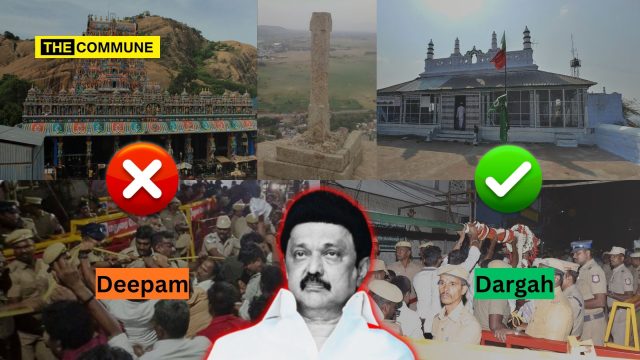
Tension escalated in the Thirupparankundram area of Madurai on Sunday, 21 December 2025, as local residents staged protests accusing the DMK-led Tamil Nadu government of selectively enforcing law and order by denying Hindus permission to light the Karthigai Deepam or even access hilltop temples, while simultaneously granting full police protection to Muslims to conduct the Sandhanakoodu festival and hoist a flag at the Sikandar Dargah.
It is alleged that the immediate trigger for the protest was the administration’s decision to permit the Dargah authorities to take the Sandhanakoodu flagpole to the hilltop under heavy police escort, even as Hindu devotees were barred from ascending the hill for religious purposes. Protesters emphasised that they were not opposing the Sandhanakoodu festival and had no objection to Muslims conducting their religious observances.
It is alleged that the grievance lay in what the locals described as the government’s refusal to extend the same permissions to Hindus. Protesters said the demand was simple: if permission was being granted to one community, it should be granted equally to others. They stressed that Hindus and Muslims in the area had lived together harmoniously like relatives for generations, and that the unrest was being created solely due to administrative discrimination.
Residents alleged that the police had sealed access to the hill entirely for Hindus. They stated that devotees were not even allowed to visit the Kasi Vishwanathar Temple, a longstanding place of worship located on the hill. Protesters questioned whether the Karthigai Deepam dispute had anything to do with that temple or any other department and asked why ordinary devotees were being punished irrespective of the specific legal issue.
View this post on Instagram
Locals stated that while the Dargah administration was being allowed to freely move up and down the hill under police protection, Hindu women who questioned the unequal treatment were allegedly detained without regard to their age or condition. Protesters alleged that women were picked up from the roadside “as if they were international criminals” while they were peacefully standing and raising questions.
They further alleged that even women who attempted to go and speak to or comfort those detained were blocked by police. According to the locals, police personnel discouraged people from approaching the detention site, warning them that they would face consequences if they tried to intervene. Elderly women were also allegedly prevented from even enquiring about the welfare of those detained.
Residents claimed that police confiscated mobile phones and prevented anyone from photographing or recording the situation. They alleged that access was restricted to such an extent that even visitors were interrogated, asked to produce Aadhaar cards, and questioned about whether they belonged to the locality before being allowed to proceed.
Protesters stated that more than twenty women, including elderly women, were present at the site and were not permitted to move freely. They alleged that women arrested earlier in the day were kept inside for hours, and that even relatives and neighbours were barred from seeing them.
Several speakers alleged that the situation illustrated a broader pattern of what they described as increasing police excesses in Madurai. They cited a recent incident in which people were allegedly arrested for lighting a lamp in memory of a deceased individual named Poornachandran, questioning how such an act could be considered unlawful.
Residents questioned why permission to light the Karthigai Deepam continued to be denied despite a court order allowing it. They reiterated that they were not demanding the cancellation of the Sandhanakoodu festival and had no objection to Muslims conducting it. However, they insisted that Hindus must be allowed to light the Deepam or, at the very least, be permitted to visit the Kasi Vishwanathar Temple.
Speakers accused the administration of treating Hindus as a minority despite being numerically large in the country, alleging that none of their religious rights were being protected in the area. They claimed that access to temples, freedom of worship, and even the right to question authorities were being systematically curtailed.
One protester invoked a saying on justice, stating that the words of the powerful were being elevated while the voices of the weak were being ignored. They warned that such a situation would not continue indefinitely and that public resentment was steadily building.
The protesters described the events at Thirupparankundram as a reflection of what they called the “Dravidian Model” of governance under Chief Minister M. Stalin, alleging that the administration’s actions demonstrated an anti-Hindu bias. They asserted that equal application of law was being denied and that selective permission was deepening divisions in an area that had otherwise remained peaceful.
By evening, the Sandhanakoodu flagpole had been successfully taken to the hilltop and installed at the Sikandar Dargah under full police protection. Hindu devotees, meanwhile, remained barred from lighting the Karthigai Deepam or accessing the Kasi Vishwanathar Temple, with protesters declaring that their agitation would continue until equal religious rights were restored.
Subscribe to our channels on WhatsApp, Telegram, Instagram and YouTube to get the best stories of the day delivered to you personally.