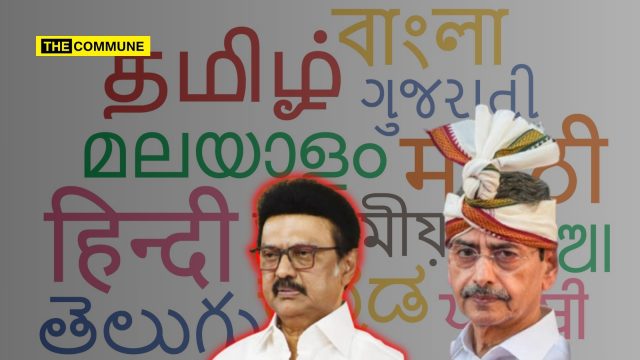
Tamil Nadu Governor RN Ravi has alleged that the DMK government denied linguistic minority communities the right to teach their children their mother tongues in schools, arguing that this suppression continued until the Supreme Court intervened in 2023. In a recent interview with a private news channel, the Governor linked this issue to what he described as a broader ideological framework of “Tamil exceptionalism” driving the state’s politics.
Responding to questions about the political hostility directed at him, Ravi said that the anti-Hindi or anti-north narrative alone does not explain Tamil Nadu’s political character. Instead, he argued, “It is essentially Tamil exceptionalism that Tamil people and Tamil Nadu are distinct from the rest of the country… they call Dravid is a separate race… and Tamil language is a language which has nothing to do with any Indian languages.”
He said both these ideas were rooted in “European origin”, specifically “German Nazis” and “Robert Caldwell” and were used in modern times to justify hostility toward other linguistic groups.
“They hate all other languages other than Tamil”
Ravi said that linguistic minorities—who constitute over 35% of Tamil Nadu’s population—have faced systemic barriers to mother-tongue education.
“In our state, there are over 35% people living of linguistic minority but they are not allowed to teach their mother tongue to their children in schools run by them,” he said. He pointed to events from 2022, claiming the state government “didn’t allow them to do” so even in schools run by minority communities.
According to the Governor, these communities were forced to approach the Supreme Court. “In September 2023 Supreme Court gave a verdict and in that case a state government fought it very strongly to hold their position but Supreme Court said no, linguistic minorities have their constitutional fundamental rights to teach their children their mother tongue.”
Ravi added that the issue extended beyond Hindi: “The reality is they hate all other languages other than Tamil. Linguistic minorities here they are afraid beyond their house to talk in their mother tongue.”
Supreme Court Verdict: Minimum Marks for Mother Tongue Subjects
The case cited by the Governor relates to a 2023 Supreme Court ruling on a petition filed by the Linguistic Minorities Forum of Tamil Nadu.
The Court held that minority schools must prescribe minimum qualifying marks in mother tongue subjects including Urdu, Kannada, Telugu and Malayalam, treating them on par with Tamil and English. This was to ensure genuine proficiency and prevent optional language subjects from being reduced to formality.
The ruling drew upon earlier circulars from 1965, 2010, and 2011 that Tamil Nadu had not fully implemented. The bench emphasised that linguistic minorities’ rights under Articles 29 and 30 include the right to meaningful mother tongue instruction.
The judgment built upon ongoing matters from 2022 (SLP(C) 16727/2022) and earlier orders that extended exemptions from compulsory Tamil papers for minority schools.
Government Resistance and Compliance
The Tamil Nadu government argued that compulsory minimum marks were unnecessary within the state’s two-language policy (Tamil and English). However, the Supreme Court disagreed and directed the state to implement the measures “in letter and spirit.”
Following the ruling, the state revised the Class 10 marks pattern in 2024 to bring minority mother-tongue subjects on par with core languages.
Governor Ravi cited the verdict as proof that the DMK government had withheld minority language rights. He framed it as part of a larger ideological hostility: “So when you talk about Hindi… they hate all other languages other than Tamil.”
Subscribe to our channels on WhatsApp, Telegram, Instagram and YouTube to get the best stories of the day delivered to you personally.