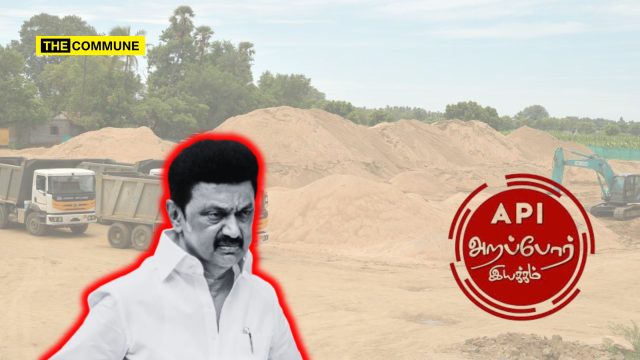
The DMK government’s decision to introduce a one-time regularisation scheme for excess and illegal quarrying has triggered a major controversy, drawing sharp criticism from anti-corruption activists such as Arappor Iyakkam who allege that the order effectively legitimises large-scale mineral plunder instead of enforcing punitive action under existing mining laws.
The Government Order (G.O.), issued recently, provides retrospective regularisation for excess and illegal quarrying carried out from 6 April 2015. The scheme covers violations both within leasehold areas and in non-leasehold zones, including cases where show-cause or demand notices had already been issued by authorities.
Under the new framework, penalties will be calculated using a weighted average seigniorage fee fixed at ₹25 per metric tonne. For quarrying beyond approved lease limits, operators will be required to pay twice the seigniorage fee as compounding charges along with applicable statutory levies. In cases where quarrying took place in non-leasehold areas, the penalty has been fixed at five times the seigniorage fee. The order further stipulates that failure to pay penalties would attract penal interest at 24% per annum. The regularisation window will remain open for two years from the date of implementation.
The government has also made drone surveys mandatory for all operational quarries to assess violations and mineral extraction volumes. Officials said drone mapping had already been completed in 904 of the state’s 1,845 rough stone quarries, with the remaining surveys to be finished within six months.
The scheme is based on the recommendations of a committee constituted in 2023 under the chairmanship of retired bureaucrat K. Allaudin, following representations made by quarry industry associations who argued that existing penalty frameworks were adversely affecting business operations.
Arappor Iyakkam Cries Foul
However, the scheme has drawn sharp opposition from transparency watchdog Arappor Iyakkam, which has formally petitioned Chief Minister MK Stalin seeking withdrawal of the order and initiation of criminal proceedings against illegal miners.
The organisation’s convenor, Jayaram Venkatesan, alleged that the order was arbitrary and contrary to statutory provisions.
He argued that the Mines and Minerals (Development and Regulation) Act, 1957 mandates full recovery of the cost of illegally mined minerals and permits criminal prosecution carrying imprisonment of up to five years. In contrast, he claimed, the State’s order sought to legalise illegal mining through minimal penalties calculated on what he termed an “abysmally low” seigniorage fee, without recovering the actual mineral value.
He further alleged that the move amounted to abdication of the State’s responsibility to initiate criminal action against violators and described the scheme as an attempt to “enrich and protect the illegal mining mafia.”
The order has also triggered political commentary and public criticism, particularly in southern districts where illegal quarrying has long remained a contentious issue.
Arappor Iyakkam cited past allegations of large-scale quarry violations in regions such as Tirunelveli and Radhapuram, where officials had previously estimated illegal extraction running into crores of rupees. He pointed to instances where local revenue authorities had ordered recovery of mineral costs and penalties amounting to hundreds of crores based on the scale of illegal excavation detected.
Venkatesan argued that under existing legal provisions, authorities are empowered to recover the full cost of minerals extracted, impose penalties running into multiple times the royalty value, and initiate criminal prosecution against violators. He contended that replacing such punitive recovery mechanisms with a compounding framework based on reduced seigniorage calculations would substantially lower the financial liability of those involved in illegal mining.
He further raised concerns about environmental and public safety implications linked to unregulated quarrying activities, including excessive blasting, land degradation, and structural damage to nearby habitations and agricultural fields.
Source: Times of India
Subscribe to our channels on Telegram, WhatsApp, and Instagram and get the best stories of the day delivered to you personally.