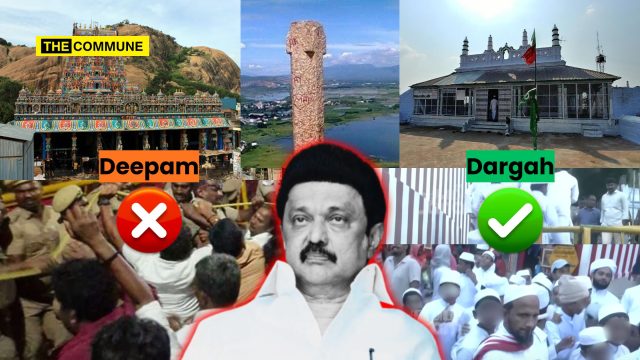
The Santhanakoodu festival at the Sikandar Badusha Dargah atop Thiruparankundram hill was held in the early hours of 7 January 2026 between 2 AM and 5 AM, under restrictive conditions imposed by the Madurai Bench of the Madras High Court. However, the conduct of the festival triggered controversy, with allegations of selective enforcement by authorities, particularly in light of two earlier High Court orders in December 2025 directing that Karthigai Deepam be lit at the Deepathoon, which were not implemented by the DMK government in Tamil Nadu.
December 2025 Karthigai Deepam orders
In December 2025, the Madurai Bench of the Madras High Court twice directed that Karthigai Deepam be lit at the Deepathoon on Thirupparankundram hill. The first order directed the temple administration to perform the ritual. After the order was not complied with, the court passed a second direction permitting the petitioner and 10 devotees to light the Deepam, with CISF protection.
Despite these clear judicial directions, temple and state authorities prevented the ritual from being carried out. Devotees stated that police blocked access to the hilltop and refused to facilitate the lighting of the Deepam, effectively resulting in non-compliance with both court orders as the District Collector imposed Section 163 BNSS (formerly Section 144 CrPC) since there was allegedly a chance for communal tension to arise.
High Court Restrictions for Santhanakoodu
In contrast, for the Santhanakoodu festival at the Sikandar Badusha Dargah, the High Court permitted only a curtailed form of the Urus festival. Justice S Srimathy allowed the Santhanakoodu to proceed while explicitly banning Kandhuri, prohibiting animal sacrifice, and disallowing cooking, carrying, or distribution of non-vegetarian food. Participation was restricted to a maximum of 50 persons, and the order was made applicable from the foothills to the hilltop.
The court also directed the police to strictly enforce law and order and ensure compliance with previous judicial rulings. A plea by the dargah committee seeking relaxation of the 50-person cap was rejected after the State informed the court that the hilltop lacked sufficient space to safely accommodate larger crowds.
Events During The Festival
According to reports, the Santhanakoodu procession commenced after 2 AM on 7 January 2026, with police initially allowing only 50 persons to proceed uphill. Barricades were erected along the hill path and police personnel were deployed in large numbers.
However, local residents and eyewitnesses alleged that after the initial group returned, additional devotees were allowed to access the hilltop, leading to arguments and brief scuffles near the barricades. Police maintained that crowd movement was managed in phases, while critics alleged that the numerical cap imposed by the court was diluted on the ground.
Selective Court Order Enforcement
The sequence of events has intensified allegations of unequal enforcement of court orders by the DMK government. Residents and Murugan devotees pointed out that while the government prevented even a court-permitted Deepathoon lighting involving 10 devotees under CISF protection, it proceeded to conduct the Santhanakoodu festival within, or claiming to be within, the limits prescribed by the High Court.
They argued that the contrast raises serious questions about neutrality, consistency, and adherence to judicial authority, particularly at a site that has seen repeated litigation over religious practices.
As of the morning of 7 January 2026, the Santhanakoodu festival had concluded, but police presence continued in and around Thirupparankundram amid heightened public scrutiny over the implementation of judicial orders.
The Thirupparankundram episode exposes not a failure of administration but a pattern of ideological bias. When the High Court ordered that Karthigai Deepam be lit; first through the temple and then, after defiance, by just 10 devotees under CISF protection, the DMK government suddenly discovered “law and order” constraints and invoked prohibitory powers to shut the ritual down.
But when it came to the Santhanakoodu festival, the same State machinery swung into action to enable the event, regulate crowds, and defend its conduct as compliant with judicial limits, even as those limits were visibly stretched. Is this the message the DMK government wants to send – court orders are enforced or ignored not by their legal force, but by political comfort?
At Thirupparankundram, the DMK government seems to turn neutrality into a slogan, secularism into selectivity, and judicial authority into something that will not be obeyed?
Subscribe to our channels on WhatsApp, Telegram, Instagram and YouTube to get the best stories of the day delivered to you personally.