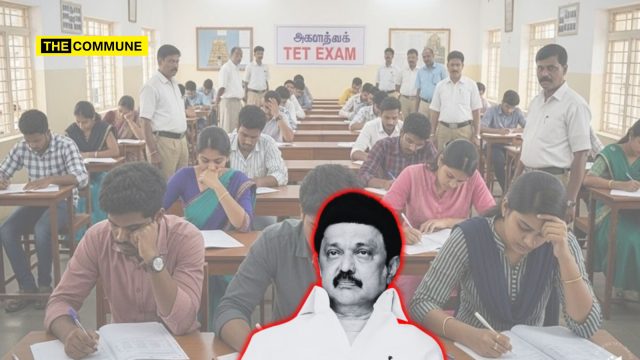
The DMK government in Tamil Nadu has announced that teachers working in government-aided minority schools are exempted from clearing the Teacher Eligibility Test (TET), triggering fresh debate as the decision comes amid conflicting judicial pronouncements by both the Supreme Court and the Madras High Court.
The School Education Department said the decision was taken based on existing judgments of the Supreme Court and the Madras High Court and would bring immediate relief to thousands of teachers whose salaries, increments, or service benefits had been stalled due to non-clearance of TET. The order clarified that teachers appointed in government-aided religious and linguistic minority schools would not be required to pass TET, that no teacher should be removed from service on this ground, and that all withheld salary increments and monetary benefits must be released without delay.
Under the Right of Children to Free and Compulsory Education (RTE) Act, 2009, teachers appointed in government and government-aided schools are required to meet minimum qualifications prescribed by the National Council for Teacher Education (NCTE), including clearing TET. Minority institutions, however, have long argued that this requirement does not apply to them, citing constitutional protections under Article 30 and judicial precedents exempting minority schools from the RTE Act.
Madras High Court’s April 2025 Ruling
The state government’s latest order stands in sharp contrast to a detailed judgment delivered in April 2025 by the Madurai Bench of the Madras High Court, which ruled that TET is applicable to all educational institutions, including minority-run schools.
A Division Bench comprising Justices J Nisha Banu and S Srimathy held that the government is empowered to prescribe minimum educational qualifications for teachers across all categories of schools. The court observed that the NCTE had originally granted five years, later extended to nine years, for in-service teachers to acquire TET qualification, and that appointments and promotions thereafter must be based on possession of TET.
The Bench relied heavily on the Constitution Bench judgment in the TMA Pai Foundation case, which recognised the State’s authority to regulate educational standards, including prescribing qualifications, salaries, and experience for teachers even in minority institutions. The court concluded that exempting minority schools from TET would amount to discrimination under Article 14, as teachers in non-minority schools face denial of appointments, promotions, and even continuation in service for failing to clear the exam.
The judgment categorically held that TET applies to government schools, private aided and unaided minority institutions, private aided and unaided non-minority institutions, and other specified categories, and upheld the education department’s refusal to approve appointments or promotions of teachers lacking TET.
Supreme Court’s September 2025 Ruling
The legal landscape was further reshaped by a landmark judgment delivered by the Supreme Court of India in September 2025. The top court ruled that all in-service teachers of Classes I to VIII in non-minority schools, including those appointed before the TET mandate was introduced in 2011, must clear the examination within two years to continue in service.
The Supreme Court held that TET is not merely an eligibility test but a constitutional necessity flowing from Article 21A, which guarantees the right to quality education. Teachers who fail to clear the exam within the stipulated period would face compulsory retirement with terminal benefits, while those with less than five years to retirement would be exempt from appearing for TET but would be ineligible for promotions. All future appointments, the court said, must mandatorily be TET-qualified.
However, on the question of minority institutions, the Supreme Court stopped short of issuing a final ruling. The court stated that its order would remain outside the purview of minority schools for the time being, noting that the issue requires examination by a larger bench. The judges expressed doubts over the correctness of the 2014 Pramati Educational and Cultural Trust verdict, which had exempted minority institutions from the RTE Act, and referred the matter for authoritative adjudication.
Data from the Teachers’ Recruitment Board shows that Tamil Nadu has conducted the TET only six times since 2012, along with one special examination in 2014. Of over 37 lakh candidates who appeared, only about 1.68 lakh cleared the test, reflecting a pass rate of just 4.5 per cent. Teacher associations have raised doubts about whether more than two lakh in-service teachers without TET can realistically clear the exam within two years.
Legal conflict and Pending Questions
The issue of TET applicability has seen divergent rulings across courts. While the Bombay High Court ruled in 2017 that TET is mandatory even for minority institutions, earlier decisions (2016) of the Madras High Court had held that TET was not enforceable against minority schools, especially for teachers appointed before 2011. The April 2025 Madurai Bench judgment marked a clear departure by holding that minority institutions cannot be exempt from minimum teacher qualification standards.
The Supreme Court, in its latest ruling, highlighted the tension between Article 21A, which guarantees children the right to free and compulsory education, and Article 30(1), which protects the rights of minorities to administer educational institutions. The court observed that quality-control measures such as teacher qualifications do not dilute the minority character of institutions and warned that exempting minority schools from TET could violate the principle of equality under Article 14.
Source: Minnambalam
Subscribe to our channels on Telegram, WhatsApp, and Instagram and get the best stories of the day delivered to you personally.