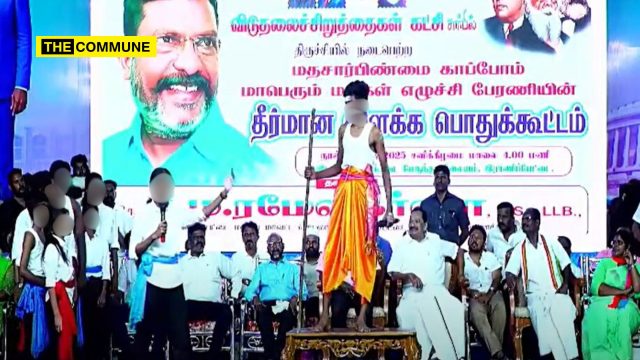
In yet another controversial move targeting the Brahmin community and Hindu religious traditions, the Viduthalai Chiruthaigal Katchi (VCK) has come under fire for featuring children in a politically charged skit at the recent Ranipet Resolution Public Meeting. Critics have condemned the act as a blatant use of minors in political and religious propaganda, raising serious ethical and legal questions.
The skit, presented under the theme “Hindu Religion Is Our Own Religion”, sought to promote a Dravidianist reinterpretation of Hindu deities by portraying them as rebranded forms of the Buddha. It began with children chanting Buddhist mantras such as “Buddham Saranam Gachhami”, followed by Islamic slogans declaring religious and linguistic identity, “My mother and father are not from an Arab country. We are not strangers. Allah is formless to us. Tamil is our mother tongue, and we are Indians. Allahu Akbar.”
The skit then shifted to a dramatized depiction of Hindu caste discrimination. A saffron-clad child, adorned with sacred ash (vibhuti), a janeu (sacred thread), and portraying a Brahmin priest, was shown addressing others with derogatory remarks, “Hey, abhishtu get lost, go away! Come near me only when I call you. Don’t rush forward like a cashew nut!”
Other children were showcased asking, “Saamy! aren’t we Hindus?” claiming to represent the various varna groups Shudra, Vaishya, Kshatriya, and Panchama (Dalits) asserting that they too are Hindus. Then a scene builds a narrative to depict resistance against Brahminical authority, as Dalits. One child portraying a Dalit character challenges the priest’s authority, saying, “Why swamy should we always be at the back? Why should we always stand at back? Test our devotion if you must!”
The priest responds, “What? You want me to test your devotion? Fine, now you’ll understand why I told you to stand at the back. Repeat after me—Om Namo Narayana! Om Namo Narayana! Jai Shri Ram!” All the other varna groups depicted as following his lead and chant as instructed. However, when he turns to the Panchamar girl and asks her to repeat “Om Namo Narayana,” she instead chants, “Namo Tassa Bhagavato Arahato Samma Sambuddhasa,” a Buddhist mantra.
The priest, taken aback, shouts, “Stop! What are you saying? I told you to chant something else. Fine, repeat this instead Jai Shri Ram!” She firmly replies, “Jai Bhim! Jai Bhim!”
The priest then tries to explain that chanting “Namo Narayana” grants one a place in Vaikuntha (the Hindu heavenly abode) and chanting “Jai Shri Ram” grants moksha. But she responds, “Making me stand at the front or back depends on my actions and character, not your permission. Rather than live as a submissive slave just for a place in Vaikuntha, we choose to live freely, even if poor, as the original people of this land as Buddhists! Jai Bhim! Jai Bhim! Jai Bhim! Jai Bhim!”
The skit goes further, making a veiled reference to Union Minister L. Murugan and President Droupadi Murmu, both from marginalized communities, stating that while someone from their background may become a minister or even the president, they can never become a Shankaracharya.
One child asks, “Swamy, we are also Hindus, right? Can we also become Shankaracharyas?” the priest replies, “What a mess! Everyone wants to become a Shankaracharya. Hey, you can even become the President of India, but don’t even dream of becoming a Shankaracharya.” Another asks, “Swamy, what kind of justice is this? Can’t we become Shankaracharyas? Are we not Hindus?” the priest mocks, “Hey Muruga, you can even become a Union Minister, but don’t even think about becoming a Shankaracharya.”
This narrative distorts Hindu traditions. Being born a Brahmin does not automatically grant access to temple sanctums (garbha griha) or ritual authority—such roles are governed by temple Agamas (scriptural codes). Even senior religious figures like Shankaracharyas are not permitted to enter certain temples based on traditional rules.
Observers view the skit as an attempt to reinforce long-debunked Dravidianist propaganda aimed at vilifying Hindu practices and customs, while emotionally manipulating young minds to serve political ends.
Subscribe to our channels on Telegram, WhatsApp, and Instagram and get the best stories of the day delivered to you personally.