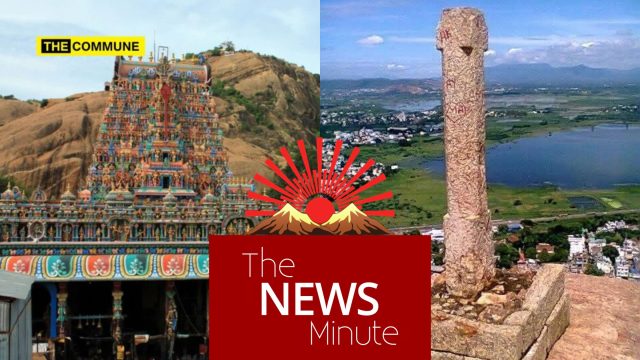
As the Thirupparankundram Karthigai Deepam issue intensifies, the DMK government and its lackeys in the academia and media are attempting a remarkable narrative pivot: to redefine the historically recorded Deepathoon as nothing more than a colonial-era survey stone. The clearest example of this push appears in The News Minute’s (TNM) latest “ground report,” which repeatedly amplifies claims that the Deepathoon is a mere theodolite marker, despite documentary proof published by the Tamil Nadu government itself in 1981 describing the Deepathoon as a sacred hilltop lamp-lighting site.
TNM Tries Hard To Buttress DMK Govt’s Claims
The TNM piece repeatedly stresses that the lamp was never lit there, that the Deepathoon is a theodolite stone, that courts previously ruled in favour of lighting only at Uchchipillaiyar Temple, that the judge’s order is ‘questionable’ and that ‘Hindu groups’ aim to provoke communal tension.
Each of these talking points tracks neatly with the DMK’s line in court, in press conferences, and in ministerial statements.
Yet conspicuously absent is:
- The fact that HR&CE itself argued in earlier cases that Deepathoon existed and it is not a new structure
- Local oral traditions across decades
- References to Sangam-era literary mentions
The contradiction between the state’s earlier position and its stance now
By ignoring the practices of the people, TNM presents the “survey stone” claim as settled fact, when it is, at best, an unverified assertion contradicted by Tamil Nadu’s own documentation.
Selective Evidence: A Feature, Not A Bug
TNM’s framing relies almost entirely on residents who oppose lighting the hilltop Deepam, activists aligned with “secular organisations”, lawyers who have long been critical of Justice GR Swaminathan, and retired officials offering technical opinions about survey stones.
But when residents who support hilltop Deepam lighting are quoted, their statements are treated as anecdotal or politically influenced.
What is missing is the foundational principle of any balanced ground report – The state’s own historical record.
By excluding it, TNM constructs a narrative bubble in which the Deepathoon has no sacred past, no ritual continuity, and no cultural legitimacy.
Why The “Survey Stone” Narrative Matters To The DMK
If the Deepathoon is accepted as a sacred site that has historical continuity and also recognised by local residents, then the state’s refusal to implement High Court orders becomes far harder to justify.
By portraying the Deepathoon as a meaningless colonial marker, the state reframes the issue as one of “law and order,” not religious freedom, the government positions itself as protecting communal harmony, anyone demanding access appears extremist or politically motivated, and judicial orders enabling ritual access can be attacked as reckless.
In effect, the “survey stone” narrative is the foundation for the government’s entire defence.
TNM frames the Deepathoon movement as a “Sangh mobilisation ignoring historical evidence.”
But the only historical evidence ignored in this debate by TNM is the one produced by the Tamil Nadu government itself in 1981.
The attempt to recast Deepathoon as a trivial colonial marker rather than a sacred ritual site recognised by Tamil scholars and residents reveals a deeper political discomfort – the Deepathoon’s historical and cultural legitimacy undermines the DMK’s current narrative.
TNM’s reportage, which seems to be more out of editorial convenience, amplifies only one side of the historical argument, that which aligns with the ruling party’s immediate political needs.
To reduce Deepathoon to a mere “survey stone” is an attempt to erase Tamil Nadu’s own documented heritage in service of a contemporary political argument.
Subscribe to our channels on WhatsApp, Telegram, Instagram and YouTube to get the best stories of the day delivered to you personally.