The Indian Express published an opinion piece by DMK/I.N.D.I ally Samajwadi Party spokesperson Ghanshyam Tiwari that attempts to portray a hypothetical Middle East escalation as a “Black Swan event” that could bring down the BJP government. The piece frames a potential conflict involving Iran, Israel, and the United States not as a serious geopolitical crisis but as a possible political turning point in Indian domestic politics.
It reads less like geopolitical analysis and more like a political prayer that a regional crisis will become the BJP’s electoral undoing. Let us take it apart, claim by claim.
The Indian Express Deleted the Post On X But Left the Article Up
Before even engaging with the article’s content, there is a separate and pointed question of editorial conduct to address. The Indian Express published the op-ed and shared it on its official social media handles.
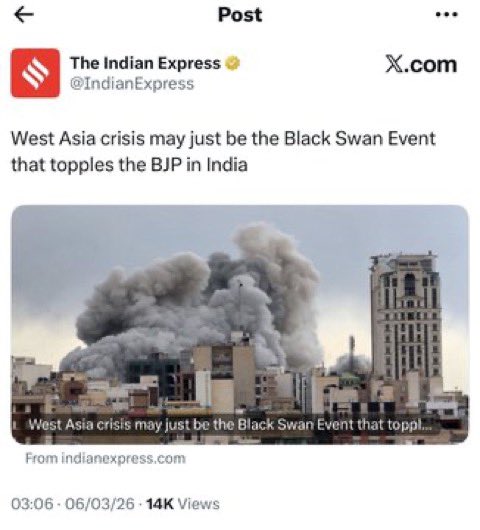
Then, following a wave of public backlash pointing out the op-ed’s wishful thinking and brazenly partisan framing, the newspaper quietly deleted its social media post promoting the piece. The article, however, remains live on its website.
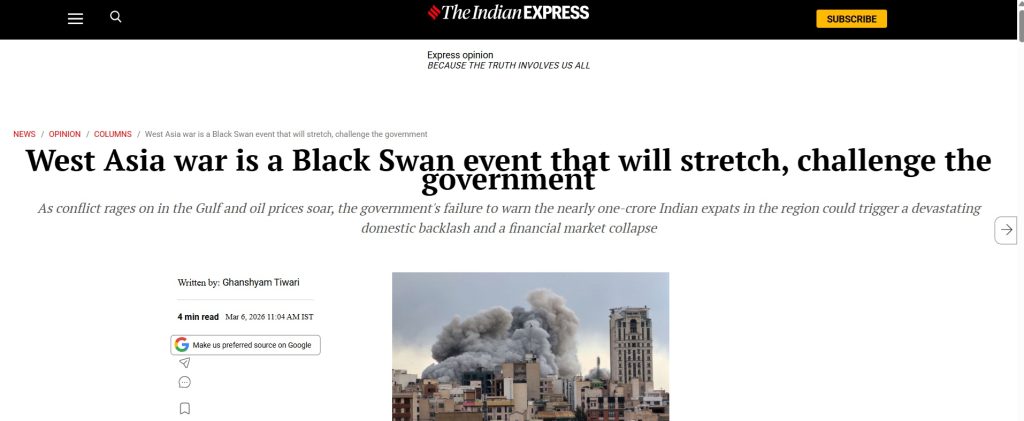
This tells you everything about the editorial calculus at play. The newspaper knew, after the backlash hit, that the piece was indefensible in public. Deleting the tweet was an acknowledgment of that. Yet the article stayed up, meaning the retraction was not based on principle but on optics management.
The Indian Express wanted to limit the social media damage while keeping the search-engine-indexed article in place for continued circulation. That is not editorial courage. That is having it both ways. A publication with genuine editorial standards would either defend its decision to platform the piece publicly and fully, or issue a correction. Silently deleting the social media post and hoping no one notices is the behaviour of an outlet that knows it got caught, not one that stands behind its editorial choices.
It also reveals the asymmetry in how The Indian Express treats controversy: when backlash comes from the right, the post disappears. When backlash comes from the left, the full editorial apparatus mobilises in defence of the author. The standard is plainly political.
The “Silence” That Wasn’t Silent
The op-ed’s most glaring factual failure is its central charge: that the Modi government “did nothing” and that its “silence speaks volumes.” This is simply false. Within 48 hours of the conflict’s escalation, Prime Minister Modi chaired an emergency meeting of the Cabinet Committee on Security specifically focused on the safety of India’s nearly 90 lakh Gulf expatriates. He then conducted a rapid diplomatic blitz: holding calls with the leaders of Bahrain, Saudi Arabia, UAE, and other Gulf states, condemning the attacks and pressing for de-escalation. The Ministry of External Affairs had in fact issued travel advisories for Iran as early as January 5 and January 14, weeks before hostilities fully escalated, urging Indian nationals to leave by any available means. India issued one again on 23 February 2026.
For the UAE specifically, advisories were issued on February 28 and again on March 3. IndiGo and Air India added special flights to evacuate stranded Indians, and Etihad flights were already resuming operations from Dubai and Abu Dhabi at the time the op-ed was published.
Moreover, India has repeatedly demonstrated its ability to respond effectively during regional emergencies. From Operation Rahat in Yemen (2015) to Operation Ganga in Ukraine (2022) and evacuations during conflicts in West Asia, New Delhi has built a strong record of protecting its citizens abroad when crises unfold.
The insinuation that the government knowingly withheld warnings from expatriate Indians in the Gulf is not analysis; it is speculation bordering on political theatre.
The article either did not know these facts or chose to ignore them. The Indian Express published it either way.
The IRIS Dena: Weaponising a Tragedy
The sinking of IRIS Dena, a genuine tragedy in which over 100 sailors remain missing, is deployed in the op-ed as evidence of India’s “submission” to the US and Israel. The IRIS Dena was sunk by a US Navy submarine in international waters approximately 20 nautical miles west of Galle within Sri Lanka’s Search and Rescue responsibility zone, not India’s.
India is not a military alliance partner of Iran, was not IRIS Dena’s escort, and has no operational obligation to intercept a US submarine strike in open ocean. Yes, India did invite Iran to participate in the MILAN 2026. Once a participating vessel departs Indian waters and re-enters the open ocean, it reverts fully to its own nation’s operational command and responsibility. India has zero legal, operational, or treaty-based obligation to escort it beyond Indian territorial or exclusive economic zone waters.
No navy in the world escorts foreign exercise participants back to their homeports. The US, UK, France – none of them escort Indian Navy ships back to Visakhapatnam after joint exercises. The obligation simply does not exist in any framework of international maritime law or naval protocol. Holding India responsible for IRIS Dena’s fate after it left Indian waters would be equivalent to holding a host country responsible for a visiting diplomat’s car accident after they crossed the border. The logic does not survive basic scrutiny.
The Indian Navy is, however, already conducting search and rescue operations, which is exactly what India can and should do.
The Strategic Autonomy India Is Actually Exercising
The deeper geopolitical reality the article deliberately ignores: India is the only major power talking to all sides simultaneously. Modi has engaged Netanyahu, Gulf Arab leaders, and kept Iranian diplomatic channels open. India abstained rather than aligned during relevant international deliberations. India has very little to gain by taking a hard stand in such a situation. This is not submission to the US-Israel axis, as the article implies. If it were, a nuclear-armed India with US-supplied technology would have been an active staging ground for strikes on Iran. It obviously is not.
India today is one of the few countries that maintains working relationships with every major power bloc in the Middle East. This diplomatic flexibility, often described as strategic autonomy or multi-alignment, allows New Delhi to protect its interests in an increasingly polarised world.
The region has faced crises before, and it will face them again. India’s response will continue to be guided not by partisan anxieties but by long-standing principles of pragmatic diplomacy, strategic balance, and the protection of Indian citizens worldwide.
That is not geopolitical analysis. It is partisan speculation masquerading as strategy.
Subscribe to our channels on Telegram, WhatsApp, and Instagram and get the best stories of the day delivered to you personally.