


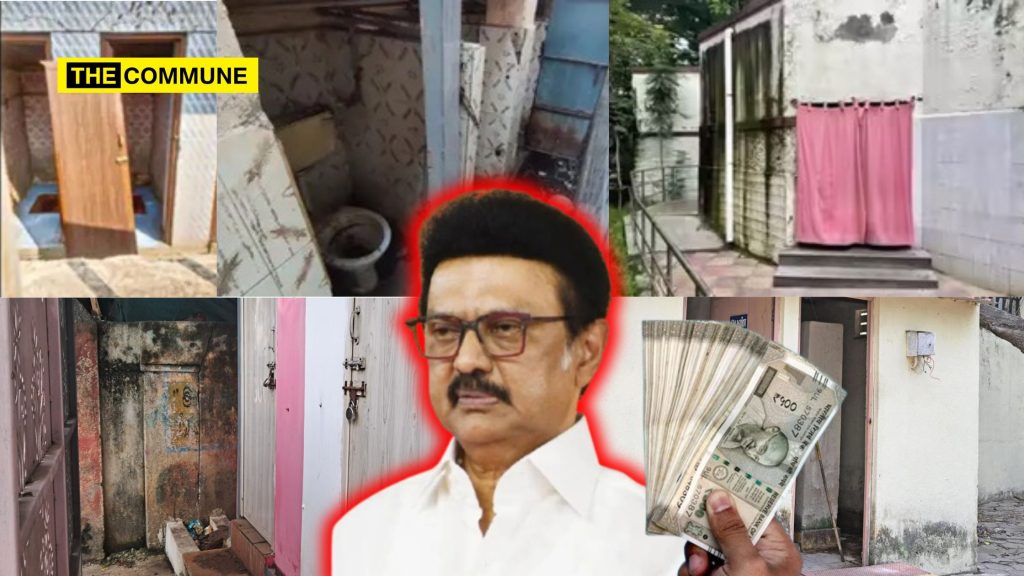
The Greater Chennai Corporation’s grand “Singara Chennai 2.0” promise has disintegrated into a public health disgrace, with over ₹1,100 crore flushed into toilet construction, privatisation, and maintenance schemes over the past decade — all for facilities that remain stinky, unusable, and in some cases, physically crumbling.
Marketed as a symbol of the Dravidian Model’s commitment to urban upliftment, Chennai’s public toilet infrastructure today stands as its most pungent failure.
Toilets Missing, Sealed Or Cracked But Contracts Flow
Between 2019 and 2024, the Corporation spent ₹620 crore under the Swachh Bharat Mission (SBM) to build and maintain 10,000 public toilet seats across 1,260 locations. Another ₹430 crore went into a nine-year toilet privatisation deal, one of India’s first, for just two zones: Royapuram and Thiru Vi Ka Nagar, plus parts of Marina. ₹50 crore more was spent on mobile toilets, e-toilets and so-called “Oppanai Arai” facilities under Singara Chennai. Yet the on-ground reality reeks of corruption, neglect, and absence of oversight.
In Anna Nagar, an entire 10-storey SBM toilet that still shows on Google Maps is now completely missing. In Tower Park, the women’s side of a toilet had no door, just a pink curtain. At the SBM toilet near Rajarathinam Stadium in Egmore, there was no staff, no cleanliness, and no CCTV, despite tender requirements mandating all three.
In Adyar, ₹1.6 crore was spent in just six months to maintain toilets. Yet at one location, the commode was found sealed with cement and the toilet shut down. At Indira Nagar, the e-toilet marked on Google Maps was removed five months ago without explanation.
Apparao Gardens: Toilets From A Horror Movie
At Apparao Gardens in Aminjikarai, a 20-year-old toilet looks like it belongs in a warzone. The floor is lined with water-filled holes. One cracked wall looks ready to collapse, and a stray dog was spotted resting on the commode. Local resident Padmini summed it up: “Using a restroom shouldn’t be something that threatens your safety.”
From ₹3.18 To ₹364 Per Seat: A 100x Inflation Of Maintenance Cost
GCC’s own figures reveal staggering cost inflation: maintenance cost per toilet seat jumped from ₹3.18 to ₹364, more than 100 times what leading private agencies charge. Despite zero enforcement of key performance indicators (KPIs), such as cleanliness, staff presence, CCTV, or functioning sewage lines, not a single contractor has been blacklisted. Not even RSB Infra, which holds contracts for Royapuram and Thiru Vi Ka Nagar.
In council meetings, even ruling DMK councillors flagged the Corporation’s total failure to implement sanitation standards. Accounts Committee chairman K Dhanasekaran admitted on record that the GCC lacks both technical expertise and funds to manage basic public toilets.
Mobile Toilets Vanished; Privatisation Push Escalates
Mobile toilet buses launched with great fanfare last year by Mayor R Priya have disappeared without a trace. Still, officials remain committed to the same privatisation model that’s already failed, now expanding it with a proposed ₹1,243 crore project across the remaining 13 zones.
Work has been completed only in zones 5, 6, and the Marina stretch. The remaining packages are split among private firms like Sumeet Facilities, JCV Marketing, Fergra Enterprises, and TD Engineering. But the rest of the city has waited nearly two years as the corporation cites “tedious approval processes” for delays, even as toilet conditions worsen.
Oppanai Arai: An Exception, Not the Rule
Only a few Oppanai Arai toilets, launched under Singara Chennai 2.0, show signs of success. At some locations like Rajarathinam Stadium and Moore Market, daily maintenance is tracked via WhatsApp, CCTVs are operational, and toilets are accessible to persons with disabilities. But these are isolated examples in a system drowning in dysfunction.
The Dirty Dravidian Model, Exposed
While the DMK government touts its urban schemes as symbols of inclusive governance, the toilet scandal in Chennai paints a far darker picture, one of inflated contracts, hollow infrastructure, absent accountability, and sheer contempt for the urban poor.
The ₹1,100 crore toilet fiasco is no longer just a story of public sanitation; it is a litmus test of the Dravidian Model’s credibility in delivering basic dignity to its citizens.
How much was siphoned?
- ₹620 crore under Swachh Bharat Mission
- ₹430 crore on Royapuram + Thiru Vi Ka Nagar privatisation
- ₹50 crore for mobile, e-toilets and Oppanai Araai
- ₹1,243 crore project for remaining 13 zones pending approval
- ₹4.5 crore ‘She’ Mobile Toilet Buses missing from city streets
So much money spent and yet, dogs on seats, curtains for doors, and toilets that don’t exist.
Greater Chennai Corporation’s Singara Chennai dream has sunk into stench. Even after more than ₹1,000 crore was spent to clean public toilets and another Rs 1243 crore to be spent this year, they remain stinky, dirty and in a ramshackle state.
In order to clean, maintain and… pic.twitter.com/0O4wdPntVU
— Omjasvin M D (@omjasvinMD) July 29, 2025
(With inputs from Times Of India)
Subscribe to our channels on Telegram, WhatsApp, and Instagram and get the best stories of the day delivered to you personally.