


The DMK has long projected itself as a progressive force claiming to have “broken the shackles of patriarchy” under the guidance of its ideological forefather, E.V. Ramasamy Naicker. However, the reality appears far from this self-congratulatory narrative. Practices like bigamy and polygamy continue to thrive within the party’s ranks a glaring contradiction to their rhetoric of women’s liberation.
A prime example is senior leader, party treasurer and DMK MP TR Baalu. Baalu is married to both Renuka Devi, his long-time partner, and Porkodi, his niece. Together, they have five children three sons and two daughters.
The issue of Baalu’s dual marriages came under public scrutiny as far back as 2004, during his candidacy for the South Chennai Lok Sabha constituency. S. Purushothaman, an independent candidate, filed a complaint with the Election Commission, alleging that Baalu had violated provisions of the Hindu Marriage Act and the Indian Penal Code by listing two spouses T.R.B. Porkodi and B.R. Renukadevi in his election affidavit. He demanded Baalu’s disqualification. During scrutiny, Karate Thiagarajan, then Chennai’s Deputy Mayor and AIADMK member, also objected to Baalu’s nomination based on this revelation. Yet, the returning officer dismissed the objections and cleared Baalu’s candidature.
Despite the controversy, Baalu has consistently listed both wives in his election affidavits across multiple years, including 2009 and 2024. His financial disclosures not only confirm the existence of two spouses but also detail shared ownership of assets, including:
In 2009, he declared assets worth ₹7.69 crore, distributed among himself and both wives. In 2014, he declared 20.15 Crores.
By 2024, the declared assets had risen to ₹17.40 crore, including movable assets worth ₹1.08 crore and immovable property valued at ₹16.31 crore. His 2024 affidavit showed his asserts with both his wives.

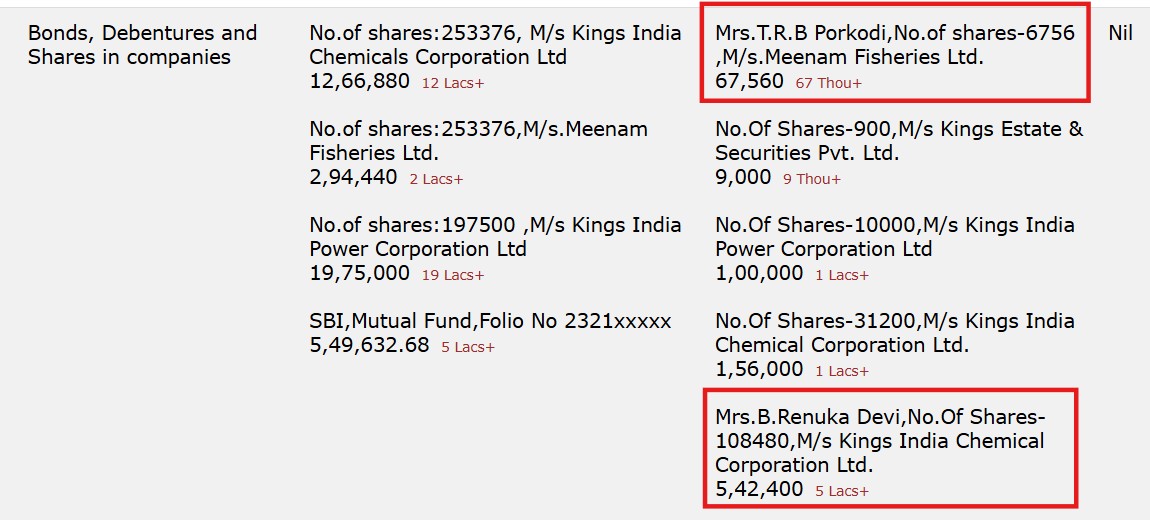



While government employees and even local body election candidates are disqualified for minor technicalities, a sitting MP who openly practices bigamy faces no consequence. The DMK continues to uphold its “rationalist” image, loudly praising EVR’s legacy for liberating women, yet permits and even promotes leaders who violate basic tenets of gender justice.
Baalu, now 82 and DMK MP from Sriperumbudur, remains one of DMK’s most senior and influential figures. The party has never addressed the contradiction between its stated ideology and the personal lives of its top brass a silence that exposes the hollowness of its commitment to women’s equality.
In truth, the DMK’s glorification of EVR’s social reforms rings hollow when its own senior-most leaders live in open contradiction to those very ideals. The gap between ideology and practice is no longer a crack – it’s a chasm.