


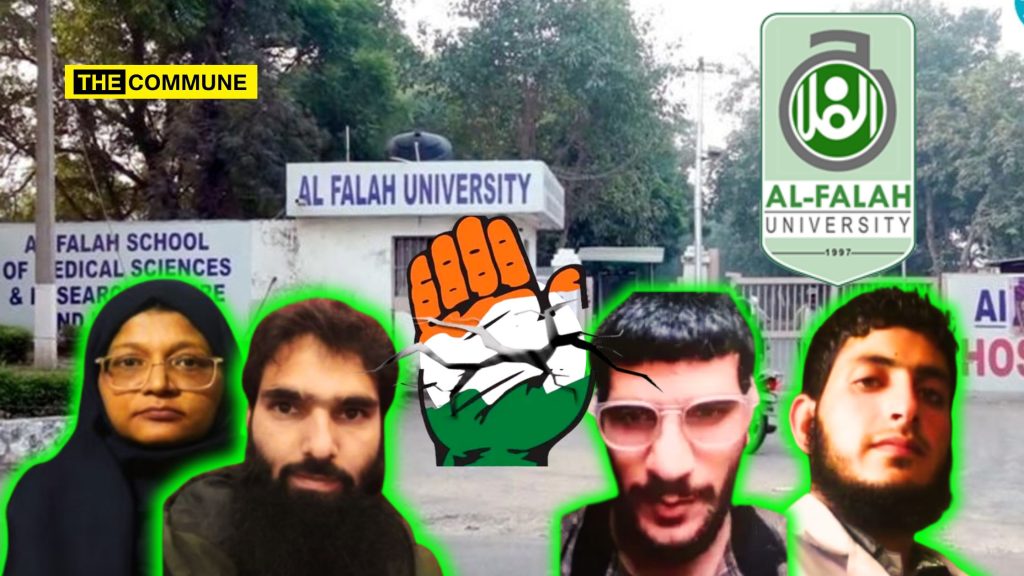
A sprawling 70-acre private campus in the foothills of the Aravalis, Al-Falah University in Dhauj, Faridabad, has become the focal point of a massive anti-terror investigation, unmasked as the operational hub for a sophisticated “white-collar” terror module with links to Pakistan-based Jaish-e-Mohammed (JeM) and Ansar Ghazwat-ul-Hind.
The Al-Falah University, established in 2014 under the Al-Falah Charitable Trust, that was formed in 1995 and began as an engineering college in 1997, located just 30 km from the national capital, is under the scanner following the arrest of multiple doctors on its faculty and staff in connection with the Delhi car blast that killed more than 10 people and a massive haul of explosives.
In 2013, Al-Falah Engineering College received ‘A’ category accreditation from the National Assessment and Accreditation Council (NAAC). Al-Falah Medical College is also affiliated with this university.
However, the National Assessment and Accreditation Council (NAAC) on 13 November 2025 has clarified that Al-Falah University in Faridabad is not accredited and has never applied for accreditation. NAAC has issued a show-cause notice to the university for falsely displaying accreditation claims on its official website.
On 2 May 2014, the Haryana government amended the Haryana Private University Bill (2006) and granted it recognition as a private university. At that time, the state government was run by Congress and Bhupinder Singh Hooda was the Chief Minister. Through the Haryana Private University Amendment Bill (2014), approval was granted to a total of 17 private universities in the state.
Given the proximity to the national capital and the vast campus size, one but wonders whether it was the Congress government which allotted the prime property to the trust in question for a miniscule price.
Was Free/Subsidized Land Given To Al-Falah University?
As per reports in the media, according to alleged documents, the allotment was made under the banner of “promoting minority education.” Critics at the time described it as politically motivated, questioning why such a large tract of land was transferred without competitive bidding or financial consideration.
The Trust’s managing trustee, Javed Ahmed Siddiqui, had already drawn public attention for a questionable track record, raising further concerns.
Did The Grant Enable Years Of Lapses?
Since its establishment, Al-Falah University has been linked to:
- Academic programmes run without full statutory recognition (2014–2018)
- Student complaints over result delays and mark sheet discrepancies
- Irregular fee hikes of nearly 28%
- Vacant faculty positions and compromised academic quality
- Degree-verification failures affecting job applicants in several states
- Allegations of minimal or no reservation for SC, ST, and OBC communities despite occupying public land
- A 2020 state inquiry found incomplete documentation, missing records, and administrative inconsistencies.
Did The Land Grant Contribute To Terror?
Following the blast near Delhi’s Red Fort Metro station, the university has come under scrutiny after certain faculty members or former students were mentioned in terror-related investigations, prompting security agencies and the Haryana administration to launch fresh reviews of the campus, land use and regulatory compliance.
The Key Players: Doctors Turned Alleged Terror Operatives
Investigation has revealed that at least five individuals associated with the university’s medical college and hospital are central to the terror plot.
Dr. Muzammil Shakeel (aka Dr. Muzammil Ganaie): A 35-year-old doctor from Pulwama, Kashmir, he was employed at the Al-Falah School of Medical Sciences and Research Centre. His arrest on 8 November 2025 was the breakthrough, leading to the recovery of a staggering 2,900 kg of IED-making materials, primarily ammonium nitrate, from two rooms he rented in Faridabad. He is alleged to be a core member of the JeM module.
Dr. Umar Mohammed (aka Umar Nabi): Also, from Pulwama, he was the driver of the i20 car that exploded near the Red Fort metro station on 10 November 2025. He joined Al-Falah University in 2021. Investigations reveal he left the university campus immediately after Dr. Muzammil’s arrest and was in hiding for 10 days before executing the blast. A red Ford EcoSport, believed to be owned by him, has also been recovered for investigation.
Dr. Shaheen Saeed: Dr Shaheen Saeed (also reported as Shaheen Shahid or Shaheen Sayeed) was serving on the medical faculty at Al-Falah University’s Medical College in Faridabad. She was arrested on 11 November 2025. She is accused of being a key operative tasked with establishing JeM’s women’s wing, ‘Jamaat-ul-Momineen’, in India. An assault rifle, pistol, and ammunition were recovered from her Maruti Suzuki Swift car, which was frequently used by Dr. Muzammil, pointing to her active logistical role.
Dr. Adeel Ahmed Rather: From Kulgam, Kashmir, he was employed at the university and was arrested from Saharanpur, Uttar Pradesh after he was spotted putting up posters of Jaish-e-Mohammed in Srinagar on 27 October 2025. CCTV footage from the area led to his arrest in Saharanpur, in a joint operation by J&K and UP Police.
Dr. Nisar-ul-Hassan: A professor in the department of medicine, he has been reported missing since the Red Fort blast. Significantly, he was dismissed from Shri Maharaja Hari Singh (SMHS) Hospital in Srinagar in 2023 by the Jammu and Kashmir Lieutenant Governor for alleged “anti-national activities.”
The University As A Terror Base: Evidence And Planning
Investigators paint a picture of the university being used as a secure base for meticulous planning over two years.
Diaries and Coded Plans: Notebooks recovered from Dr. Muzammil’s (Room 13) and Dr. Umar’s (Room 4) campus lodgings contained coded references, names, and numbers with dates from November 8-12, with the word ‘operation’ scribbled repeatedly. This suggests the group was planning multiple synchronized strikes, with the Red Fort blast likely being one part of a larger carnage.
Logistical Hub: The module used the university’s proximity to Delhi and its campus facilities to operate under the radar. The suspects’ vehicles were parked on campus, and they coordinated movements from there.
Recruitment Scrutiny: The university’s hiring process has come under severe criticism. Both Dr. Umar and Dr. Nisar-ul-Hassan were hired despite being dismissed from their previous government positions in Kashmir for negligence and alleged anti-national activities, respectively, raising serious questions about the institution’s background verification policies.
While no institutional guilt has been established yet, the recurrence of the university’s name in such probes has intensified questions around oversight and the original decision to grant the land.
Al-Falah Trust
The institution is run by the Al-Falah Charitable Trust, headquartered in Okhla, New Delhi, with Prof Jawad Ahmad Siddiqui as its Chairperson and Chancellor. Reports have noted past legal issues for Siddiqui and that the university receives foreign funding from Arab nations, as reported in Times of India.
Jawwad (Jawad) Ahmad Siddiqui is a controversial businessman whose name has surfaced repeatedly in major financial fraud cases involving alleged “Islamic investment” schemes in Delhi. As chairman of the Al-Falah Group, Siddiqui along with his brothers was reportedly arrested and lodged in Tihar Jail for a multi-crore scam in which the company allegedly collected massive deposits from the public, particularly from Muslim households and even madrasas, under the guise of high-return halal investment schemes.
Reports from the time describe how Al-Falah promised impossible dividends of 35–40% annually and went on to collapse, leaving hundreds of small investors devastated and unable to recover their savings. Siddiqui’s family was also linked to another collapsed firm, Al-Fahad Investment, run by his brother Hamood, which similarly disappeared with depositors’ money after RBI rejected its registration. Despite this history, questions have resurfaced today as Siddiqui’s name appears to be associated, at least online, with Al-Falah University, raising concerns about how an individual previously jailed for large-scale fraud could transition into the leadership of a private university and whether the same person is involved.
The Central Question
As inquiries continue, the core issue being raised in political and administrative circles is whether it was justified for the Congress government (if it did) to give 70 acres of valuable public land free of cost/at a subsidized cost to Al-Falah Trust – an institution that would later face allegations ranging from academic violations and administrative failures to security concerns?
The Haryana government’s current investigations may determine whether the 2014 allotment served public interest or represents a case where a politically motivated decision created long-term risks.
Subscribe to our channels on WhatsApp, Telegram, Instagram and YouTube to get the best stories of the day delivered to you personally.