


Sometimes a film isn’t just cinema. It’s a statement. Our art is a reflection of the society that we live in today. And Aditya Dhar’s Dhurandhar is a statement – that this is a new India that is unapologetic and gives back as good as it gets. Our soldiers enter our enemy’s homes and beat them to pulp. Our artists and storytellers are now doing the same.
Dhurandhar feels like a classified dossier opened for the public — every frame signalling an India that has moved from defence to offence, turning cinema itself into a cultural surgical strike against decades of narrative assault by D-gang filmmakers.
Bollywood finally gets a political action drama that isn’t scared of Pakistan, the ISI, or the Congress ecosystem—and most importantly, a film that doesn’t tiptoe around historical realities.
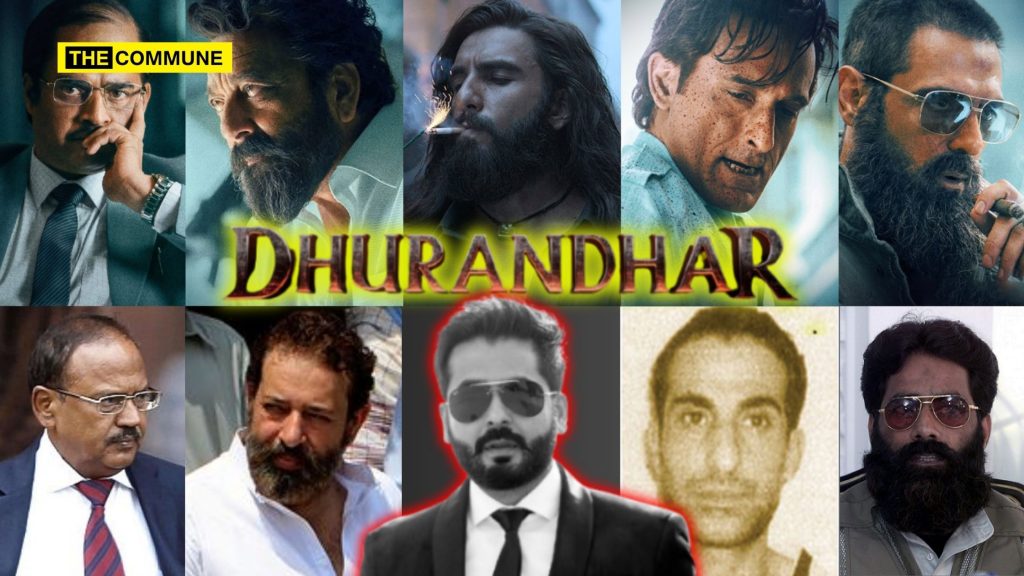
But before we go ahead with the review, it helps tremendously to know the real figures whose shadows loom large over the film.
The Real Men Behind The Reel
Rehman Dakait Played By Akshay Khanna
The feared Karachi crime lord, was more than a gangster—he was a quasi-political actor protected by Pakistan’s deep state. His reign over Lyari forms the violent texture of the film’s Karachi underworld, and Akshay Khanna infuses that biography with a menacing and terrific performance.
Chaudhry Aslam Played By Sanjay Dutt
Pakistan’s infamous “encounter specialist” who led the Lyari Task Force against Karachi’s underworld before terrorists assassinated him in 2014. Sanjay Dutt’s role is clearly modelled on him—steely, haunted and built on a lifetime of combat with Karachi’s monsters.
Ilyas Kashmiri Played By Arjun Rampal
Former Pakistani commando turned global jihadi asset, deeply tied to ISI operations and cross-border terror campaigns. Arjun Rampal’s character channels the cold-blooded tactician Kashmiri was.
Ajit Doval Played By R. Madhavan
And in unmistakable shadows stands Ajit Doval, India’s living legend of covert doctrines and national security strategy. Dhar never names him, but the film breathes Doval’s worldview—the doctrine of offence as defence.
The Hits
The film begins, in classic Aditya Dhar style, in sharply defined chapters—each chapter world-builds, introduces new characters, creates a texture, ends with a bang and shifts us into a deeper labyrinth. By the interval (two hours into the film!) you don’t even realise time has passed. The pace is relentless.
This isn’t Bollywood’s usual cardboard Pakistan. Dhar takes us into the dirty gutters of Lyari, the gang alleys, the ISI-controlled shadows, and Pakistan’s terror breeding underbelly with frightening authenticity. It feels like Dhar himself air-dropped into Karachi taking notes like a R&AW operative to draw the viewers into the dirty miserable hellhole called Pakistan and Pakistanis are shown like they deserve to be shown.
The authenticity hits like a gut-shot: Dhar’s research feels forensic, as if he embedded with ghost operators, sketching Lyari’s bullet-riddled bazaars and Peshawar’s teeming madrasas. Dhar can probably add “Expert on Pakistan Affairs” to his Insta bio—he’s earned it. Dhar deploys Guy Ritchie-esque on-screen text blasts to tag characters.
The violence in the film is Tarantino-esque in its rawness and unflinching brutality, but it goes a step further. The gore doesn’t feel stylised—it feels disturbingly real. Dhar doesn’t just show violence, he makes you feel it. Unlike Tarantino, where you admire the craft of bloodshed from a safe cinematic distance, Dhurandhar drags you into the visceral pain of it. You don’t just witness the violence—you absorb it.
Akshaye Khanna’s Rehman Dakait is the film’s feral heart—tight-lipped menace propelling the plot more than Singh’s brooding Hamza, who arrives looking every inch the chiseled “chad” but shines in quiet vulnerability. Sanjay Dutt’s Chaudhary Aslam is a powder-keg patriarch, his gravelly Pashto inflections evoking the real cop’s doomed valor. Arjun Rampal slinks as Ilyas Kashmiri, all icy calculation, while Sara Arjun slips into Yalina’s skin, though their romance feels like the one soft spot in this ironclad tale. R. Madhavan pops as the Doval-like RAW head, his silences louder than soliloquies during the first 10 minutes of the film.
The Misses
If there’s one place the film overindulges, it’s in the length of the action and chase sequences. A tighter edit would’ve made them far more impactful, because after a point the outcome becomes predictable.
The romance between Hamsa and Yalina, too, needed more emotional depth. The stakes feel oddly low, making the track come across as formulaic rather than integral.
And while the narrative relies heavily on dialogue to unfold the larger conspiracy, there are moments where it slips into a cinematic-documentary tone. A more organic integration within the screenplay—rather than spoken exposition—could’ve made these revelations even more powerful.
Dhar, The Dhurandhar
Aditya Dhar holds no punches and rips apart Congress laying bare its sins. If you’ve brushed up on UPA-era scandals or 26/11 intel lapses, every frame lands heavier.
The film reveals how the Congress-led UPA sourced Indian currency security material from the British firm De La Rue—the very same company supplying Pakistan—jeopardizing India’s national security, implicating a senior Congress leader and his son in the process.
There’s a scene involving Ajit Doval look-alike Madhavan briefing the Minister while the R&AW head who resembles AS Dulat, is seen going soft on Pakistan.
The film also discusses how counterfeit notes, terror funding make their way into India through illegal slaughter houses in Uttar Pradesh and the ‘secular’ politics that shield them. It feels like Dhar asking the viewers “Do you understand the reason behind demonetization now?” but without preaching or cinematic dialogues.
Perhaps the most devastating is Dhar’s portrayal of 26/11 Mumbai terror attacks and the events leading upto it.
In the second half comes the most haunting moment of the film. It’s not even a scene—just a blood-red screen, stark black text, and chilling voices echoing in the background. No characters, no action, nothing “cinematic” in the traditional sense. Yet Aditya Dhar folds a real-life incident into his fictional universe with such precision that the hall froze in pin-drop silence. The audience wasn’t watching a scene—they were experiencing a cold, uncomfortable truth.
He drives home the point that never ever should Congress come to power.
Aditya Dhar practically lined up Congress, Pakistanis and the ISI like guilty suspects, pulled out a lathi of cold facts, and landed blow after blow—right on their backs. The line “Ghayal hun isiliye Ghatak hun” (I am wounded, therefore I am lethal), delivered near the film’s climax, isn’t just a dialogue—it’s the declaration of Dhar and the New India itself.
Anupama Chopra has called the film laden with “shrill nationalism” and “inflammatory anti-Pakistan narrative”. Dhruv Rathee compared Dhar to ISIS because he cannot digest India finally portraying Pakistan exactly as it is — a terrorist manufacturing factory calling itself a country.
Their outrage proves Dhar’s accuracy. Period.
Dhurandhar isn’t cinema.
It’s a debriefing.
It’s a counter-attack.
It’s a cultural surgical strike.
And yes—Congress, Pakistan, and their loud online lackeys will cry. If Pakistan and its loyal Indian proxies are rattled, Operation Dhurandhar is already successful.
Waiting for more of their meltdown in March 2026.
S Kaushik is a political writer and a film buff.
Subscribe to our channels on WhatsApp, Telegram, Instagram and YouTube to get the best stories of the day delivered to you personally.