“If you fall upholding Dharma, you will attain heaven. If you are victorious, the world is yours. So rise, O Arjuna, and prepare yourself for battle.” — Bhagavad Gita (2.37)
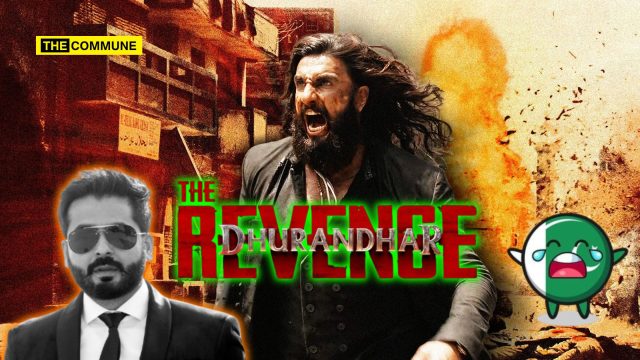
Let me just say this right at the beginning – Dhurandhar 2 operates on such a high-octane, testosterone-charged frequency that the energy in the theatre is unreal. It’s the kind of film where the intensity is so palpable that it doesn’t matter who you are – you feel it. The tone, the aggression, the conviction… everything is dialled up to a level where the film doesn’t just play out on screen, it spills into the audience.
And that opening line from the Gita? It doesn’t just set the tone – it defines the entire journey that follows.
A Film That Knows Exactly What It’s Doing
From the very first act, it becomes evident that Aditya Dhar is in complete control of his narrative. This isn’t a film trying to navigate safe ground or appease different sections of the audience. It’s deliberate, pointed, and fully aware of the reactions it’s going to trigger.
There’s a certain sharpness in how the story unfolds this time. Dhar isn’t interested in ambiguity—he’s interested in clarity, impact, and follow-through. And that’s what gives Dhurandhar 2 its edge over the first part. It feels more assured, more aggressive, and far more gripping in the way it commits to its themes.
You realise that Aditya Dhar isn’t interested in playing safe anymore.
In fact, the film plays out like a direct, ruthless response to a certain section of critics and commentators—people like Anupama Chopra and Sucharita Tyagi, and the broader “Aman Ki Asha” ecosystem—especially in that moment when the protagonist’s full force is unleashed in a brutal, no-holds-barred sequence, with Aari Aari blaring in the background and that line hitting you square in the face: “Ladies and Gentlemen, you’re still not ready for this!”
He goes all in—taking Pakistan to the cleaners and tearing into its ecosystem with zero restraint, presenting its characters in a raw, unvarnished light while boldly highlighting the deep-seated hostility that Islamist forces direct at Hindus and Sikhs, with Arjun Rampal delivering dialogues that make your blood boil, your fists clench, and leave you simmering with anger as the scene unfolds.
This film is going to be a difficult watch for them. It’s going to trigger meltdown so bad that they might start having seizures in the theatre. They’ll need to talk to therapists for the rest of their lives to cope. Or they might just end up like Bade Sahab in the film.
Detailing That Feels Almost Too Real
One of the biggest strengths of the film is its insane attention to detail. Dhar doesn’t treat real-world references as mere add-ons; he builds them into the very fabric of the narrative.
These aren’t surface-level insertions. They carry weight, and more importantly, they make you think. By the time the film progresses, you’re not just following a story—you’re connecting it to real events and decisions in a way that feels unsettlingly immersive.
The casting department genuinely deserves applause here.
The actors portraying figures resembling a gangster-politician who was gunned down in full public display and a Pakistani politician are so convincingly chosen that you momentarily forget you’re watching actors. There’s a certain eeriness to how real they feel on screen, and that adds tremendously to the film’s authenticity.
For the sake of not giving away spoiler, I just want to say that there are going to be epic euphoric moments in the theatre.
Performance-wise, the film is tighter than Part 1. There’s a sense that every actor understands the weight of the narrative and plays into it with full conviction.
And then come the dialogues.
Some of them don’t just land—they linger long after the scene is over.
“Jab se ye chaaiwala Hindustan mein aaya hai, hamare logon ke andhar aur kauf bad gaya hai”
(Ever since this chaiwala (tea seller) came to power in India, fear has increased even more among our people)
Moments like these create a visible shift in the theatre. You can feel people reacting—not loudly, but collectively.
Echo Shots And Easter Eggs
For those who’ve followed Part 1, there’s a lot to appreciate here. Dhar has packed the film with subtle callbacks and narrative echoes that don’t immediately stand out but pay off beautifully later.
It’s the kind of writing that rewards attention without demanding it.
At nearly four hours, the film could have easily lost momentum. Surprisingly, it doesn’t.
It adopts a slow-burn structure, allowing the narrative to build gradually. There are minor inconsistencies in timeline transitions, but they don’t significantly disrupt the flow. For the most part, the film keeps you engaged, pulling you deeper into its world.
How Did 4 Hours Go?
the film could have easily lost momentum. Surprisingly, it doesn’t.
It adopts a slow-burn structure, allowing the narrative to build gradually. The film keeps you engaged, pulling you deeper into its world. And the interval block comes at an unexpected moment.
Tracks like “Aari Aari” and “Destiny (Mann Atkeya)” are not just good—they elevate entire sequences. There are stretches where the music takes over and does the heavy lifting emotionally, and it works beautifully.
It’s constructed with precision, building tension steadily and then delivering a payoff that leaves the theatre buzzing.
Just when you think the second half might ease off, it does the exact opposite—gathering momentum and getting better with every passing stretch, all the way to the end.
Balidan Paramo Dharma
At its core, Dhurandhar 2 echoes the spirit of “Balidan Paramo Dharma” – the ultimate duty is sacrifice. Beyond the spectacle and scale, the film stands as a quiet yet powerful ode to the countless unnamed operatives who live and operate deep within hostile territories, far from recognition or glory. These are the men who exist in the shadows, cut off from identity, family, and even history, so that the nation can breathe in safety. Dhar doesn’t romanticise them excessively – he humanises their cost, their isolation, and their unwavering resolve, making you realise that the price of security is often paid by those whose stories are never told.
Dhurandhar 2 doesn’t try to be universally acceptable, and that is precisely what makes it stand out.
It is bold, it is intense, and it is unapologetic in its storytelling. More importantly, it is confident—confident enough to take a position and build an entire cinematic experience around it.
If Part 1 established the foundation, Part 2 feels like a statement. The deliberately provokes those who provoked us thus far.
Forget Anno Domini. In Indian cinema, it’s now AD and BD—After Dhurandhar and Before Dhurandhar.
S. Kaushik is a political writer.
Subscribe to our channels on WhatsApp, Telegram, Instagram and YouTube to get the best stories of the day delivered to you personally.