


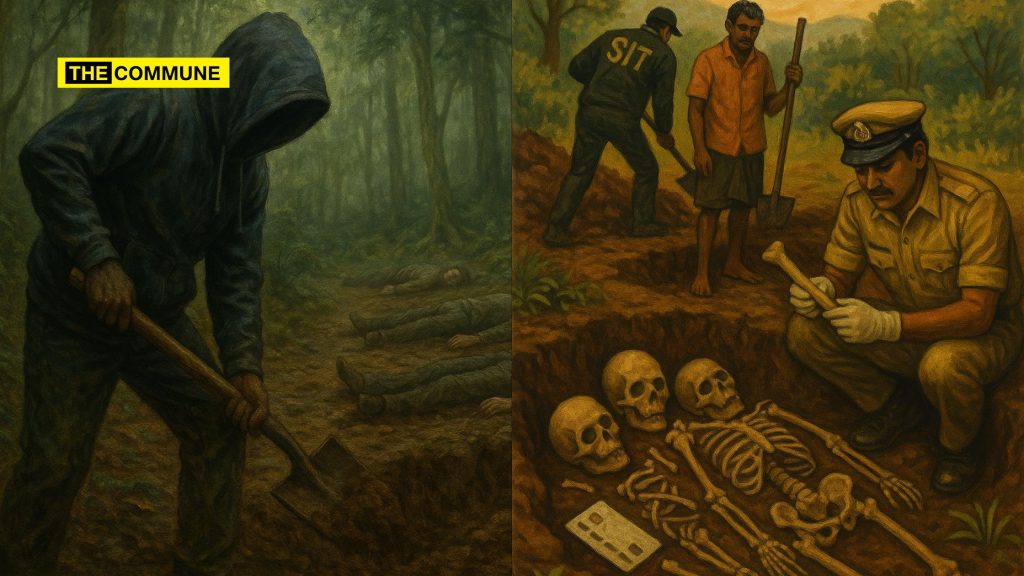
The investigation into sensational allegations of mass graves in Dharmasthala has entered a critical phase, with the Special Investigation Team (SIT) yet to find any evidence supporting claims of the secret burial of women. The accusations, initially made by a former sanitation worker who claimed to have been involved in clandestine burials over the years, have come under increasing doubt as forensic digs progress.
The SIT launched the excavation operation on July 29 at multiple sites the whistleblower identified. Over the following two days, five locations were examined with no human remains found. On July 31, at a sixth site located near the Netravathi river in a forested area, skeletal fragments were finally unearthed. Preliminary analysis by a forensic specialist indicated that the remains likely belonged to a male, though full laboratory testing is still underway to determine age, identity, and cause of death.
Roughly 15 bone fragments were recovered, many of them fractured, and notably, no skull was discovered at the site. As of August 3, digging had been conducted at ten of the thirteen marked spots.
In a twist, investigators also retrieved a woman’s debit card and a man’s PAN card at the site. The PAN card was traced to a deceased man named Suresh from Bengaluru Rural district, who reportedly died of jaundice earlier in 2025. His family said he had battled alcoholism and had visited Dharmasthala shortly before his passing, leading authorities to believe he might have lost his card during the trip. Bank records have been sought to learn more about the woman linked to the debit card.
The slow pace of significant findings has led to skepticism around the sanitation worker’s statements, especially his claims that several of the buried victims were women or young girls who may have suffered abuse. So far, there is no indication of any criminal wrongdoing at the excavation sites.
Man Claims First-Hand Witness Account Of Burials
Amid the faltering evidence, a man named Jayanth T came forward on August 2 in Belthangady, asserting that he had personally witnessed what he described as illegal burials. He offered to share details with the SIT and later reiterated his claims to local media.
Judge Steps Away From Case Over Alleged Conflict Of Interest
The investigation took another turn when Judge Vijaya Kumar Rai B of the 10th Additional City and Civil Sessions Court in Bengaluru recused himself from hearing matters related to the case. His decision followed public scrutiny over his past affiliations with institutions linked to the Dharmasthala temple trust. Reports indicated that he had studied at temple-run schools and once worked under a legal team that represented MP Veerendra Heggade.
Judge Rai B had previously granted an injunction—sought by Heggade’s brother, D Harshendra Kumar—blocking media outlets and social platforms from reporting on the burial allegations. Kumar had alleged that numerous online posts and reports defamed his family and the temple trust, prompting him to seek legal action to remove over 8,000 digital links.
The Allegations: A Summary
The whistleblower, a former sanitation worker, alleges:
- He was forced to bury hundreds of bodies (mostly women and minors) between 1998 and 2014.
- The bodies showed signs of sexual assault, strangulation, and acid burns.
- He fled Dharmasthala in 2014 after his niece was molested by someone linked to the temple.
- He returned in 2025, exhumed one skeleton, and filed an FIR seeking witness protection.
Critical Flaws In The Allegations
With so many allegations and exaggerated numbers floating around, there seems to be no evidence to prove any of those. However, several questions crop up in the mind owing to the following flaws in the allegations made.
#1 No Physical Evidence Or Independent Verification
The whistleblower claims to have buried hundreds of bodies, yet only one skeleton has been presented. No forensic reports, DNA tests, or autopsy records have corroborated his claims.
The locations of these alleged burials remain undisclosed, despite his offer to guide police.
Here’s what needs to be asked – If hundreds of bodies were buried over 16 years, why has no one else – locals, pilgrims, or workers – ever reported foul smells, suspicious activities, or mass graves?
#2 Contradictions In The Whistleblower’s Account
He claims he was forced to bury bodies secretly, yet Dharmasthala is a highly frequented pilgrimage site with thousands of visitors daily.
He alleges superiors threatened him, but no names have been disclosed, even in his FIR. He fled in 2014 but returned only in 2025 – why the 11-year delay?
Here’s what needs to be asked – If he was truly traumatized, why did he wait so long to speak up? Was he influenced by external forces?
#3 Panchayat Records Dispute The Claims
Dharmasthala Panchayat Vice President Shrinivas Rao stated that all unclaimed bodies are officially documented and disposed of lawfully.
Records of burials (including suicides near the Netravati River) have been maintained since the 1980s, with receipts and official approvals.
The panchayat denies any clandestine burials and challenges the whistleblower to provide proof.
Here’s what needs to be asked – If the panchayat has maintained records, why hasn’t the media scrutinized them instead of relying solely on unverified claims?
#4 The Sowjanya Case: A Separate Tragedy, Not Proof Of A Conspiracy
The 2012 rape and murder of Sowjanya, a 17-year-old student, was a horrific crime that remains unresolved. However, linking it to the current allegations is misleading. Santhosh Rao, the accused, was acquitted in 2023 due to lack of evidence.
The CBI and courts found no proof of involvement by temple officials. Sowjanya’s family’s grief is genuine, but activists are exploiting their pain to push unverified claims.
Here’s what needs to be asked – If the temple was involved in a cover-up, why did the CBI, CID, and Karnataka HC find no evidence in Sowjanya’s case? And if these were connected, why were there no protests at that time? As per the witness, the murder and burials were a decade before Sowjanya’s rape and murder occurred.
#5 Why Did Only One Whistleblower Come Forward After So Long?
The lone witness says he remained silent for over a decade, that is, throughout years of major protests about other tragedies in the same town, only coming forward now, after living “in hiding”. Why didn’t his conscience or fear for his life drive him to speak up during previous waves of scrutiny?
The whistleblower admits to having no identifiable information regarding the deceased – he claims he never knew their names, origins, or details, and cannot explain why no families except one (Ananya Bhatt) have stepped forward even after massive publicity
#6 Why Are There No Missing Persons Records Or Family Testimonies?
The magnitude of “hundreds” and “thousands” of rape, murder, and disappearances would, in any scenario, be expected to provoke multiple missing persons reports, press coverage, or at least numerous families demanding action. Since the claims surfaced, only one family (Ananya Bhatt’s mother) has registered a fresh case supporting the exhumation request. Is it credible that all other families have been silenced, lost, or uninterested?
Panchayat and police protocols mandate notices in newspapers, week-long waits for bodies to be claimed, and official registration of every natural or unnatural death in the area.
Al Jazeera claims “How did anyone not notice so many people were missing? Well, here’s the thing. They did. For years, people in the area have reported the sudden disappearance of girls and women. Families and activist groups say their complaints went nowhere as influential people, even the police, covered up the questions surrounding the town.”
Here’s what must be asked – Are there factual gaps in the audit trails? Where are the records of missing, untracked individuals to support these extraordinary claims?
Is Dharmasthala Being Targeted By Leftist Communal Forces?
Is this a coordinated attack on Dharmasthala’s religious and social influence? If the whistleblower’s claims are true, why has no one else, no grieving families, no co-workers, no local witnesses come forward in 20+ years?
Dharmasthala is located in Dakshin Kannada, a communally sensitive region with Islamist forces trying to gain foothold like they did in Malappuram region of Kerala. Over the past decades, Dakshin Kannada has seen several instances of communal violence and murders linked to religious or community-based issues. There have been cases of ISIS-recruitment in the region as well.
It is possible that Dharmasthala which has deep religious significance for Kannadigas and Hindus in general has been fighting the Islamist jihadi forces and preventing from converting the masses.
While there may be truth to the murders of Sowjanya, Ananya, and other young girls, tying it to the institution, the temple is not right. Investigation is necessary for each of the cases and the perpetrator must be brought to justice. But to malign an entire institution, an entire community just for the sake of the leftist agenda is so not done.