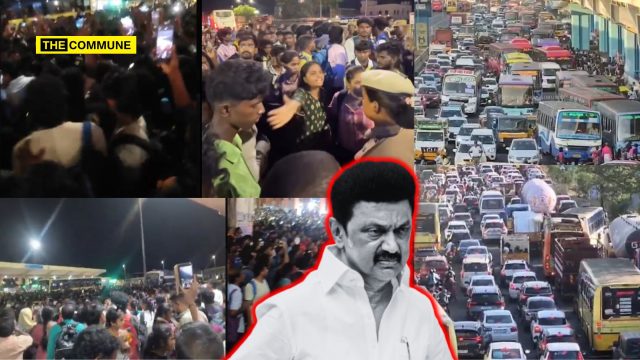
Chief Minister M.K. Stalin spent the final days of the election campaign urging Tamil Nadu’s citizens to fulfil their “democratic duty” but his own government ensured that duty came at the cost of hours stranded on roadsides, exploitative fares, and broken promises. On the night of 22 April 2026, as lakhs of Chennai residents attempted to reach their hometowns to vote, the DMK administration’s transport machinery collapsed under demand it had months to prepare for, triggering road blockades across the state. A government that plastered its Vidiyal Payanam free bus scheme on every election hoarding could not arrange enough buses to get its own voters to the ballot box.
The Crisis at a Glance
Voters across Tamil Nadu were left stranded or faced severe delays in reaching their hometowns to cast their votes ahead of the April 23 Assembly elections, as the DMK government’s much-publicised special transport arrangements fell far short of meeting the demand on the ground. Despite the state government claiming to deploy over 11,323 special buses between April 21 and April 23, commuters reported acute shortages, inflated private bus fares, hours-long waits, and chaotic scenes at major bus terminals.
Highways Turned Into Parking Lots?
Even for those who managed to board a bus or get into a vehicle, the journey was a nightmare of its own making. On the GST Road corridor, one of the primary arteries connecting Chennai to the southern districts, drone footage showed a sea of vehicles stretching for kilometres with no movement, a gridlock that drew comparisons to a car park rather than a national highway.
View this post on Instagram
Commuters reported that it took nearly three hours just to travel from Perungalathur to Kilambakkam, a distance of roughly 10 kilometres, while those who departed from Chennai at midnight were still stuck between Melmaruvathur and Tindivanam by dawn, barely 80 kilometres into a journey that could stretch 500 km or more.
In one particularly damning first-hand account circulating on social media, a commuter who boarded an MTC bus from Koyambedu at 10:40 PM had still not reached Kilambakkam by 3:25 AM – over four and a half hours to cover what should be a 20-minute ride. On the private sleeper buses, the dominant long-distance option across the city, conditions deteriorated into scenes that were nothing short of alarming: angry mobs abusing and attempting to attack drivers, passengers fainting inside stifling cabins, and the full spectrum of travel hardship playing out in real time.
தாம்பரம் – கிளாம்பாக்கம் சாலையில் போக்குவரத்து நெரிசல்#Tambaram | #Traffic | #Chennai pic.twitter.com/Z6TPu4sCDF
— PttvOnlinenews (@PttvNewsX) April 22, 2026
Chennai Traffic – Complete mess, chaos and collapsed plans:
Opted public transport (MTC) from Koyambedu at 10.40 PM and it’s now 03.25 AM, yet to reach Kilambakkam, now have a guess over the speed.,
The PRIVATE BUSES (not ones rented by TNSTC) but the sleeper buses dominant…
— Punnaivalavan K A (@APunnaivalavan) April 22, 2026
Blockades, Protests, and Broken Promises
Chennai – The mass exodus from Chennai began on Wednesday night (April 22), with lakhs of residents heading to their native places. However, commuters at Kilambakkam bus terminal reported that buses were either absent or severely overcrowded on key routes, particularly those heading to southern districts such as Madurai, Tirunelveli, and Theni. Social media was flooded with posts from frustrated travellers still stuck inside buses hours after scheduled departure.
Tamilnadu state is killing democracy and the right to vote! @TNelectionsCEO @ECISVEEP what action are you gonna take to save people’s rights?
THIS SHOWS PURE #DMK governance failure!! #DMKFailsTN pic.twitter.com/TdYagxyz4A
— WizzMee (@wizz_mee) April 23, 2026
Poonamallee – Kanchipuram Route: Residents in Poonamallee waiting to reach Kanchipuram staged a road blockade after no buses arrived on their route despite long hours of waiting. Police officials who arrived at the scene negotiated with protesters and promised to arrange additional buses, following which the agitation was called off. The Tiruvallur District Collector Prathap, who visited the spot for an inspection, was surrounded by aggrieved commuters demanding immediate intervention.
Coimbatore – Singanallur: In what was described as comparable to a peak Deepavali rush, hundreds of passengers at the Singanallur bus terminus in Coimbatore staged a road blockade on Trichy Road late Wednesday night, demanding government buses to Madurai, Theni, and Tirunelveli. Passengers stated that the Transport Department had failed to plan for election travel with the same seriousness given to festival seasons like Deepavali or Pongal.
Due to a shortage of buses, people travelling to Madurai to cast their votes are forced to wait for more than three hours at the Singanallur bus stand in the city. @xpresstn @mannar_mannan #ElectionWithTNIE pic.twitter.com/PGSkvyu3hJ
— Senthilkumar Subramaniam 👨👩👧👦 (@Senthil_TNIE) April 23, 2026
Private Bus Operators Exploit the Situation
With government buses woefully inadequate, private omni bus operators exploited the surge in demand by hiking fares manifold. The Tamil Nadu Transport Commissionerate issued warnings stating that errant operators would face heavy penalties including permit revocation and deployed special teams of RTOs and Motor Inspectors at checkposts across the state. Helpline numbers were also released for passengers to report fare violations.
Scale of the Failure
Despite official claims that approximately 1.89 lakh passengers had used special bus services by the afternoon of April 21, commuters alleged that services remained critically insufficient – especially on corridors heading south from Chennai. With over 6 crore voters enrolled in Tamil Nadu for the 2026 polls, the sheer scale of inter-district movement on election eve exposed a glaring gap between government announcements and actual delivery.
DMK Supporters Claim EC Has To Arrange Transport
The DMK members and its supporters on the other hand claim the reponsibility lies with the Election Commission.
கிளாம்பாக்கத்தில் போக்குவரத்து நெரிசல் எப்படி என அங்கலாய்ப்பவர்களுக்கு, ஒட்டு மொத்த அதிகாரமும் தேர்தல் ஆணையத்திடம்.
ஒரேயொரு வித்தியாசம் தான், இதனை மேற்பார்வையிட்டு ஒழுங்குப் படுத்த பொங்கல் போலவோ, தீபாவளி போலவோ போக்குவரத்துறை அமைச்சர் அண்ணன் @sivasankar1ss களத்தில் இல்லை. pic.twitter.com/Msw0E1Yy5R
— Saravanan Annadurai (@saravofcl) April 23, 2026
Yes, the Model Code of Conduct is in place once right now but that does not absolve the ruling government from arranging basic necessities for its citizens.
💡👇I see DMK sympathizers saying given the election is today, the DMK ministers or the CM don’t have any control over these events happening, which looks purposefully done to make it difficult for the voters.
Everyone knows the truth.
👉DMK CAN’T absolve responsibility here.… https://t.co/RDxUdkjAZO— Saikiran Kannan | 赛基兰坎南 (@saikirankannan) April 23, 2026
💡On election day:
×Article 324 → ECI controls elections
×Articles 154 & 162 → State govt still runs buses/transport
×Articles 256 & 257 → State is bound to follow ECI directionsConstitutionally, DMK govt remains responsible for buses, on polling day, bound by ECI mandates. https://t.co/Ja0FzvX3Ag
— Saikiran Kannan | 赛基兰坎南 (@saikirankannan) April 23, 2026
Who Is Responsible for Voter Transport?
Arranging public transport for voters to travel to their hometowns is primarily the State Government’s job, not the Election Commission of India’s (ECI). The ECI’s transport mandate is far more limited in scope. Here is how the responsibilities are clearly divided:
What the ECI Is Responsible For
The ECI’s transport obligations under its Assured Minimum Facilities (AMF) guidelines are narrow and specific:
- Providing pick-and-drop transport for PwD (Persons with Disability) and senior citizens from their residence to the polling booth and back
- Ensuring wheelchairs and volunteers are available at polling stations via the SAKSHAM app
- Arranging transport for election staff and polling officials to reach voting stations
- Ensuring free public transport passes for senior citizens and PwD voters on poll day
The ECI is responsible for making the voting booth accessible – not for ferrying voters across hundreds of kilometres to their home constituencies.
What Is the State Government’s Responsibility
The deployment of special buses, management of bus terminals, traffic regulation, and coordination of inter-district transport during elections falls squarely on the State Government and its Transport Department. Once the Model Code of Conduct is in force, the state government continues to function as a caretaker administration and retains full operational control over departments like transport, police, and highways. The Tamil Nadu government, not the ECI, announced, planned, and was accountable for the 11,323 special buses.
The Damning Contrast
The cruelest irony of this episode is one the DMK cannot escape: a government that made free bus travel for women the centrepiece of its election manifesto, a scheme worth ₹600 crore in subsidies could not provide basic, functional transport to its own voters on the eve of the election in which it seeks a fresh mandate.
Given how the Stalin-led government operates as a perpetual advertisement machine – more focused on inaugurations, slogans, and branding than on quiet administrative efficiency, voters who anticipated failures and booked early were the only ones who made it home in time. Those who trusted the government’s announcements paid the price. Deliberately or incompetently, the result for thousands of Tamil voters is the same: democracy stranded on the roadside.
Subscribe to our channels on WhatsApp, Telegram, Instagram and YouTube to get the best stories of the day delivered to you personally.