


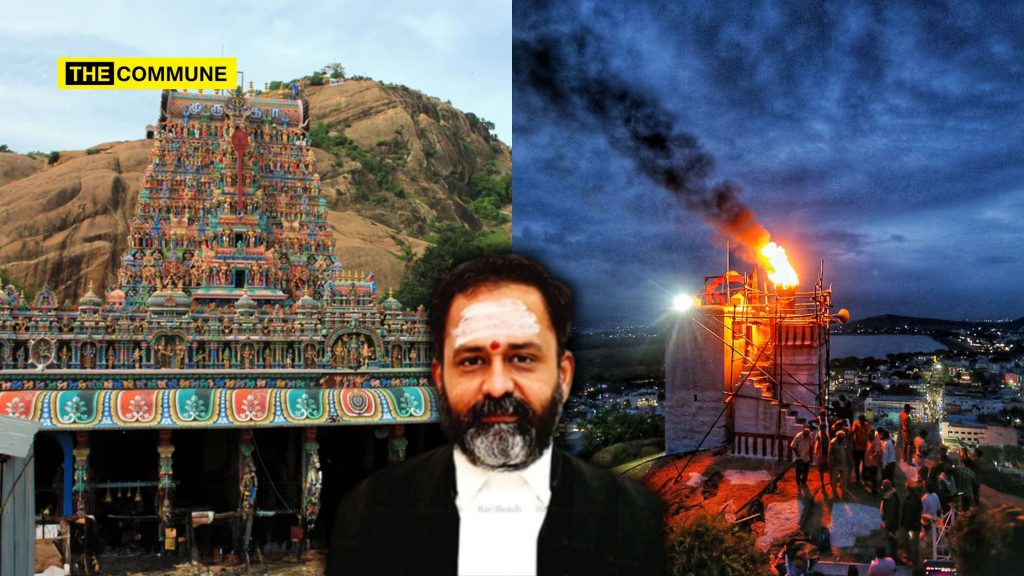
In a significant ruling, the Madurai Bench of the Madras High Court directed the management of the Arulmigu Subramania Swamy Temple in Thirupparankundram to light the Karthigai Deepam (festival lamp) at the ancient stone lamp pillar known as the “Deepathoon,” located on one of the hill’s peaks.
Justice GR. Swaminathan pronounced the common order on Monday, 1 December 2025, allowing four writ petitions that sought the lighting of the lamp at the Deepathoon, while dismissing one petition that opposed it.
Background Of The Dispute
The legal battle stems from a long-standing dispute over religious rights and property on Thirupparankundram Hill, which houses both the Hindu temple and the Muslim shrine, Sikkandar Badhusah Dharga.
The lead writ petition was filed by Rama Ravikumar, who claimed to be a devout Murugan devotee and sought quashing of a November 3, 2025 communication by the temple Executive Officer refusing permission to light the Karthigai Deepam at the Deepathoon and insisting that the lamp would be lit only near Uchi Pillaiyar Temple as per existing custom.
Several other writ petitions by devotees, including M. Arasupandi, S. Paramasivam, A. Karthikeyan and R. Kanagavel Pandian, either sought directions to light the sacred lamp at the ancient stone lamp pillar atop the hill or opposed any deviation from the present practice of lighting only at the Uchi Pillaiyar location. The State, HR&CE officials, temple management, Sikkandar Badhusha Dharga, the Waqf Board and the Archaeological Survey of India were among the respondents, with multiple parties impleaded on both sides of the dispute.
Key Arguments And Court’s Findings
The court meticulously examined the century-old legal history, including a 1923 civil suit (O.S No.4 of 1920) which was upheld by the Privy Council. The judgment established that the temple holds title to the entire hill except three specific areas granted to the Muslim community: the Nellithope burial ground, the flight of steps leading to the mosque, and the mosque site itself.
“The unoccupied portion of the hill has been in the possession of the temple from time immemorial,” the judgment emphasized. Deepathoon, located on the lower peak, lies outside Muslim-owned portions.
“That the Deepathoon is a temple property is proved by the
recent happenings.”, Justice GR Swaminathan said.
The judge also noted that the temple management itself had recently “hurriedly put up a covering” around the Deepathoon, proving it exercises control over the structure: “If the Deepathoon and the adjoining area belonged to the Dargha, the Dargha would not have kept quiet.”
“Lighting lamp atop the hill is a Tamil tradition. There is a popular
saying “Kundrin Mel Itta Vilakkai Pola” (Like a lamp lit atop the hill).“, the judge noted.
Justice Swaminathan noted, “The Privy Council had held that other than these three, the devasthanam has title and possession over the rest of the hill.” He emphasized that the Deepathoon is not situated within any of these Muslim-owned areas but on a lower peak, at least 50 meters away from the mosque.
Rejecting the argument of res judicata, the judge clarified that earlier litigation dealt with lighting the lamp at the hilltop where the mosque stands, not at the Deepathoon on the lower peak. “A settled issue cannot be reopened. But the petitioners before me do not insist that on the hilltop, the lamp should be lit. They only want the lighting of the lamp at the Deepathoon,” he observed.
Locus Standi And Custom Vs. Right
The court held that the petitioners, as devotees, are “persons having interest” under the Tamil Nadu HR&CE Act and have the locus standi to seek protection of temple property. Importantly, the judge distinguished between a matter of “custom” and a matter of “right.”
“The contesting respondents have lost sight of a fundamental aspect. The question is not one of custom. The question is one of right. Lighting lamp atop the hill is a Tamil tradition.”
He quoted classical Tamil literature, including Seevaga Chinthamani, to establish the antiquity of hill-top Deepam lighting traditions atop hills during Karthigai month, as seen in Thiruvannamalai and Yanai Malai.
Property Protection and Duty of Temple
Justice Swaminathan underscored the temple management’s duty to assert its property rights to prevent encroachment or loss. “It is therefore necessary that the temple management remains vigilant throughout to foil any attempt to encroach on its property. This can be done only by regular and periodical assertion of title,” he noted.
He also referenced a 1996 court order (W.P.No.18884 of 1994) which permitted lighting the Deepam at any place on the hill with prior HR&CE permission, provided it was at least 15 meters away from the Dargah areas. The Deepathoon, being 50 meters away, complies with this condition.
Criticism Of Temple Management
The order expressed disappointment that the temple management had aligned with the Dargah trustees in opposing the petitioners. “The temple management in the instant case appears to have forgotten the lessons of history… But now the temple management is on the same page as that of the Dargha,” the judge remarked.
He further said, “While amity is to be celebrated, rights of both the parties have to be respected. Rights of one party cannot be sacrificed. When the Dargha management recently asserted that the hill is not Skandar hill (another name of Lord Muruga) but Sikkandar hill (Sikkandar is the name of the Fakir whose body is said to be interred in the Dargha) and attempts were made to offer animal sacrifice in the hill premises, the cause was taken up not by the temple management but by the devotees and
activists. The temple trustees are keeping quiet.”
He also quashed the Executive Officer’s impugned decision as lacking jurisdiction, noting that such a vital issue should have been decided by the Temple Trust Board.
Peace Committee Resolution Mentioned
The Court held there would be no prejudice to the Dargah, “By lighting the lamp at Deepathoon, the rights of the Dargha or the Muslims will not in any way be affected… Deepathoon is located 50 meters away from the Dargha.”
Justice GR Swaminathan noted that the Dargah management has not demonstrated as to how they will be affected if the lamp is lit at the Deepathoon.
The court noted a 2005 peace committee resolution where the Dargah management had expressed “no objection” to lighting the lamp at Deepathoon, provided it was beyond 15 meters from the Dargah. “Though this is not an enforceable resolution, one can safely conclude that the opposition appears to be more at the instance of certain vested interests,” Justice Swaminathan observed.
Final Directions
The court directed the temple management/devasthanam “to light the Karthigai Deepam at Deepathoon also apart from the usual places” starting from this year, that the Commissioner of Police, Madurai City, had to ensure compliance and prevent any obstruction.
“Lighting a lamp is a sacred act. It cannot offend anybody’s sensibilities,” the judge concluded, dismissing the argument that the Places of Worship Act would be violated.
Subscribe to our channels on WhatsApp, Telegram, Instagram and YouTube to get the best stories of the day delivered to you personally.