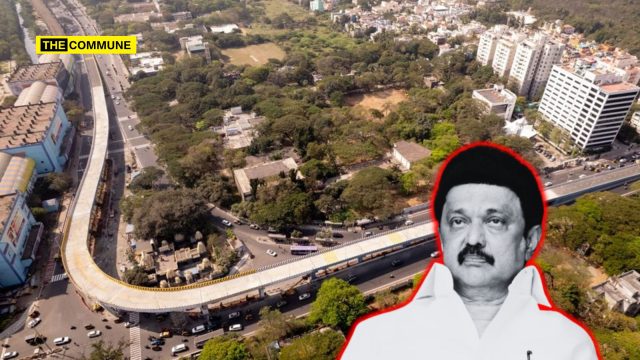
Just days after Chief Minister MK Stalin inaugurated the ₹60-crore Madhya Kailash flyover, commuters have reported an unexpectedly uneven ride along the 652-metre structure, prompting questions over construction quality and execution.
The flyover, opened last week to ease traffic movement from Sardar Patel Road to Old Mahabalipuram Road (OMR), quickly drew attention after videos showing a bumpy ride began circulating on social media.
According to reports, the first 80 metres from the Sardar Patel Road side, where the Highways Department laid a bituminous macadam approach, appeared smooth. However, the remaining stretch, constructed in concrete, was said to have noticeable undulations.
Experts indicated that only a detailed technical assessment could determine the exact cause. Sampath Kumar, professor of highways and transportation at Sathyabama University, told Times of India the issue could be linked to higher-than-expected deflection in the steel bearings supporting the flyover.
He explained that the structure relies on steel reinforcements tied with steel wiring, which normally deflect within calculated limits when loads pass over them. He noted that if there were inaccuracies during load testing, the reinforcements could deflect more than designed, resulting in a bumpy ride. Over time, he cautioned, excessive deflection could raise structural concerns, including the possibility of cracks developing beneath the deck.
The professor further pointed out that load tests are typically conducted using multi-axle trucks positioned at the centre of the flyover and said it would need to be examined why smaller vehicles such as cars and two-wheelers are already experiencing noticeable bumps.
Another possible factor cited was the grade of concrete used. The expert noted that M40 concrete, commonly used in Tamil Nadu, has a finer aggregate mix, whereas higher grades such as M50, and even M90 in some Delhi metro projects, provide greater rigidity.
R. Ramarao, a highways contractor with over three decades of experience and president of the Greater Chennai Contractors Association, reportedly suggested that poor levelling during concrete laying could also cause such undulations. He added that uneven elevation between expansion joints could produce a bumpy feel, noting that even a 10-mm variation could be noticeable to motorists. Rectification, he said, would typically require relaying the concrete, which becomes difficult once the flyover is opened to traffic.
Highways Chief Engineer Jawahar Muthuraj and Superintending Engineer Rajadurai were reported to be in meetings and had not immediately responded to queries.
Another official associated with the project stated that asphalt surfaces generally offer better flatness compared to concrete. The official maintained that the flyover is structurally safe and said the department would examine the complaints, adding that the surface irregularities are expected to settle over time in concrete.
Days after inauguration by chief minister @mkstalin , Madhya Kailash flyover turns into a bumpy ride. Poor quality of construction or works rushed for inauguration?
Just days after chief minister M K Stalin inaugurated the ₹60-crore Madhya Kailash flyover, commuters are facing… pic.twitter.com/0aL7pZkI8b
— Omjasvin M D (@omjasvinMD) February 26, 2026
Source: Times of India
Subscribe to our channels on WhatsApp, Telegram, Instagram and YouTube to get the best stories of the day delivered to you personally.