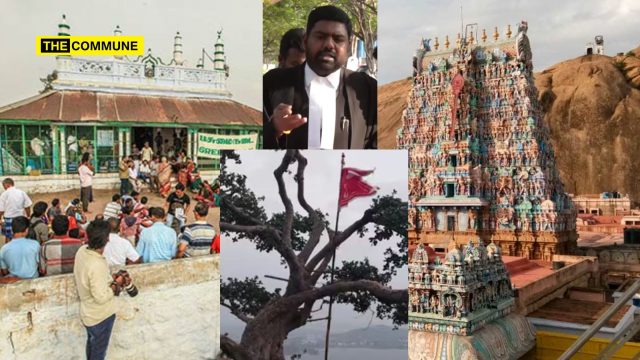
The petitioners in the Thirupparankundram case raised serious objections over the hoisting of flags on what he described as the Sthalavruksham (sacred tree) located atop the hill, alleging administrative failure to protect temple property despite clear legal obligations.
Speaking to the press after court proceedings, the counsel said that during the day’s hearing, arguments were advanced specifically on the status and sanctity of the Sthalavruksham. He questioned how, on the very same day, authorities were allowing or defending a peace committee decision permitting flag hoisting on a tree at the hilltop without even clearly identifying whether it was the sacred tree in question.
The lawyer said that during the arguments, Justice GR Swaminathan had reiterated that the Thirupparankundram temple property was formally declared as such as early as 1920. He stated that irrespective of whether officials considered it an inconvenience or a privilege, there was a mandatory legal duty to safeguard temple property.
He explained that the Hindu Religious and Charitable Endowments (HR&CE) Department and the HR&CE Act were created precisely to protect, preserve, and regulate temples, their properties, and their sanctity. On that basis, he said, the department had not just the power but the obligation to act to protect temple assets.
Referring to the final arguments placed in the appeal, the lawyer pointed out that the upcoming Sandhanakoodu festival had to be viewed in the context of how ground realities had changed after both the 1920 declaration and a subsequent 1996 judgment.
As an example, he said that the kodimaram (flagstaff) which was earlier located within the dargah premises had now been moved out. He further alleged that flags were now being tied at the very crown of what is being referred to as the Sthalavruksham, describing it as the sacred tree or shrine tree associated with the temple.
“We have shown this clearly,” he said, adding that despite this, neither the HR&CE Department, nor its officials, nor the Tamil Nadu government had stepped in to formally acknowledge that the tree in question was the Sthalavruksham or to object to the flag hoisting on it.
The lawyer stressed that the Sthalavruksham was not demonstrate or symbolic in nature, but a sacred entity explicitly mentioned in the sthala puranam, the traditional temple history of the Thirupparankundram Murugan temple.
He warned that allowing flags to be tied on the sacred tree would set a dangerous precedent. “If today it is said a flag can be tied here, where will this go tomorrow? What will be the next stage?” he asked.
Questioning administrative inaction, he said that if such actions were allowed to continue unchecked, it would become impossible to protect temple property. He asked who would safeguard such properties if the HR&CE Department itself failed to discharge its statutory responsibilities.
Citing Section 6(15) of the HR&CE Act, the lawyer explained that the law clearly defines a “person interested” as anyone who has devotion and an intention to worship at the temple. On that basis, he said, all devotees qualified as persons interested and were legally entitled to approach the court.
“It is only for this reason that all these petitioners have come forward and pursued this matter,” he said, adding that these arguments had been formally placed before the court.
Subscribe to our channels on WhatsApp, Telegram, Instagram and YouTube to get the best stories of the day delivered to you personally.