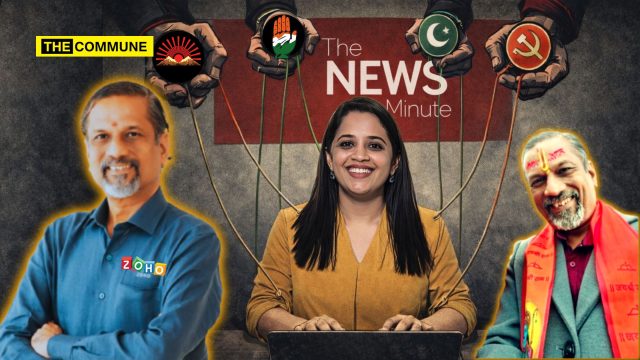
Imagine the most horrible, cunning person you’ve ever met. Someone for whom loyalty, ethics, and truth don’t matter. Someone who would do anything for their own benefit, even if it meant selling out their own mother for money. Someone who wouldn’t even think twice before bootlicking for personal gain. Set them beside The News Minute, and that person would still come across as principled.
After a voyeuristic, Nakkheeran-style hit job peeping into the personal life of Zoho founder Sridhar Vembu, the leftist rag – or more accurately, the DMK’s unofficial mouthpiece – The News Minute signaled that it would publish a full profile of Vembu.
On 9 January 2026, they published a 10,000-plus-word hit job on Sridhar Vembu, cunningly hiding it behind a paywall like cowards to force subscriptions to their trash.
In this no-punches-pulled article, we dissect the full hitjob and expose the venom with which The Naxal Minute functions.

The profile is a long-winded character assassination. It sets its intention right at the beginning – we hate Vembu because he is a Hindu, a Brahmin, a ‘Sanghi’ and so you must hate him too.
Paragraph after paragraph, it does the same thing: cherry‑pick facts, launder innuendo through anonymous quotes, and then hang everything on the one sin TNM can never forgive – that Vembu refuses to fit their ideological script. Let us take a deeper look.
Rigging The Frame From Paragraph 1
The piece doesn’t begin with his achievements, his words, or his background. But with a quote from RSS’s mouthpiece Organiser. So, with this they have stained him saffron.
Indulekha Aravind uses it as the first filter through which the reader must see Vembu. He is guilty by association before his own words even appear.
Then comes the lush travel‑writing: poor farm labourers, “verdant paddy fields”, Western Ghats, and at the end of the road, the billionaire Brahmin in a house villagers call an “agraharam”. The implication is clear – now identify him by his caste. Then they mention the village is also home to other castes.
The word “agraharam” is waved like a caste dog‑whistle, and readers are expected to fill in the rest. This is TNM’s method throughout. Facts are thin; atmosphere does the heavy lifting.
Just like that, without a single example of him discriminating against anyone, they’ve painted him as a casteist living apart from the villagers. They highlight he’s a Brahmin and now frame his guilt by identity, a cheap trick to make readers view his every action through a lens of prejudice they’ve provided.
Image-Building Turned Into Moral Crime
Next comes the “poster boy” construction: Padma Shri, veshti, cycling CEO, swadeshi talk, BJP proximity. You get descriptions like he is a “poster boy” for BJP and RSS, he takes photos in veshti in paddy fields, he says “I don’t care about net worth.” All of it is real. None of it is illegal or hidden. But instead of asking whether any of this is false, the article pivots to anonymous voices calling him a “great marketer” and someone who “makes a virtue out of necessity.”
That’s the accusation. No specific lie is identified. No statement is shown to be untrue. Image-building itself is treated as deception because the image is politically inconvenient.
They never point to a specific thing he said that was a lie. Did he fake Zoho’s revenue? Did he invent the Zoho Schools program? Did he Photoshop himself in the village? No. They just offer anonymous opinions that he’s good at telling his story, as if every successful person isn’t. It’s a hollow accusation designed to make you doubt his sincerity without having to prove a thing.
The usual tactic these hit jobs employ is the use of anonymous “ex-employees” they claim to have spoken to—no names, no accountability, just vague references. By that standard, The Commune could just as easily spin an imaginary story citing similar “sources” who have supposedly engaged with Dhanya Rajendran or anyone else in that Leftist-Dravidianist den.
The Divorce Case – Presenting Half-Truths
When the article reaches the California divorce proceedings, it drops all pretense of balance.
Interim court language is presented as though guilt has already been established. The fact that these are interim orders that appeals are ongoing, that family courts routinely use aggressive language to secure assets – all of that is either buried or mentioned much later, after the damage is done.
The ex-wife’s allegations are reproduced in detail. Vembu’s response is reduced to a line or two. No documents. No explanation. No real attempt to present both sides. It reads less like reporting and more like a prosecution brief.
Startup Stories Don’t Work The Way TNM Pretends They Do
On Zoho’s origins, the article does the same trick. Over the years, media profiles and talks have simplified the founding story – as almost every startup founder does. In courtroom filings, Vembu’s timeline is more precise: Tony Thomas set up Advent in 1995; he joined in 1997; his brothers ran Vembu Systems in Chennai.
TNM presents this as if they’ve unearthed a conspiracy. “There have been variations,” they say ominously, and then… stop. No smoking gun, no forged cap table, nothing.
Just the insinuation that because informal interviews and a legal declaration don’t use identical wording twenty years apart, something must be dirty. It’s investigative theatre without the investigation.
Zoho’s Product Model And Hiring: Ethics By Selective Outrage
On the business itself, TNM cannot deny the scale:
- Over 50 products.
- FY24 standalone revenue ₹11,193 crore, profit ₹3,298 crore.
- Around a million paying organisations in 80 countries.
So it tries to degrade the achievement with sneers. Zoho is a “fast follower”, “no innovation”, just copying Salesforce for smaller clients. Who says so? A conveniently unnamed SaaS competitor. Given TNM’s nexus with DMK, one can guess that it could be the wannabe Steve Jobs who wears black turtle-neck shirt in sweltering sun and ‘kisses’. No product analysis, no technical breakdown, nothing beyond the jealous grumbling of a rival.
Conveniently, the same piece elsewhere quotes two former executives calling Vembu a “genius” and a “great mix of technologist and builder”. That contradiction is never resolved.
On Zoho Schools, the framing borders on perverse. TNM admits that:
- The programme takes kids straight out of school, mostly from disadvantaged backgrounds.
- Trains them for two years on stipend.
- Absorbs them into jobs they simply wouldn’t get otherwise.
Then it hacks with the sickle like a typical Communist rag: since they don’t get a degree, they are “locked in” and “it’s exploitative”. Locked into what? A stable, long‑term job in a profitable global company whose employee turnover is 7% against an industry 12–15%.
The piece produces no data on how many Zoho School grads actually wanted to leave and were blocked, or whether other firms do or do not hire them. It’s a theoretical worry converted into a moral indictment.
Meanwhile, pay and ESOPs are attacked using anecdote: one ex‑employee says “I was making peanuts” while my product earned millions. Perhaps he was underpaid. Perhaps not. TNM never shows an actual compensation benchmark across product companies at Zoho’s stage. The line is emotionally satisfying, and that is enough.
If Dhanya Rajendran wants to have a real debate about labour, equity and ESOPs, she might want to start with how much “equity” her own reporters hold in TNM before lecturing a bootstrapped firm that doesn’t owe the VC‑style lottery to anyone.
Political Change Framed As Original Sin
A huge part of the article is obsessed with Vembu’s shift from a rationalist, liberal blogger to a supporter of Indian cultural conservatism and the current government. TNM frames this not as a personal evolution, but as a suspicious “makeover.”
In the 2000s, Vembu liked Buddhist philosophy, free markets, and wrote about “Maoism in Silicon Valley” when a Google engineer was fired over right-wing views. Later, Vembu is seen defending the RSS, attending a Swadeshi Jagran Manch event, and praising Modi. They also have a problem with S Gurumurthy being his mentor.
For TNM, anybody associated with the RSS or BJP is a crime. If you’re a Hindu-hating, Modi-bashing, Yogi-dissing communist or an Islamist, you’re a warrior.
Anti-Vaccine Stand – One Solid Hit Used To Smear Everything Else
Vembu is entitled to have his views about vaccines. He cites some research – which general medicine doctors do not accept. It is his view, just because one is an anti-vaxxer or does not believe that vaccines can help people, one cannot label them with any grand smear, just because you do not agree to them. His comments on vaccines are used to suggest he’s drifting into pseudoscience. And this, they use to bleed into every other domain – business, governance, philanthropy as though one bad belief proves a general collapse of reason.
Tenkasi: Philanthropy Recast As RSS Pipeline
The reporting from Govindaperi is revealing – not about Vembu, but about TNM. Villagers say:
- He cleared a farmhand’s debt.
- He funded multiple temple renovations.
- His school feeds children, gives uniforms, bikes, runs a clinic and an ambulance.
A DMK sympathiser compares him to god: “He has done only good things for us since he moved here.” Any normal outlet would treat this as a complex figure: ideological right‑wing, maybe problematic on some issues, but tangibly improving one rural cluster’s life. TNM’s reflex is different: How do we spin this as sinister?
When a BJP leader says Vembu’s Swadeshi talk “will eventually help us when people start thinking of their roots, India, and religion,” TNM runs it as proof of a long game. When a DMK minister complains that Vembu is telling the global tech world DMK is “anti‑India and anti‑Hindu,” TNM prints it as “actual damage,” without producing the offending quotes. Also why is DMK being branded so? Can we talk about the venom spewed from the Dravidianist and DMK camps under the garb of rationalism? Can we talk about your own abusive writers like Bharathy Singaravel who has a Nazi mindset and spews casteist venom against Brahmins?
The villagers’ lived experience – debt relief, free education, health access – becomes less important than the party line out of Chennai. That’s TNM’s idea of speaking “truth to power”: repeat what one party says about a businessman, and ignore what hundreds of poor families say about him.
The Ultimate Sin: Doing Good For The “Wrong” Reasons
Here is the heart of TNM’s grievance. Vembu is doing things that are, on their face, good: building a free school, teaching traditional arts, funding temple renovations, creating jobs in a rural area.
But because he does these while also supporting the BJP and the RSS, TNM can’t accept that the goodness might be genuine. So, they politicize everything.
Kalaivani Kalvi Maiyam’s curriculum which includes bharatanatyam, yoga, silambam, parai, Tirumurai, savings, skills becomes “RSS ideology in the guise of cultural and social activities,” according to a DMK functionary.
TNM prints this partisan opinion as if it’s evidence. When villagers rave about the school and the clinic, their gratitude is immediately reframed. They’re not thankful beneficiaries; they’re unknowing participants in a “soft power” campaign.
His business success is treated the same way. Winning a government contract or his app getting downloads after a minister’s praise isn’t a commercial win; it’s painted as a suspicious reward for political loyalty. Questions about his app’s privacy features are presented not as tech issues, but as his moral failings.
A Conclusion Written Before The Reporting Began
This “in-depth profile” by Indulekha Aravind started with a conclusion: Sridhar Vembu is a problematic poster boy for an ideology they dislike. Then, they worked backwards, twisting facts, omitting context, and amplifying whispers to make everything in his remarkable life fit that story.
RSS, BJP are evil, so anyone associated with them in the remotest way are also evil. If you replaced RSS with say Communist, Congress or even the DMK in the same article, the very same ‘qualities’ of Vembu would have been applauded as ideological consistency, courage, or integrity.
It is obvious TNM is not neutral, we know where their loyalties lie, so they are taking so much effort to appease that audience alone. With their credibility hitting new lows after Dharmasthala, after a brief stint as TN Murasoli, The News Minute has transformed into the English version of a voyeuristic tabloid as The Nakkheeran Minute. Muzhusa Chandramukhi (Nakkheeran) ah maarina Gangava (The News Minute)ah paar.
Subscribe to our channels on Telegram, WhatsApp, and Instagram and get the best stories of the day delivered to you personally.