


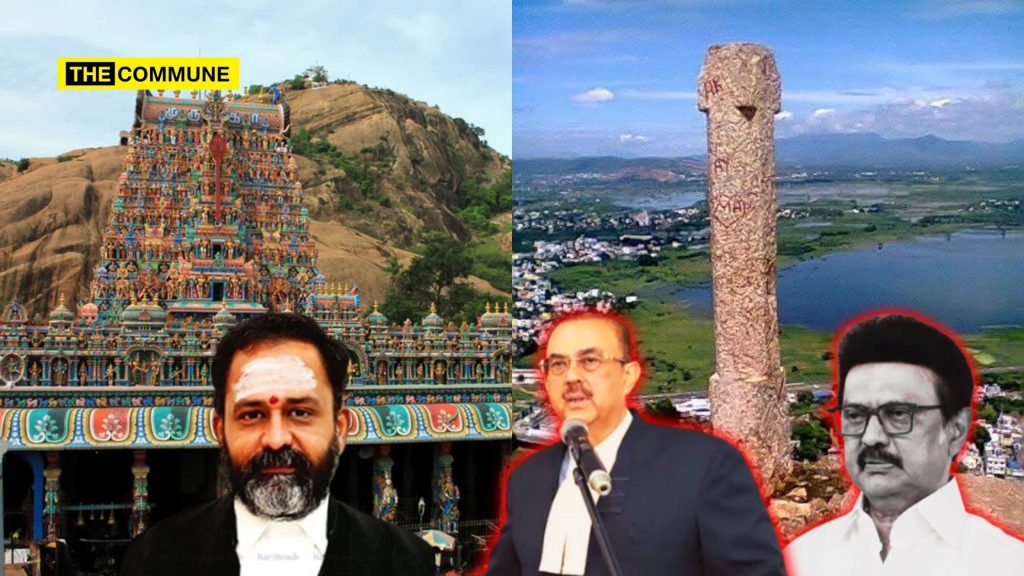
Senior Advocate Vikas Singh, appearing for the Tamil Nadu state authorities, launched a sharp and pointed attack on the December 1 order of Justice GR Swaminathan of the Madras High Court permitting the lighting of a lamp at a stone pillar, referred to as “Deepathoon”, atop the Thiruparankundram hill during the Karthigai Deepam festival.
Addressing a Division Bench of Justices G Jayachandran and KK Ramakrishnan, which is hearing appeals against the single judge’s order, Singh went beyond assailing the legal reasoning and questioned the very constitutional propriety of the decision. He argued that Justice Swaminathan had “created a religious right where none exists” and had travelled far beyond the limits of judicial authority.
Singh, who is also the President of the Supreme Court Bar Association, contended that there was no historical, religious or legal basis for the claimed right to light a lamp at the stone pillar. Relying on earlier decrees, including a 1923 judgment, he submitted that while the hill was broadly associated with the Devasthanam, the Nellithope area and the flight of steps leading to the dargah were clearly recognised as falling within Muslim rights. According to Singh, those records explicitly noted that attempts to light a lamp at the top of the hill had been stopped in the past and that there was no established custom supporting such a practice.
“There is no agama, no shashtra, and no legal material to support this claimed religious right,” Singh told the court. He further pointed out that even the term “Deepathoon” did not appear in any prior judgment or historical record and surfaced for the first time only in the writ petition that resulted in the impugned order.
Singh also criticised the single judge for ignoring the constitutional limitation that Articles 25 and 26 are expressly subject to public order. Allowing access to the stone pillar, which lies along the route to the dargah, would inevitably create serious law-and-order issues, particularly during Karthigai Deepam when large crowds could attempt to reach the site, he argued. He questioned how the order envisaged crowd regulation in an area that was narrow and historically recognised as belonging to the dargah.
The most stinging criticism was reserved for what Singh described as clear judicial overreach. He highlighted that Justice Swaminathan had directed the lighting of an “additional lamp”, even though no such relief had been sought by the petitioner. “What is this ‘additional’ lamp and where does it come from?” Singh asked, arguing that the direction had no basis in the pleadings before the court.
At one point, Singh remarked, “I wonder what the judge was doing in this process,” and alleged that the order had the effect of creating public disorder rather than preserving public order. He asserted that the judge had no material to even conclude that a Deepathoon existed, and that, even assuming its existence, the court had no business directing that a lamp be lit there. At most, he said, the authorities could have been asked to examine feasibility, but nothing further.
When counsel on the opposite side objected to the tenor of the remarks, Singh defended his submissions, stating that the gravity of the situation would soon become evident. He added that the judge would be seen “contesting an election very soon” and said that while he had refrained from commenting on the impeachment notice moved against Justice Swaminathan, it was legitimate to examine whether the judge had adhered to constitutional boundaries.
The Division Bench did not immediately respond to Singh’s remarks on the judge but continued hearing arguments on the merits of the appeals. It also indicated that it would consider the Tamil Nadu Waqf Board’s earlier offer of court-monitored mediation and sought to hear the stand of the Archaeological Survey of India on the issue.
Source: LawBeat
Subscribe to our channels on WhatsApp, Telegram, Instagram and YouTube to get the best stories of the day delivered to you personally.