The Supreme Court of India is set to revisit one of its most contested rulings. On 7 April 2026, a nine-judge bench will take up around sixty review petitions challenging the 2018 Sabarimala verdict – a judgment that forced open the doors of the Sabarimala Dharma Sastha Temple to women between ten and fifty years of age, overriding a tradition rooted not in prejudice but in the specific theological identity of the presiding deity.
The question before the bench is bigger than entry to one temple. It is whether a secular court holds the authority to walk into a religious tradition it does not belong to, declare itself competent in theology, and redesign a faith from the inside. The answer, drawn directly from the Constitution the court claims to uphold, is no.
What Actually Happened at Sabarimala
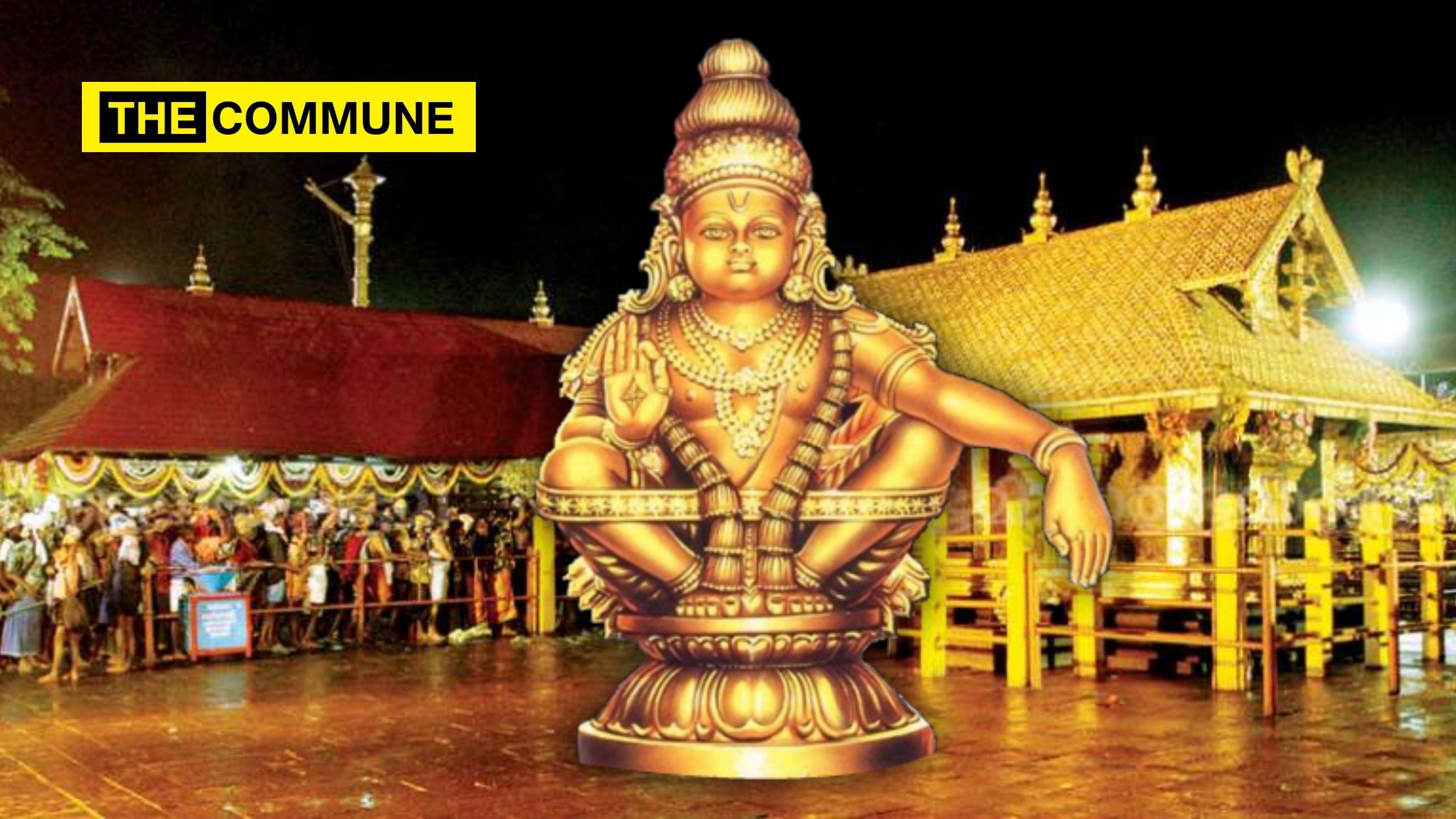
The restriction at Sabarimala was not invented to exclude women. It flows from the nature of Lord Ayyappa himself – a deity worshipped in the form of Naishtika Brahmachari, one who has taken the vow of absolute lifelong celibacy. The tantric tradition of the temple, its agamic framework, and the centuries-long practice of its priests are all built around this theological premise. The 1991 Kerala High Court, in S. Mahendran v. The Secretary, Travancore, had already adjudicated this and upheld the restriction as constitutional, directly traceable to the nature of the presiding deity. In 2006, the Indian Young Lawyers Association, whose members had no connection to the temple and no stake in its tradition, filed a writ petition in the Supreme Court seeking to override all of this. In 2018, a 4:1 majority complied.
The backlash was not manufactured. The National Ayyappa Devotees Women’s Association filed a review petition against the ruling – women defending a tradition the court claimed to be rescuing them from. The Pandalam Royal Family, the Nair Service Society, the All Kerala Brahmins Association, the Travancore Devaswom Board, the chief priest Kantaru Rajeevaru, sixty petitions, from across the spectrum of those who actually know and live this tradition, all said the same thing: the court had no business here.
Even the Kerala LDF government, which had cheered the 2018 verdict and deployed police to escort women into the temple, eventually walked back into the Supreme Court and stated that judicial review of a religious practice “followed for so many years connected with the belief and values accepted by the people” must be preceded by “wide consultation with eminent religious scholars.” It took the State six years to arrive at what the devotees said on day one.
The Constitutional Case Against Judicial Intervention
The written submissions filed on 23 March 2026 by Gitarth Ganga, the Jain spiritual research institute guided by Jainacharya Yugbhushansuriji, make the constitutional argument with surgical precision. The starting point is this: the rights under Article 25 are not rights the Constitution created. During the Constituent Assembly debates, a proposed amendment sought to replace “are equally entitled to freedom of conscience and the right” with “shall have the right” – a change that would have indicated the rights were being conferred by the State.
The Assembly rejected it. The framers proceeded on the explicit understanding that religious freedom pre-existed the Constitution, that it was being recognised and protected, not dispensed as a State concession. As the Supreme Court itself held in M. Nagaraj v. Union of India: “It is a fallacy to regard fundamental rights as a gift from the State to its citizens.”
This has a direct and devastating implication. If the rights under Article 25 originate in religion itself, not in the Constitution, then the creatures of the Constitution, meaning the legislature, the executive, and the courts, cannot define, limit, or adjudicate upon what a community holds to be its religious practice. The State cannot arrogate to itself the power to determine what is or is not part of an individual’s religion. The submissions put it plainly: “the constitutional guarantee of religious freedom cannot be interpreted in a manner that authorises the State, or constitutional courts for that matter, to sit in an ‘ecclesiastical’ jurisdiction.” The Constitution grants courts no such jurisdiction. It never did.
The ‘Essential Practices’ Fraud
Here is the part nobody in the liberal legal establishment will admit. The “Essential Religious Practices” doctrine, the tool used by the 2018 majority to assess whether the Sabarimala restriction deserved protection does not exist in the Constitution. The word “essential” appears nowhere in Articles 25 or 26. It was introduced by the Supreme Court itself in the Shirur Mutt case of 1954, responding to a framing error by the then Attorney General. The AG had argued that “secular activities associated with religion but not really constituting an essential part of it” were open to State regulation. The Court, in rebutting that argument, inadvertently adopted the same vocabulary and launched a doctrine that has since been stretched into a theological scalpel.
What the submissions argue correctly is that the proper constitutional question is not whether a practice is “essential” to a religion as assessed by a judge, but whether the practice is genuine, sincerely held, and traceable to the faith of the community.
The burden is on the State to first establish that what it seeks to regulate is actually secular in character – economic, financial, or political. If a practice occurs within a place of worship, the presumption must be that it is religious. Courts have inverted this entirely, treating religious communities as if they must audition their traditions before a judicial panel and prove their beliefs worthy of protection. Jainacharya Yugbhushansuriji put the absurdity plainly: courts defer to doctors in medical matters, to forensic experts in criminal matters but when a tantri explains the theological basis of a temple’s tradition, five judges overrule him. “That’s a theological question,” he said. “Not a legal one.”
Article 26 Was Never Subject to Equality Rights
The 2018 majority used Article 14, the right to equality, to override the Sabarimala tradition. This was constitutionally impermissible. Article 26, which protects the rights of religious denominations to manage their own affairs in matters of religion, was deliberately not made subject to the other provisions of Part III. Dr. Ambedkar, when introducing the Article, added the limitation of “public order, morality and health” and stopped there. He did not make it subject to Article 14 or Article 15. That omission was conscious. The framers understood that collective religious autonomy required insulation from individual equality claims. The 2018 majority collapsed that distinction and in doing so, rewrote the Constitution through judgment rather than amendment.
If the Sabarimala temple is recognised as a distinct religious denomination which the petitioners argue it is, given its unique agamic tradition, its own tantric lineage, and its specific theological framework around the deity, then Article 26 gives it complete autonomy over its practices. No individual petition, however, constitutionally framed, can override that collective denominational right.
The Selective Application No One Talks About
There is a pattern that the nine-judge bench must confront honestly. Hindu temples across India are administered by State-appointed boards, their revenues managed by government officials, their pujaris hired and fired by bureaucrats, their sacred endowments diverted at will and their traditions subject to judicial review. No mosque, no church, no dargah is run this way. This is not secularism. It is selective subjugation dressed in constitutional language.
The petitioners in the Sabarimala review have explicitly asked the bench to extend its scrutiny uniformly – to the entry of Muslim and Parsi women into places of worship, to practices in the Dawoodi Bohra community, to Jain practices like Santhara that courts have mischaracterised as suicide. The bench should accept that invitation. Because if “constitutional morality” is a standard that applies only to Hindu temples, it is not a constitutional standard at all. It is a political one.
What the Nine-Judge Bench Must Decide
The review petitions before the bench on April 7 are asking for something straightforward: apply the Constitution as it was written. Read Article 25 broadly, as the framers intended. Read the grounds for State interference narrowly, as the proportionality doctrine requires. Recognise that the determination of religious practice belongs to the religion – not to courts exercising theological judgment they were never authorised to exercise. Grant Indian-origin religious denominations the juristic personality they currently lack, so they can defend their own traditions in their own name rather than depending on priests and devotee associations to carry the legal burden. And acknowledge that “Dharmic sampradaya”, the term the Hindi text of the Constitution actually uses, is not the same as a Western Christian denomination and must be interpreted through the civilisational lens of India, not borrowed frameworks from Ireland.
The 2018 verdict was not a victory for women’s rights. The women of Sabarimala, the ones who climb the pathinettampadi in vratas, who observe the forty-one-day deeksha, who have done so for generations, did not ask to be liberated. They filed petitions demanding the tradition be restored. A judgment that overrides their faith in the name of protecting them is not justice. It is contempt dressed in constitutional robes.
Subscribe to our channels on WhatsApp, Telegram, Instagram and YouTube to get the best stories of the day delivered to you personally.