


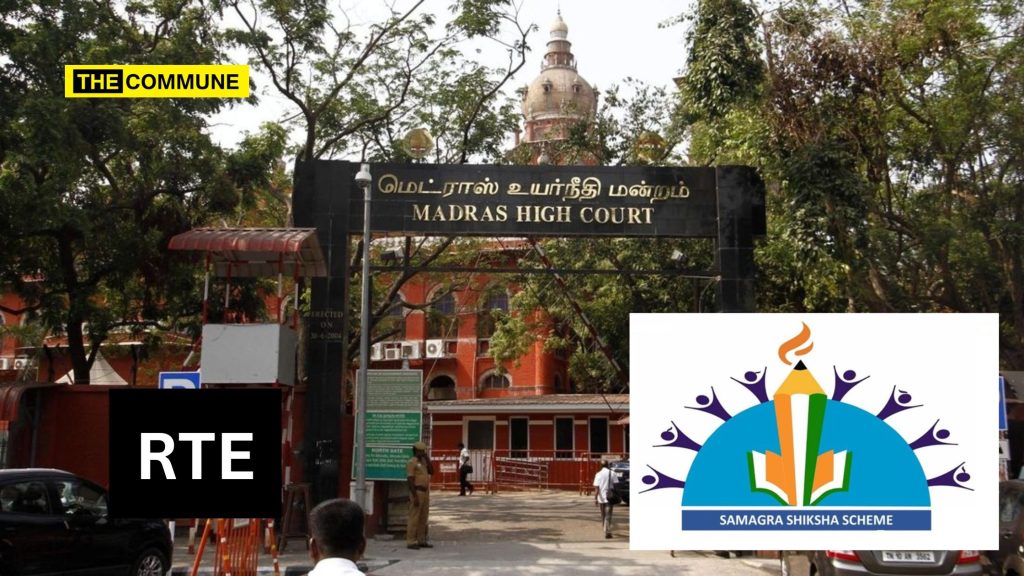
The Madras High Court directed the Union Ministry of Education to consider separating the ₹200 crore earmarked for Right of Children to Free and Compulsory Education (RTE) reimbursements from the ₹2,151.59 crore total pending disbursal under the Samagra Shiksha Scheme (SSS) to the Tamil Nadu government. The court’s observation comes amid a standoff between the Centre and the State over the non-adoption of the National Education Policy (NEP) 2020 by Tamil Nadu.
The Division Bench of Justices G.R. Swaminathan and V. Lakshminarayanan made it clear that the Tamil Nadu government cannot use the non-receipt of Central funds as an excuse to evade its statutory obligation to reimburse private schools admitting students under the RTE Act.
“The State government has an obligation to reimburse private unaided schools. Non-receipt of funds from the Union Government cannot be cited as a reason to wriggle out of this statutory obligation,” the court stated.
The bench noted that although the Centre had raised issues over releasing Samagra Shiksha funds due to Tamil Nadu’s resistance to implementing the NEP, that dispute should not affect obligations under the RTE Act of 2009. “Section 7 of the RTE Act states that the Central government and the State governments have concurrent responsibility for providing funds for carrying out the provisions of the Act… Therefore, funds payable to the State Government representing the Central Government’s share towards discharging the RTE obligations need not be linked to NEP 2020,” the judges observed.
The court was hearing a public interest litigation seeking directions to the State government to begin RTE admissions for the 2025–26 academic year without delay. During the hearing, Additional Advocate General J. Ravindran informed the court that the State was unable to reimburse private schools on time due to the Centre withholding funds.
He added that for the academic year 2022–23, Tamil Nadu had borne the entire ₹188.99 crore RTE reimbursement cost.
In response to this, the court suo motu impleaded the Union Ministry of Education as a respondent and requested Additional Solicitor General (ASG) A.R.L. Sundaresan to obtain instructions from the Centre.
The ASG argued that Samagra Shiksha is an integrated scheme aligned with NEP 2020, covering education from pre-school to Class 12. He said Tamil Nadu’s refusal to adopt the NEP had led to difficulties in disbursing funds, and that the RTE Act’s implementation was primarily the responsibility of the State.
Disagreeing, the judges held that both Centre and State share responsibility under the RTE Act. “We are not in a position to issue any binding direction in this regard,” they said, but added that the Centre must “consider” separating the RTE component from the overall Samagra Shiksha allocation and disbursing it independently.
Authoring the judgment, Justice Swaminathan quoted former Chief Justice of the United States Earl Warren: “Today, education is perhaps the most important function of the state… It is doubtful any child may reasonably be expected to succeed in life if he is denied the opportunity of education.”
Meanwhile, the Supreme Court has refused to grant urgent hearing to Tamil Nadu’s plea seeking the release of Samagra Shiksha funds withheld by the Centre.
(With inputs from The Hindu)
Subscribe to our channels on Telegram, WhatsApp, and Instagram and get the best stories of the day delivered to you personally.