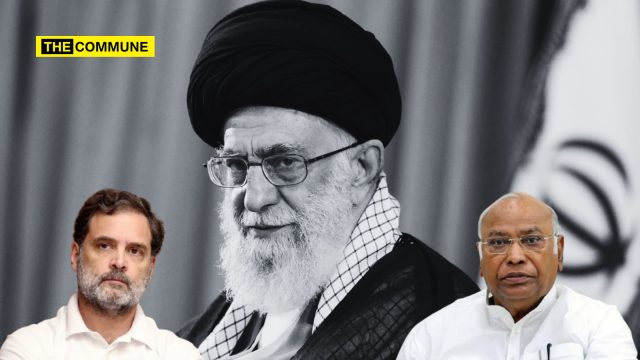
Ayatollah Ali Khamenei was killed in a joint US-Israeli airstrike on 28 February 2026. As the world processes the death of one of its most consequential, and controversial, theocratic rulers, Iran stands at a crossroads. And predictably, as India recalibrates its posture toward a post-Khamenei Tehran, Congress has found its voice – criticising the Modi government’s handling of the India-Iran relationship and offering unsolicited wisdom on strategic autonomy and diplomatic balance.
Congress leader Pawan Khera made two incendiary claims following the killing of Ayatollah Khamenei on 28 February 2026.
First, he accused Modi of “abdication of moral leadership” for not immediately condemning the US-Israel strike, declaring that “India has never before looked this weak” and that “this silence will be registered in history.”
Then came the more explosive charge – Khera claimed that Israel “used Modi’s Knesset visit as a cover” to plan the assassination, calling Modi a “puppet of America and Israel” with “no free will.”
History will never forget.
Modi stood in the Knesset, giggling, accepting a non-existent fake award, and expressing his unconditional loyalty to his “friend” and war criminal, Benjamin Netanyahu, while Israel used his visit as a cover to plan the assassination of Iran’s Supreme… https://t.co/cne0c0lhHY
— Pawan Khera 🇮🇳 (@Pawankhera) March 2, 2026
Most revealingly, Khera referred to Khamenei as “India’s friend” and “the spiritual guide of millions.” This is the same Ayatollah who in 2020 publicly demanded India stop “massacring Muslims” and called it an “enemy of Islam” – and whom Congress never once stood up to defend India against.
Khamenei’s Record On India: Not The “Friend” Congress Claims
For all the romantic language now being deployed about Ayatollah Khamenei being “India’s friend,” his public record tells a very different story.
Silence on Pakistan’s Role in 26/11
After the 2008 Mumbai terror attacks — carried out by Pakistan-based Lashkar-e-Taiba — Tehran conspicuously avoided directly calling out Pakistan’s state complicity. While India marshalled global pressure against Islamabad, Iran chose diplomatic ambiguity.
At no point did Khamenei publicly condemn Pakistan’s role with the clarity India expected from a supposed strategic partner.
For a country that lost 166 lives in 26/11, that silence mattered.
Interference During Anti-CAA Protests (2019–20)
In December 2019, during protests against the Citizenship Amendment Act, Khamenei publicly commented on India’s internal affairs, urging the Indian government to “confront extremist Hindus” and warning about the condition of Muslims in India.
This was not a routine diplomatic remark. It was a direct intervention in India’s domestic legislative process.
No sovereign nation welcomes external religious leadership framing its internal debates as civilisational oppression. Yet Congress today speaks of him as a moral authority.
“Enemy of Islam” Remark (2020)
In 2020, Khamenei posted that Muslims in India were being “massacred” and suggested that the country risked becoming an “enemy of Islam” if it did not change course.
This was inflammatory language — especially from the Supreme Leader of a theocratic regime — aimed at stirring global Muslim sentiment.
India formally rejected these remarks and advised countries to “look at their own record.”
Kashmir Commentary
On multiple occasions, Khamenei publicly referenced Kashmir in the same breath as Palestine and Yemen — framing it as part of a global Muslim grievance narrative.
That framing directly echoes Pakistan’s international positioning of Kashmir.
For a country claiming strategic partnership with India, this was hardly neutral.
The irony is not lost. Because the party now lecturing India on Iran is the same party that spent an entire decade systematically dismantling India’s standing in Tehran – voting thrice against Iran at the IAEA, surrendering a 25-year energy deal, and ultimately bowing before American pressure to cut Iranian oil imports. If India’s relationship with Iran carries any baggage today, Congress packed most of the suitcase.
Three Votes. One Collapsed Deal. A Legacy of Capitulation.
Let us begin with the facts that Congress would rather you forget.
Under the UPA government led by Dr. Manmohan Singh, India voted three times against Iran at the International Atomic Energy Agency – in September 2005, February 2006, and November 2009 to declare Iran in “non-compliance” with its nuclear safeguards obligations. Each vote helped build the case for referring Iran to the UN Security Council, exactly the outcome the United States and its Western allies were pursuing. Each vote was a direct blow to India-Iran bilateral trust, executed not out of any Indian strategic compulsion, but to curry favour with Washington, specifically, to smooth the path for the India-US civilian nuclear deal.
Iran’s response to the September 2005 vote was swift and unambiguous. A 25-year LNG deal signed just months earlier in June 2005, which would have supplied five million tonnes of liquefied natural gas to India annually, was declared no longer valid. Iranian officials coldly stated that future energy cooperation would depend on “new, less favourable terms.” A quarter-century of energy security, signed and sealed, was torn up because the UPA chose American approval over Indian national interest.
UPA under Manmohan Singh had voted thrice against Iran at the IAEA:
-Sept 2005
-Feb 2006
-Nov 2009It even led Iran to cancel a 25-year long LNG deal. Quite ironic of Congress to bash Modi’s Foreign Policy today when he is merely watching country’s interests as per reality. pic.twitter.com/RbJYFA1tAw
— Monica Verma (@TrulyMonica) March 2, 2026
This was Congress trading India’s energy future for a diplomatic pat on the back from Washington.
2012: The Image That Says Everything
Then came 2012. The cartoon from that year – Uncle Sam in his top hat, pointing at a barrel of Iranian oil while a turbaned, hands-folded Manmohan Singh stands meekly beside it, is not political satire. It is a documentary record. The Times of India headline from 16 May 2012 was unambiguous: “India bows to US pressure, cuts Iran oil import by 11%.”
2012: Congress-led UPA bent before US pressure and slashed India’s oil imports from Iran, openly compromising national interest.
2026: The same Congress now lectures Bharat on diplomacy and strategic autonomy. pic.twitter.com/cmWj1wvYSX
— Tulla Veerender Goud (@TVG_BJP) January 12, 2026
At the time, Iran was India’s second-largest oil supplier. Cutting imports by 11% was not a minor adjustment – it was a significant surrender of energy leverage, executed because the Obama administration was tightening its sanctions regime around Iran and threatening to penalise countries that continued significant oil purchases. The Congress government had a choice: stand by India’s energy interests and strategic autonomy, or fold. It folded.
This is the same Congress party that today, in the aftermath of Khamenei’s killing and amid India’s careful repositioning toward a new Iranian leadership, lectures the Modi government on the meaning of strategic autonomy and balanced foreign policy.
What Modi Actually Did
Compare that record to the present government’s. Rather than abandoning Iran under Western pressure, the Modi government deepened the Chabahar Port partnership — a project of enormous strategic value giving India a direct trade route to Afghanistan and Central Asia, bypassing Pakistan entirely. India continued to engage Tehran even as Western sanctions tightened, protecting Indian interests through carefully calibrated diplomacy rather than reflexive capitulation to Washington.
When Khamenei made hostile remarks about India, calling it an “enemy of Islam” in 2024, and in 2020 demanding India stop “massacring Muslims”, the Modi government’s MEA responded with sharpness and confidence: “Countries commenting on minorities are advised to look at their own record before making observations about others.” That is not the posture of a government afraid of Iran. It is the posture of a government that knows its own weight.
Congress, by contrast, spent its tenure in office both antagonising Iran diplomatically and being bullied economically. It got the worst of both worlds.
The Irony That History Will Not Forget
The Congress party voted against Iran at the IAEA three times. It collapsed a 25-year energy deal through those votes. It cut oil imports from Iran by 11% on American instruction. And it is now, in the week that Khamenei lies dead and Iran faces its most uncertain moment in four decades, positioning itself as the party that understands Iran better than Modi does.
There is a word for this. It is not diplomacy. It is not strategic thinking. It is the audacity of a party that believes Indians have short memories.
They do not.
Subscribe to our channels on Telegram, WhatsApp, and Instagram and get the best stories of the day delivered to you personally.