In a move that has ignited fierce political and public backlash, the Congress party, through the Indira Gandhi Memorial Trust, has conferred its prestigious Indira Gandhi Prize for Peace, Disarmament and Development upon former Chilean President Michelle Bachelet, a figure internationally known for her far-left ideology and a consistent record of making statements perceived as rabidly anti-India and sympathetic to separatist narratives in Kashmir.
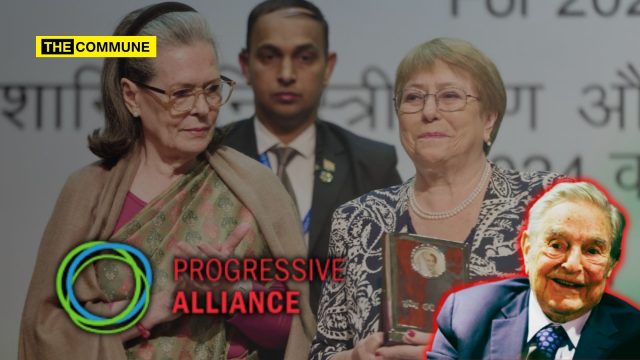
The award was presented on Wednesday, 19 November 2025, by Congress Parliamentary Party Chairperson Sonia Gandhi, who also chairs the Trust, in a ceremony attended by top Congress leadership including party president Mallikarjun Kharge.
Congress gives Indira Gandhi Peace Prize to former Chilean President and UN Human Rights Commissioner Michelle Bachelet.
Perfect pick.
⛔️ Bachelet is far-Left socialist.
⛔️ Rabidly anti-India.
⛔️ Pro-Islamist, pro-Kashmir separatist sympathiser.
⛔️ ‘Dissent’ evangelist. pic.twitter.com/HhzNkHQD8p— Abhijit Majumder (@abhijitmajumder) November 19, 2025
A “Perfect” Pick For Congress: An Ideological Ally Against The Indian State
The selection of Michelle Bachelet is being viewed by political observers not as a mere coincidence, but as a deliberate ideological statement by the Congress party. Bachelet’s profile aligns perfectly with a political narrative that often positions itself in opposition to the current Indian government, even on matters of national security and sovereignty.
#1 A Far-Left Politician
Michelle Bachelet is a lifelong member of the Socialist Party of Chile, a party with a documented history of Marxist ideology and a stated goal of revolutionary transformation. Her political career is rooted in this far-left framework, which she has carried into her international roles. The decision to honour a politician from this specific ideological strand makes one wonder about the Congress’s own political compass and its choice of international allies.
#2 Rabidly Anti-India And Separatist Sympathiser In Kashmir
As the United Nations High Commissioner for Human Rights, Bachelet moved beyond diplomatic language to become one of the most vocal international critics of India’s sovereign decisions. Her tenure was marked by:
Interference in Kashmir: Following the abrogation of Article 370, Bachelet used her UN platform in 2019 to express “deep concern” about the situation in Kashmir, echoing the talking points of separatist lobbies. She explicitly called for the “people of Kashmir” to be “consulted and engaged in any decision-making processes,” a demand that directly dovetails with the rhetoric of those seeking to challenge India’s constitutional integrity.
Baseless Allegations: Under her leadership, the Office of the UN High Commissioner for Human Rights (OHCHR) released reports on Kashmir that were officially rejected by the Government of India as “false, motivated,” and displaying a “clear bias.” These reports heavily criticized India’s security measures and legal frameworks, ignoring the threat of cross-border terrorism.
Criticism of Domestic Policies: She also repeatedly targeted India on the National Register of Citizens (NRC) process, issuing statements that the Indian government termed “unwarranted” and “not reflective of the ground reality.”
#3 The Pro-Islamist
Bachelet’s focus consistently singled out India, often framing its internal security and legal measures as an assault on Muslim communities. Her statements frequently highlighted the ‘concerns of Muslim minorities’ in the context of Kashmir and the NRC, while largely ignoring the complex security and demographic challenges faced by the Indian state. This pattern of criticism, which aligns with the propaganda of Pakistan-based elements, has led many to label her stance as de facto pro-Islamist in its selective outrage.
Furthermore, she established herself as a global “dissent evangelist,” using her UN position to routinely chastise India over its internal governance. She repeatedly criticized India’s legal instruments like the UAPA and raised alarms about the state of civic space and freedom of expression, often siding with narratives that oppose the Indian government’s policy decisions.
Congress And Bachelet: A Shared Narrative?
In her award ceremony speech, Sonia Gandhi praised Bachelet for her work on gender equality and social reforms in Chile, notably avoiding any mention of her controversial tenure at the UN and her direct confrontations with the Indian government. This selective celebration, critics argue, reveals a tacit endorsement of Bachelet’s anti-India stance.
By bestowing one of India’s most famous peace prizes upon a foreign official who has consistently undermined India’s position on the global stage, the Congress party has sent a clear message. The move is seen as a political gambit that prioritizes international left-liberal approval and domestic opposition politics over unambiguous national solidarity.
The award has solidified the perception that for the Congress leadership, a “perfect” laureate is one whose international influence has been deployed to question the actions and legitimacy of the Indian nation-state itself.
Both INC And SPC Part Of Soros-Funded Group
The Indian National Congress is a prominent member of the Progressive Alliance, an international coalition of social democratic and progressive parties. Michelle Bachelet, former President of Chile, is associated with the Socialist Party of Chile, which is also a member of the Progressive Alliance. Rahul Gandhi had recently visited Chile as part of his South America tour in early October 2025.
The Progressive Alliance funded by George Soros is a global cartel of left-liberal elites, repackaging their ideological failures as “progress” while pushing the same cookie-cutter agenda across continents. Behind its polished rhetoric of human rights and cooperation, the PA routinely meddles in domestic politics, undermining national sovereignty through coordinated narratives dressed up as international solidarity. Far from being a grassroots movement, it survives on billionaire-funded activism, relying more on donor money than public mandate. In practice, the alliance promotes agenda-driven politics that destabilise societies, making it a club of wealthy backers and disconnected ideologues rather than a genuine force for democratic progress.
Subscribe to our channels on WhatsApp, Telegram, Instagram and YouTube to get the best stories of the day delivered to you personally.